Flat, true slabs for play that lasts.
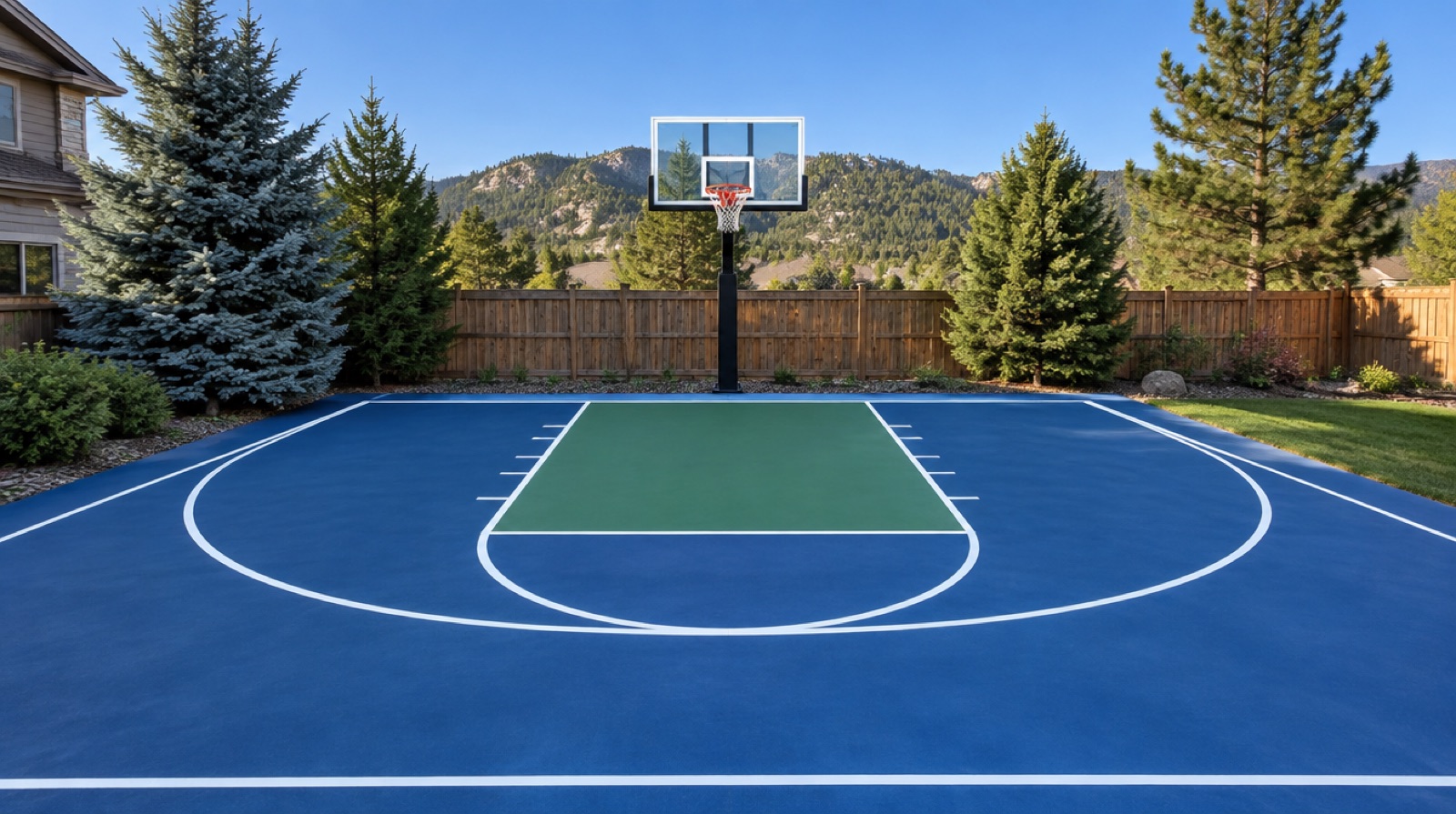
A basketball or sport court is one of the most demanding flatwork jobs we pour, and almost everything that matters happens before the ball ever bounces. The slab has to be big, dead-flat, and true across its whole surface, because a wave you can barely see with your eye turns into a bad bounce, a rolled ankle, or a puddle that sits for two days after a storm. Get the slab right and you have a surface your family or your members will use for years. Get it wrong and no amount of paint or coating hides it.
On the Front Range that bar is harder to clear than people expect. We pour over expansive clay that swells and shrinks with moisture, under a freeze-thaw cycle that pries at any weak slab, and through summer afternoons where strong UV and fast-drying air work against a clean cure. A court that ignores those conditions cracks and heaves. We build the base, reinforcement, jointing, and drainage to hold a flat, smooth surface through all of it, so the court still plays true after a decade of Colorado seasons.
A court has two jobs that pull against each other. It needs to be flat enough that the ball bounces true and nobody trips, and it needs just enough slope that water runs off instead of pooling. We pour to a slight, consistent fall, usually in one direction across the court, so the surface reads as flat underfoot and to the ball but still sheds rain and snowmelt to one edge. That slope is small and deliberate. Too much and players feel like they are running downhill. Too little and you get standing water that freezes into a hazard and works at the surface every winter. We screed and check the whole slab as we go so the plane stays true corner to corner, not just in the middle.
The bigger the slab, the more the ground underneath decides how long it stays flat. We strip the topsoil, compact a graded gravel base, and build the slab thick enough for the span and the use. Reinforcement, whether rebar or mesh sized to the job, ties the pour together so shrinkage and soil movement do not open random cracks across the playing surface. Then we cut control joints in a deliberate grid. Concrete will crack as it shrinks and as the clay moves under it. Control joints decide where, giving the slab clean, straight lines to crack along instead of jagged splits through the middle of the key. On a court that grid is planned around the layout so the joints look intentional, not like a flaw.
This is the honest concern with any poured court, and we will not pretend joints disappear. Concrete this size has to have control joints, and you will see them. What we control is how much they affect play. We keep the joints tight and the saw cuts clean so the ball rolls across them without catching, and we lay the joint grid out so it falls in sensible places rather than dead center under the hoop. A properly built slab on a compacted base does not develop the wide, lipped cracks that actually ruin a bounce or grab a shoe. If you want the joints to vanish for play, a coating or sport tile system installed over the cured slab fills and bridges them. We pour the flat, sound base that any of those systems needs to work.
An in-ground hoop or a net post is easiest and strongest when its sleeve is set during the pour, not drilled in later. We plan post and sleeve locations against your court dimensions before concrete day, set them plumb, and pour around them so the anchor is locked into the slab. That means a half-court, a full backyard court, or a multi-sport layout with pickleball lines all start from accurate, square dimensions. We size the pad to the game you are building for and leave the surface ready for the painting, coating, or tile you plan to add. Telling us the hoop and the sports you want up front lets us set everything in one pour instead of compromising later.
From homes to commercial sites across the Front Range, here is where basketball & sport courts earns its place.
A half-court or shooting pad sized to your yard with the hoop sleeve set in the pour.
One flat slab laid out to take basketball plus pickleball, tennis practice, or hockey lines.
A true, well-drained pad poured to the flatness pickleball needs before surfacing and lines go down.
In-ground anchors set plumb during the pour for hoops, nets, and posts so they never work loose.
Larger shared courts for neighborhoods and communities, poured to hold up under steady use.
A clean, cured slab finished flat and ready for acrylic court paint or a tile sport system.
Concrete behaves differently at altitude. Our expansive clay soils swell with moisture and shrink when they dry, and the freeze and thaw cycle works on any surface that takes on water. Every basketball & sport courts project we pour accounts for both, from base preparation and drainage to air-entrained mixes, proper reinforcement, and control joints cut on time. That is how the work holds its shape and finish through Colorado winters instead of failing by spring.
You also get a written estimate before anything starts, a structural engineer on staff for the jobs that need one, and a crew that pulls and manages permits when the project calls for them. Licensed, bonded, and insured, with finishes that range from a clean broom texture to stamped, colored, and sealed.
Outdoor concrete has to look good and do real structural work at the same time. Here is what shapes a Basketball Courts project.
Drainage is what keeps basketball & sport courts sound, so keep weeps and drains clear and watch that water continues to move away from the structure. Sealing exposed surfaces and clearing snow promptly protect the finish through the freeze and thaw. And whatever the project, the same rule applies across the Front Range: keep water from sitting on or soaking into the surface, and the concrete will reward you with decades of service.
You always know what is happening and what it costs before we mix a single yard. Here is the path from first call to final walkthrough.
We visit the site, measure, check drainage and soil, and hand you a clear written quote. No charge, no pressure.
We set the grade, thickness, reinforcement, and finish. Structural work gets engineered and permitted.
Forms, rebar, and a clean pour. We screed, float, and finish to the texture you picked, then cut control joints.
You can walk it in 24 to 48 hours. We walk the job with you and explain how to care for it through the first winter.
Still unsure about something?
Call the crew at (303) 569-4046 and we will talk it through.

Get a free, no-obligation estimate from a crew that knows Colorado soil, Colorado weather, and how to finish concrete that lasts.
Accessibility
Adjust the site to fit how you read and browse. Your choices are saved on this device.