
One plane, one direction of fall, and joints drawn so the ball never takes a bounce nobody asked for.
Ask anybody who has one and they'll tell you the court gets used for basketball maybe half the time. The rest is a scooter track in June, a hockey rink the week it drops below freezing, the place a kid learns to ride a bike, where the folding tables go when there are too many people in the house, and a lot of hours of somebody shooting alone at dusk.
Larkspur properties have the one thing that makes this work: room. Nobody out here is squeezing a court between two fences. What these lots hand you instead is slope, trees, and distance from the road, so grading and the access plan matter more than square footage. Get the plane right and it plays true for thirty years.
| Footprint | How it actually plays | Site demands |
|---|---|---|
| Key and apron, roughly 20 by 25 | Shooting, free throws, one-on-one | Fits almost anywhere flat. A good phase-one slab |
| Half court around 30 by 30 | Three on three, with room behind the arc | Modest grading, and it slots between mature trees |
| Stretched half court, 30 by 50 | Room to drive, shoot the corner, skate in winter | Wants a truly flat bench, so expect cut and fill |
| Three-quarter court, 42 by 50 | Transition play without the full footprint | Real earthwork and access for a bigger pour |
| Full court, 84 by 50 or larger | Organized games. It dominates the property | Heavy excavation, retaining on grade, a serious pour day |
| Multi-sport 30 by 60 | Basketball with pickleball striped over it | Orientation matters. Long axis roughly north to south |
A driveway can crown. A patio can pitch two directions to a corner. A basketball court cannot do either, because the moment the surface has a fold in it the ball starts behaving differently depending on where you dribble. So we build the whole slab as a single flat plane tilted about one percent in one direction, usually toward the low side of the property, and we check it with a laser before and after the pour rather than trusting a screed and good intentions.
Joint layout is the other half of playing true. Concrete gets control joints or it cracks where it feels like cracking, and a random crack across the top of the key is exactly what you don't want. We draw the joint plan around the court lines: outside the lane, along the sidelines and the baseline where possible, and never straight through the shooting areas. Cut them the same day the slab goes down, tight and early, so the concrete relieves itself in the cut instead of somewhere embarrassing.
Then the finish. A medium broom gives grip for shoes without shredding knees, and it takes an acrylic sport coating well if you want color and painted lines later.
We'll shoot the grades, tell you how much dirt has to move, and lay out the biggest footprint your site can actually hold.
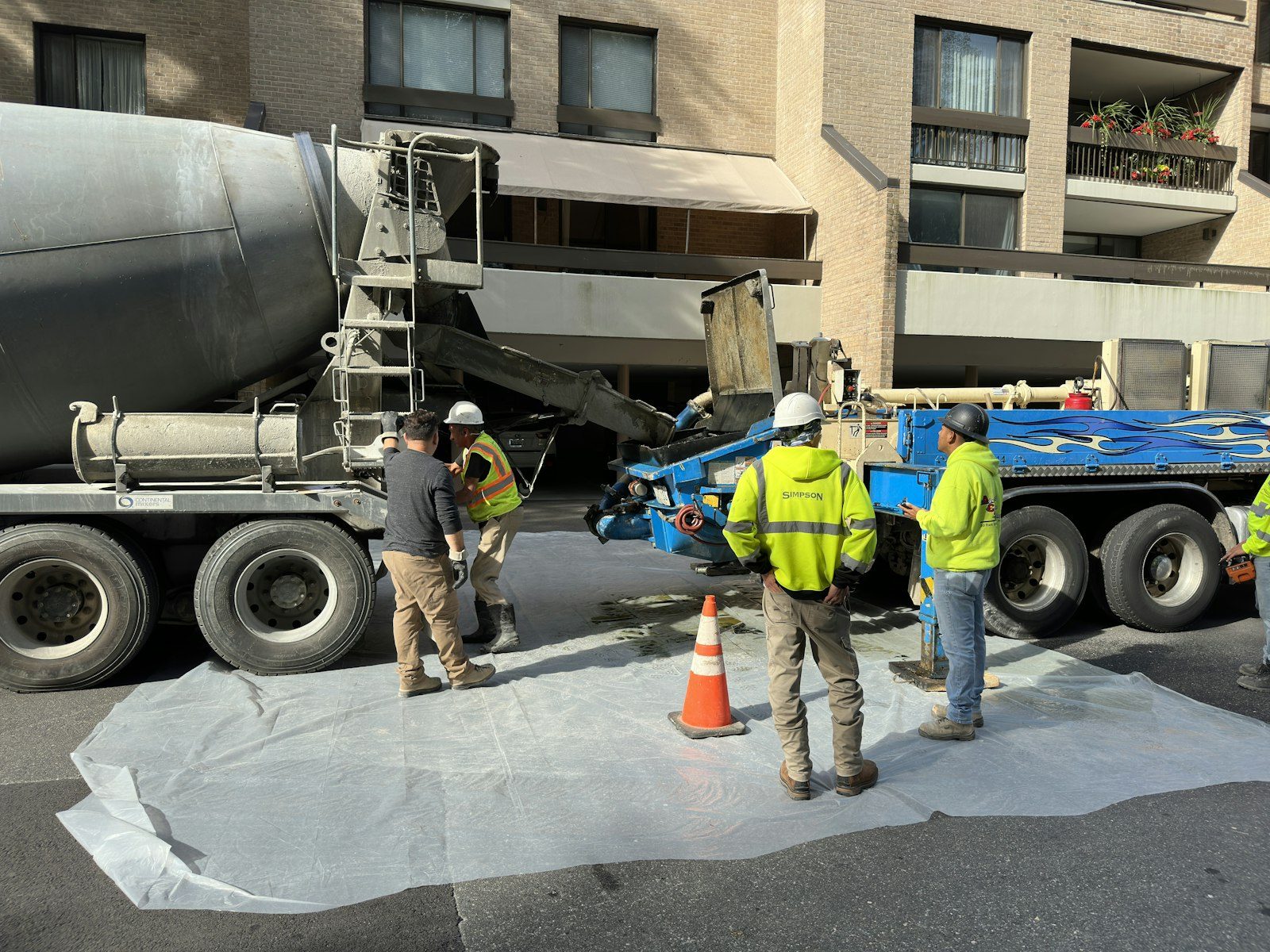
Pour between late spring and early fall. A court is a large single placement and we want a full day of settled weather, which in July and August means starting at first light and finishing ahead of the storms building over the foothills. Rain arriving mid-finish drives water into the surface and hands you a court that dusts. On something people slide across in sneakers, that's more than cosmetic.
Sun at this elevation is the underrated factor. Ultraviolet exposure runs harder here than down in the metro, and it goes after acrylic coatings and painted lines faster than most people plan for. Budget on refreshing both periodically. Prefer not to think about it? A plain broom finish with no coating ages gracefully and wants sealing every few years.
Winter use is the fun part. Snow clears off easily if you get to it before it packs, and plenty of families out here flood a corner and skate. Keep ice melt off it, magnesium chloride above all. And sweep the pine needles in autumn, because a wet needle mat left all winter stains concrete and leaves a slick patch in March.
Still unsure about something?
Call the crew at (303) 569-4046 and we will talk it through.
Get a free, no-obligation estimate from a crew that knows Colorado soil, Colorado weather, and how to finish concrete that lasts.
Accessibility
Adjust the site to fit how you read and browse. Your choices are saved on this device.