
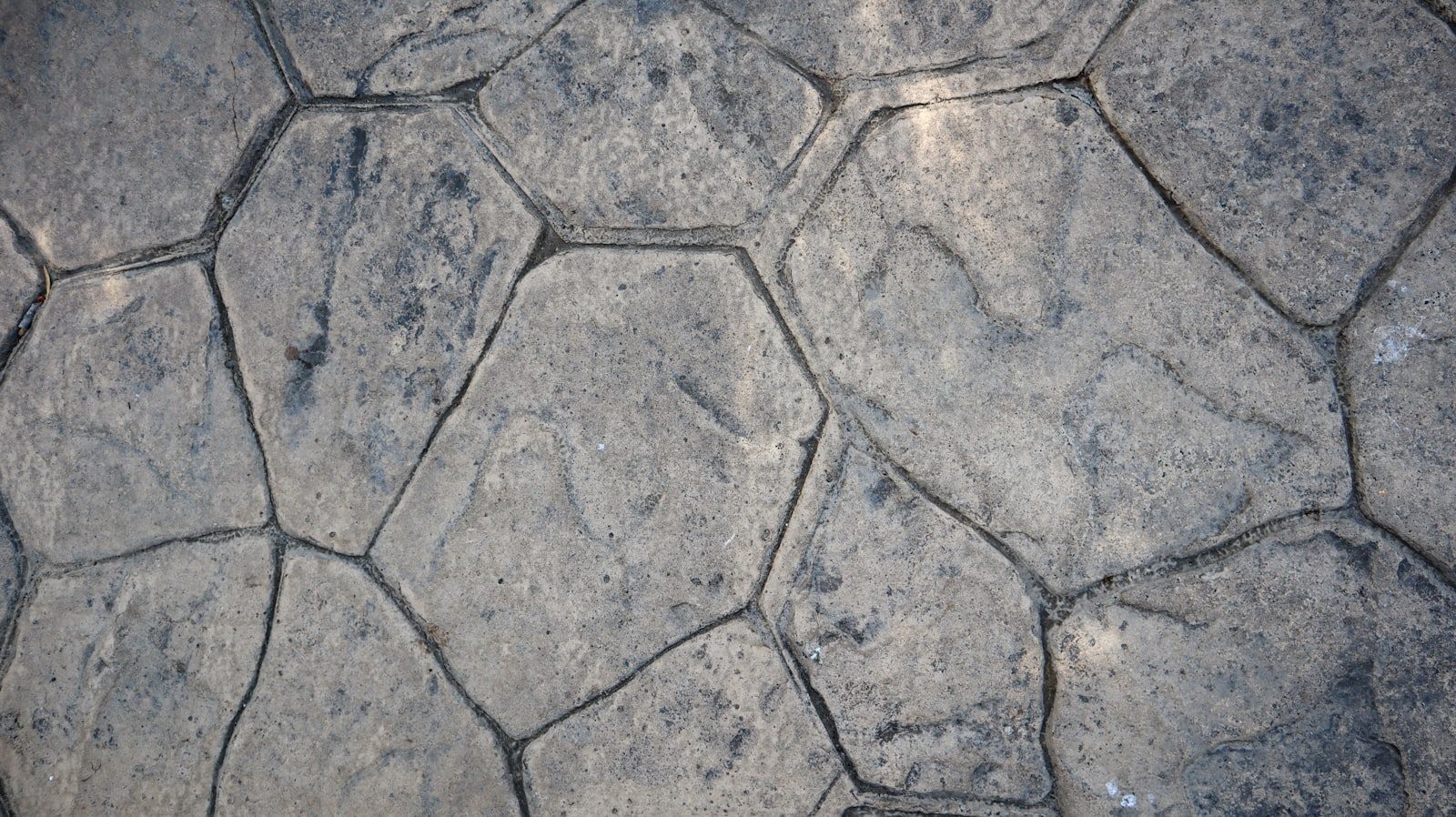
Color, pattern, and texture applied so they survive high-altitude sun and forty freeze cycles a winter.
Pick the project closest to yours. Each page covers what it costs to build right, how long it takes, and what it needs from you afterward.
Every decorative surface we pour is two decisions wearing one name. The first is chemistry: what puts color into or onto the concrete, and how permanently it stays there. The second is timing: the short window on pour day when a slab is soft enough to take a texture and firm enough to hold it. Get either one wrong and the fix is demolition.
So this page is built around those two decisions instead of a catalog of looks. Pick the coloring method that behaves the way you want in ten years, pick the texture, then plan for the upkeep Colorado sun demands.
Acid stain isn't paint. It's a mild acid carrying metallic salts that react with free lime in the cured slab, so color becomes part of the concrete rather than a layer on it. That makes it the most permanent option and the least predictable one, since the reaction follows whatever is happening inside the surface. The palette is narrow too: browns, rusts, ambers, a few greens. Ask acid stain for a clean gray and it will fight you.
Water-based stains skip the reaction. Pigment in a fine suspension soaks into the pore structure and stays put, which opens the whole color wheel and gives an evener field. Dyes go further, with particles fine enough to reach deep into a ground surface and colors more intense than any stain. They trade away sun resistance to do it, so we keep dyes indoors.
Integral color is the only one of the four that isn't a surface treatment. Pigment goes in at the batch plant and the slab is that color clear through. Chip an integrally colored patio and the fracture is the same shade. Chip a stained one and you see gray.
| Method | How the color gets there | Best use | How it ages outdoors |
|---|---|---|---|
| Acid stain | Reacts with lime already in the slab | Patios and floors where variation is the point | Very stable, since the color is chemically part of the slab |
| Water-based stain | Pigment penetrates the surface pores | Anywhere you need a specific color or an even field | Good, though abrasion eventually reaches through the colored layer |
| Dye | Fine particles carried into a ground surface | Interior floors, basements, finished garages | Poor. Direct Front Range sun pulls dye color fastest |
| Integral color | Pigment batched into the mix at the plant | Drives and anything that may chip later | Fades slowly, and a chip shows the same color underneath |
| Color hardener | Dry pigment worked in while finishing | Stamped work needing a hard, dense wear layer | Strong, because it densifies the top layer while it colors |
Stamping has a window, and it's short. The slab has to be past the point where bleed water sits on top, firm enough that a mat leaves a crisp impression instead of sinking, and still soft enough that the pattern presses to full depth. Too early and the mats swim. Too late and they bounce off a stiff surface, leaving a faint texture nobody paid for.
On a dry, breezy Front Range afternoon that window can open and close inside an hour. Which is why stamped pours get staffed differently than flatwork: mats laid out in sequence beforehand, release agent on site, enough hands for the whole field at once. We don't stamp a slab bigger than the crew standing on it.
Exposed aggregate has its own clock, running the other direction. A surface retarder holds the top skin of paste soft while the concrete beneath sets. Then the wash. Too early and the pressure washer digs stones out of a slab that hasn't gripped them. Too late and the only way to expose rock is grinding, which flattens the stones.
The tell on a bad stamped job is the corners. Anybody can press a mat in the middle of an open field. It's the last four feet against the house that tells you how it was staffed.
Finishing crew lead, Front Range
We'll bring samples out, look at the space and its exposure, and tell you which methods suit it. Visit and written estimate are free.
Polished concrete is a grinding sequence, not a coating. Diamond tooling steps through finer and finer grits, each pass removing the scratch pattern the last one left. Skip a step and it shows. The fine tools polish those coarse scratches instead of removing them, and the floor reads hazy under raking light no matter how many passes follow. Partway through, a densifier goes down and reacts with the concrete chemistry to fill the pore structure, which is why a polished floor resists staining without a film on top.
Saw-cut scoring is the cheapest decorative move there is and the most frequently botched. Score lines are shallow and purely cosmetic. Control joints get cut to roughly a quarter of the slab thickness, which is what gives concrete a weak plane to crack along. They can't do each other's job. Draw a diamond pattern in score lines, forget real joints, and the slab picks its own crack line straight through the artwork.
Decorative concrete needs upkeep, and up here it needs more than the same slab would in a milder place. Ultraviolet exposure across our altitude range is harder on pigment and much harder on sealer, and the sealer is the sacrificial layer between your color and the weather.
Plan on resealing exterior decorative work every two to three years. That's the trade you accept choosing stamped over a broom finish, and we'd rather you hear it now than the spring your patio looks chalky. Keep deicers off entirely through the first winter. Magnesium chloride is the worst offender on colored surfaces.
Still unsure about something?
Call the crew at (303) 569-4046 and we will talk it through.

We measure, check drainage and soil, and hand you a written number. No charge and no pressure to book.
Accessibility
Adjust the site to fit how you read and browse. Your choices are saved on this device.