
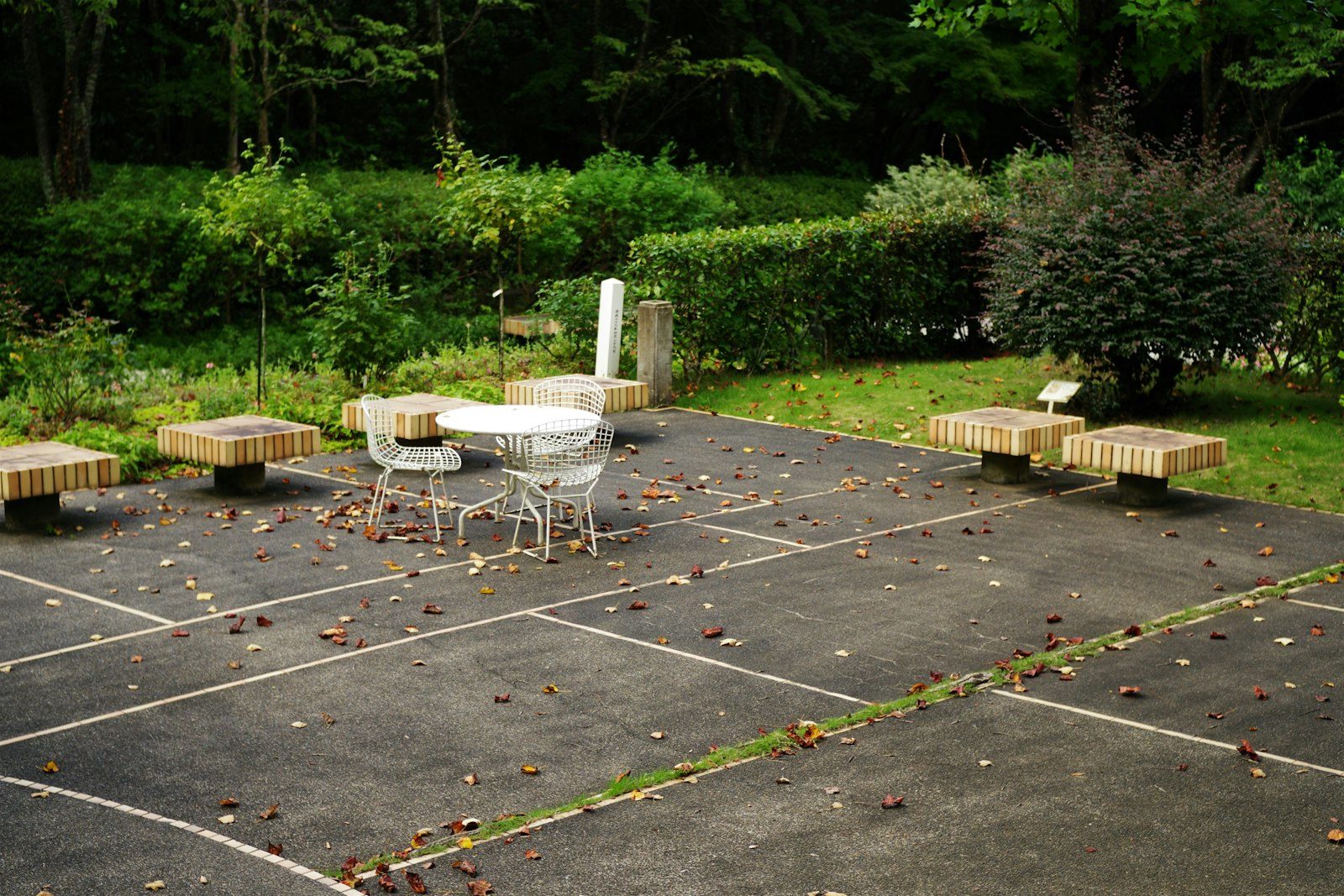
Flat, well-drained, correctly jointed slabs for the things people actually play on.
Pick the project closest to yours. Each page covers what it costs to build right, how long it takes, and what it needs from you afterward.
Everything on this page gets used with shoes off or a ball in the air, and that changes what we're building for. A patio can be a little slick and a little hot and nobody says a word. A pool deck can't, because people run across it wet. A court can't be out of plane at all, since a bouncing ball reads a surface more honestly than a level does.
So recreational concrete comes down to traction, temperature, and geometry, stacked on the usual Front Range trouble with expansive clay and freeze cycles. We build pool shells, the decks around them, and basketball and pickleball courts at backyard and full size.
Two things decide a pool deck finish and they want opposite answers. The surface has to grip a wet bare foot, which argues for texture. It also has to stay standable in August above five thousand feet, where the sun works harder on everything, and that argues for a pale color. Light gray and tan decks run cooler than charcoal or deep brown, and that's the choice homeowners tell us they'd take back.
We'll take a position: no rock salt finish on a Front Range pool deck. It looks right on a sample board and drains badly, because every one of those little pits holds water that freezes and pops the rim of the pit off. Five winters in, the deck reads as pitted instead of textured. A light broom, a knockdown texture, or exposed aggregate all give grip that survives the cold.
A pool shell and the deck around it are two structures with two different futures. The shell bears on undisturbed soil. The deck sits partly on backfill that keeps settling for years. Lock them together rigidly and something has to give, and what gives is the coping, usually in a way that cracks tile.
So there's a compressible expansion joint at the coping, running the full perimeter, filled with a flexible sealant somebody replaces every few years. That joint is maintenance, not a defect. We slope the deck away from the water at roughly a quarter inch per foot, and where a deck is pinched between the pool and the house or a retaining wall, we set deck drains and pipe them somewhere sensible. A deck that sheds toward a foundation is a drainage problem wearing a swimsuit.
| Finish | Wet traction | Barefoot heat | What it asks for later |
|---|---|---|---|
| Light broom, standard gray | Good | Coolest of the group | Rinse, and reseal only to deepen color |
| Knockdown texture over an overlay | Very good | Cool to moderate in pale colors | Reseal every two to three years |
| Exposed aggregate | Very good | Moderate, depends on the stone | Occasional reseal, hoses off easily |
| Heavy stamped pattern | Depends on grit in the sealer | Warm to hot in dark releases | Reseal every two to three years, grit added |
| Rock salt | Good while it's new | Cool | We steer people off it, since the pits spall |
Pool and court slots fill early, and winter is when the planning happens. Call (303) 569-4046 for a free site visit and a written estimate.
Most curved and free-form pools get a shotcrete shell. A heavy steel cage is tied to the shape of the pool, then concrete is shot pneumatically against it in one continuous pass, so floor and walls come out as a single piece with no cold joint between them. Cast-in-place is the other route, formed on both faces and placed like any structural wall. It suits rectangular pools, plunge pools, and anywhere the wall is also retaining soil.
Either way the shell answers to groundwater, because an empty pool is a boat. If the water table rises around a drained shell, hydrostatic pressure can float it, crack it, or both. So there's a relief valve in the main drain sump and drain rock placed to give that water a path in. And there's a rule that goes with it: never drain a pool because it looks dirty. Call somebody first.
Two calls come in about pool decks and they're almost always the same two. Somebody drained the pool without asking, or somebody sealed the deck with a product that turns it into an ice rink when it's wet.
Go Denver Concrete project crew
Roads get crowned. Courts never do. A crown puts a ridge through the playing surface, and every ball that crosses it does something nobody asked for. We build a single plane instead: the whole slab tipped one way at about one percent, so water leaves in a sheet and the bounce is identical in both halves.
Joint layout follows the same thinking. Control joints have to exist, so we put them where the game isn't: outside the key, off the service boxes, parallel with the lines rather than across the middle of play.
And the hoop is its own structure. A backboard on a pole catches wind and takes a beating from anyone who can reach the rim, so its footing goes below frost depth on its own, isolated from the slab and sized for the overhang you bought. A post set straight into the court slab works itself loose and takes concrete with it.
Still unsure about something?
Call the crew at (303) 569-4046 and we will talk it through.
We measure, check drainage and soil, and hand you a written number. No charge and no pressure to book.
Accessibility
Adjust the site to fit how you read and browse. Your choices are saved on this device.