
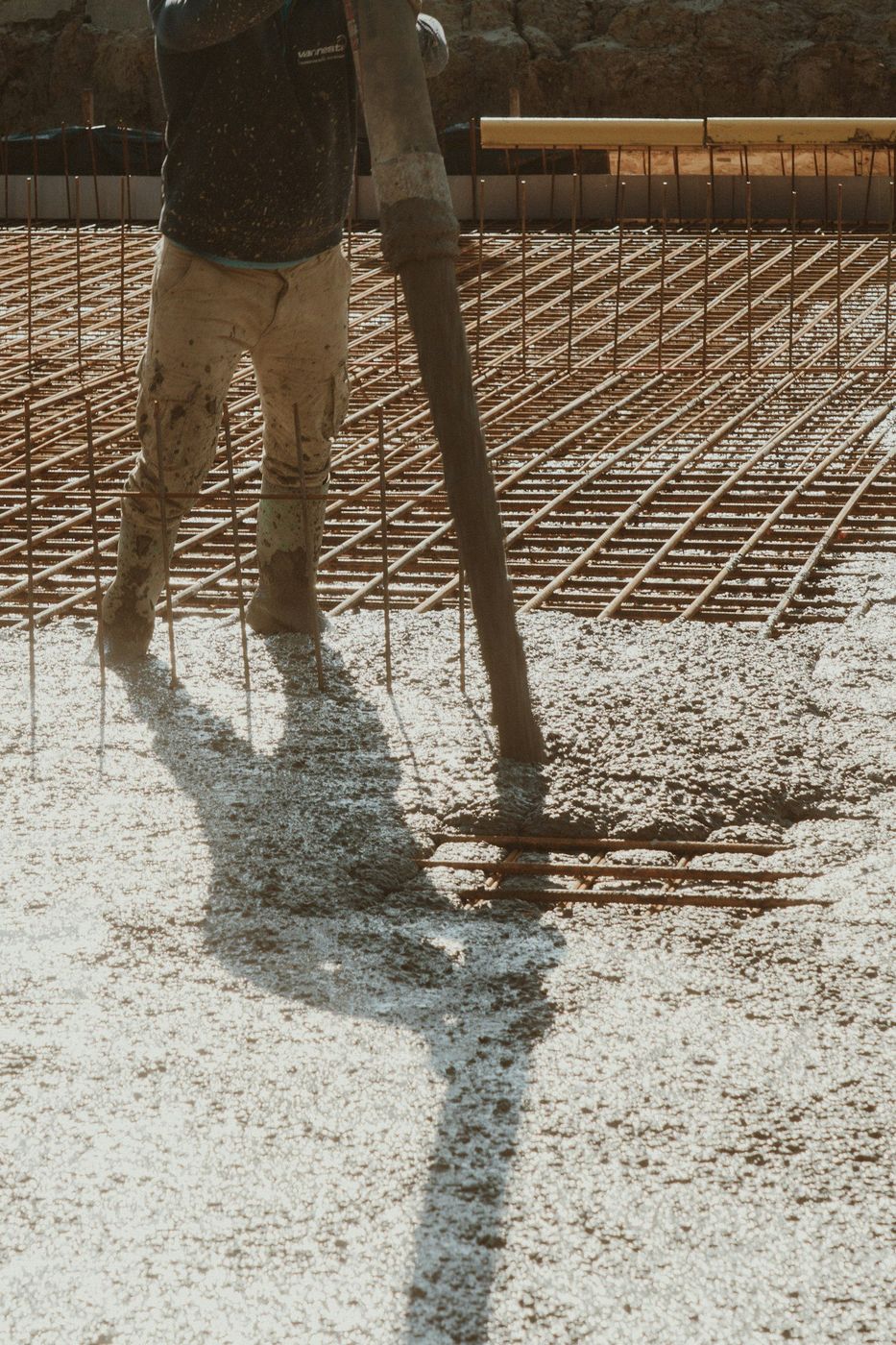
Flat enough for a true bounce, jointed so the ball never finds the seam, footed for a hoop that doesn't wobble.
The bounce tells you everything. Dribble across a court somebody built cheap and you'll feel it: a dead spot where the slab dished, a skip where the ball catches a control joint, a slow section where the surface was floated smooth in one place and left rough in another. Kids won't articulate any of that. They'll just stop using it.
Which is why the first conversation we have with a Lone Tree family is about what the court has to do rather than how big it should be. Serious half-court play for a kid who's on a team wants different tolerances than a hoop pad for driveway games. Multi-sport use with pickleball lines changes the layout. And whether you build in concrete, asphalt, or a modular tile system over a slab is a decision worth making deliberately, since it's the one thing you can't change later without starting over.
A full high school court is fifty by eighty-four feet, and almost nobody puts one in a backyard. Most of what we build in Lone Tree lands between thirty by thirty and thirty by fifty, which gives you a genuine half court with room past the arc. The bigger lots out in Carriage Club, the Fairways, and Heritage Hills can take a full thirty by fifty without crowding the yard.
Then place it. North-south orientation keeps the sun out of shooters' eyes at the times of day people actually play. Keep it off the low corner of the yard where runoff collects. Leave a run-out margin behind the baseline so a hard drive doesn't end at a fence. In RidgeGate and Montecito, where lots are tighter, that run-out is usually what sets the final dimensions.
| Surface | Argues for itself when | The catch on the Front Range |
|---|---|---|
| Poured concrete with an acrylic coating | You want a true bounce and a thirty-year surface | Higher up-front cost. Joints must be planned, not improvised. |
| Asphalt | Budget rules and the court is casual | Softens in July heat, cracks in the freeze cycle, needs sealcoating every few years. |
| Modular tile over a concrete slab | Joints matter, and you want easier landings | You're paying for the slab anyway, then paying again for tile. |
| Concrete with a bare broom finish | Utility only, and you don't mind scraped knees | Abrasive on skin and shoes. Ball wears out faster. |
| Existing driveway plus a portable hoop | You're testing whether anyone will use it | Slope is wrong, joints are wrong, and cars are in the way. |
| Sport court tile on gravel or pavers | Never, in our opinion | Any base that moves telegraphs through the tile within a season. |
A court has to drain, or you get a puddle that stays for two days after every storm. But it also has to be flat enough that the ball doesn't do anything unexpected. Those pull against each other, and the answer is a single continuous plane at a shallow pitch rather than a crowned or dished surface. One direction, one slope, no wandering. A low spot you can fix while the concrete is still wet is a low spot you live with forever once it sets.
Joints are the other half. Concrete is going to crack somewhere, so we decide where. We lay out a symmetrical grid, cut it the same day, and keep the lines out of the lane and off the free throw line where a bad bounce ruins the shot. Then we fill them with a flexible sealant so the ball crosses them without dropping in. On a properly jointed court you can hear the difference. There isn't one.
Send us your lot dimensions and we'll sketch a court layout with real run-out before you commit to anything.
Late spring through September is the pour window, and the coating schedule drives the timing. Acrylic sport surfacing wants fully cured concrete, typically a month after the pour, plus dry weather and moderate temperatures for application. A late October slab waits until spring for color, which is fine if you don't mind a gray winter.
Weather does its thing at 5,817 feet. Hail dents a fresh slab, so we watch May and June radar and keep plastic ready. Winter care is simple: shovel it, don't salt it. Magnesium chloride pits concrete and it will chew through an acrylic coating faster than you'd guess.
Parents ask about the coating color first and the joints last. It should be the reverse. Color is a weekend decision. Joint layout is the thing you either got right on pour day or think about every time the ball skips.What our crew lead tells homeowners
Still unsure about something?
Call the crew at (303) 569-4046 and we will talk it through.
Get a free, no-obligation estimate from a crew that knows Colorado soil, Colorado weather, and how to finish concrete that lasts.
Accessibility
Adjust the site to fit how you read and browse. Your choices are saved on this device.