
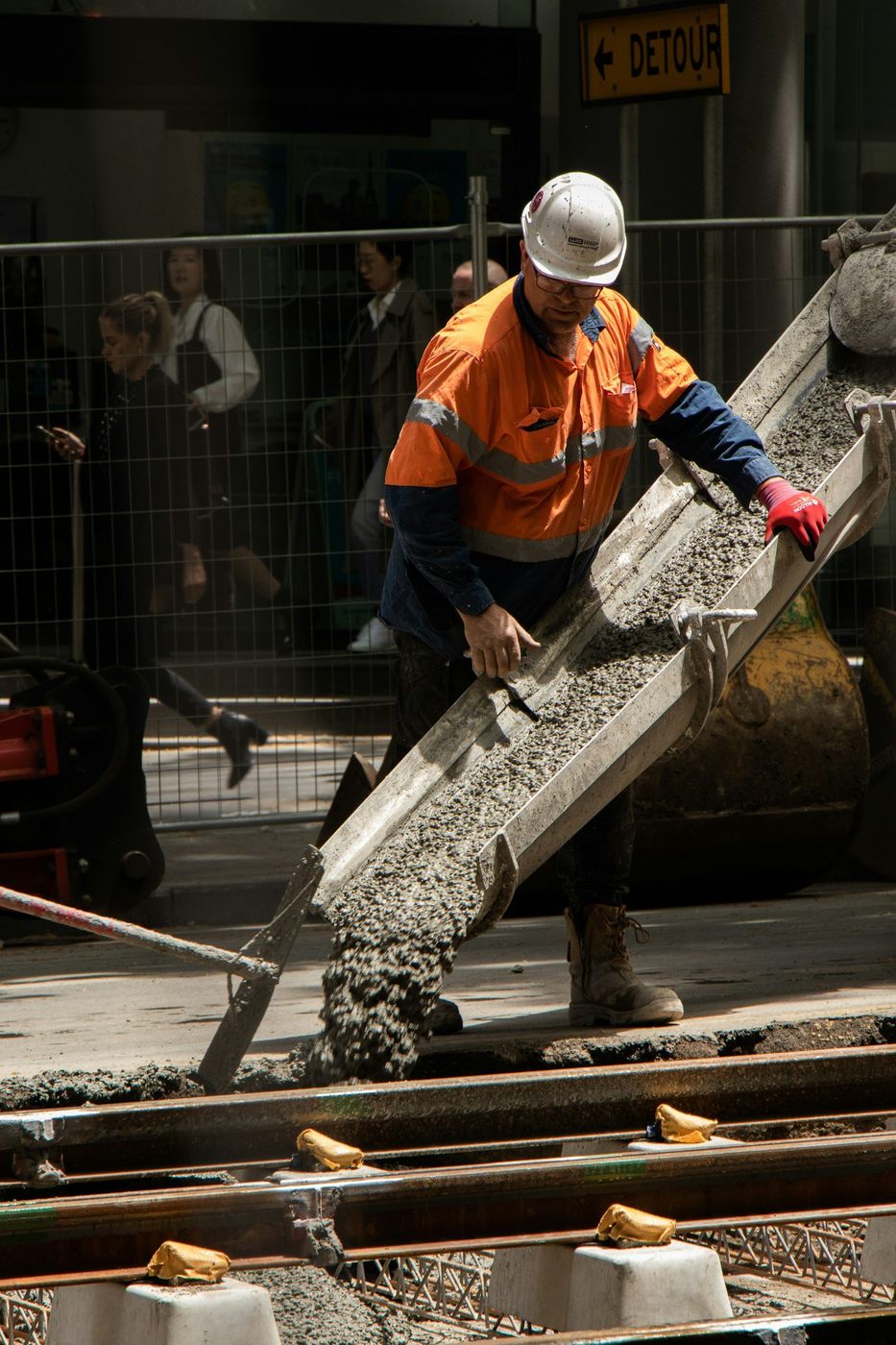
Built from the dirt up, because a court is one big rectangle and a big rectangle magnifies whatever the ground does.
Everybody looks at the top. Paint color, coating, adjustable hoop, how the lines run. Almost nobody asks what's holding it up, which decides whether the court is still true in year thirty or starts talking back in year three. This is the largest uninterrupted piece of concrete most houses will ever have, and a rectangle that big magnifies whatever the ground under it does.
So day one involves a shovel and a level, not a tape measure. How deep is the topsoil before we hit something that carries load? Native ground, or material the builder pushed around during grading? And where does water travel across this yard in a hard rain once a slab sits in its path?
Organics come off first, across the whole footprint rather than only where concrete lands. Topsoil holds moisture and breaks down, and a slab bearing on it finds the soft spot eventually. Then we proof roll and watch for ground that pumps under the machine. Anything that flexes gets dug out and replaced.
Base goes in as lifts, never one dump-and-rake. Six to eight inches of road base compacted in stages spreads load evenly and gives water a path instead of trapping it under the concrete. That second job matters more than people realize. Water sitting below a slab through a freeze is how a court grows a wave.
The soil story changes across town. Graded lots through Saddle Rock, Tallyn's Reach, and Southshore often carry deep imported fill on one half of the yard and undisturbed ground on the other, and a court crossing that boundary needs both halves built the same or it cracks along the seam. Established yards in Murphy Creek and Sterling Hills raise different questions: mature tree roots running under the pad, old irrigation, sometimes a buried slab nobody mentioned.
| Approach | When we use it | What it means for the yard |
|---|---|---|
| Balanced cut and fill | Gentle slope where the fill side compacts properly | Least expensive route. The fill half goes in lifts, never dumped. |
| Cut into the hill, no wall | Room behind the pad for a graded slope | You give up yard and inherit a swale to keep clear |
| Low wall on the uphill side | Steeper lots, or where space behind matters | Wall plus drainage behind it. Costs more, saves ground. |
| Raise the pad on structural fill | A low corner where a wall would look wrong | Imported material compacted in stages, longer schedule |
| Two elevations, stepped | Multi-sport setups with a lower shooting area | Fine for practice. Not a real playing surface. |
| Regrade the area first | Yards where water already runs the wrong way | Solves drainage and the flat-pad problem in one pass |
Flat and level are different words, and confusing them gives you puddles. A playing surface wants zero waves and a barely perceptible tip in one direction so rain leaves as a sheet. One percent does it. Nobody on the court feels that, and a downpour clears in minutes.
Don't crown it like a street. A ridge down the center with fall to each side kicks a hard dribble sideways and puts a hump under every wing shot. One plane. Pick the low side by where the water should end up and hold everything else true. That comes down to how the crew screeds: grade set first, a straightedge pulled both directions, someone on a laser calling low spots while the mix can still be corrected.
Joints are the other thing players feel. A slab this size will crack, so the cuts choose where. We draw that grid before the pour so it lands on or beside painted lines instead of through the lane where the ball lives, then fill every cut with flexible sealant so no edge can grab. Timing: late spring through September, earlier being better. A June court cures, gets jointed, and gets painted before weather turns, which matters, because our bright dry winter afternoons are half the reason to own one.
Send a photo from the house looking out and tell us the slope. We'll tell you the biggest pad that fits and what the grading takes.
You can tell within one bounce whether somebody built the base. A court on good ground sounds the same everywhere. A court poured on topsoil has three dead spots by the time the kids are in middle school, and there is no fixing that from the top side.Straight from the crew
Still unsure about something?
Call the crew at (303) 569-4046 and we will talk it through.

Get a free, no-obligation estimate from a crew that knows Colorado soil, Colorado weather, and how to finish concrete that lasts.
Accessibility
Adjust the site to fit how you read and browse. Your choices are saved on this device.