
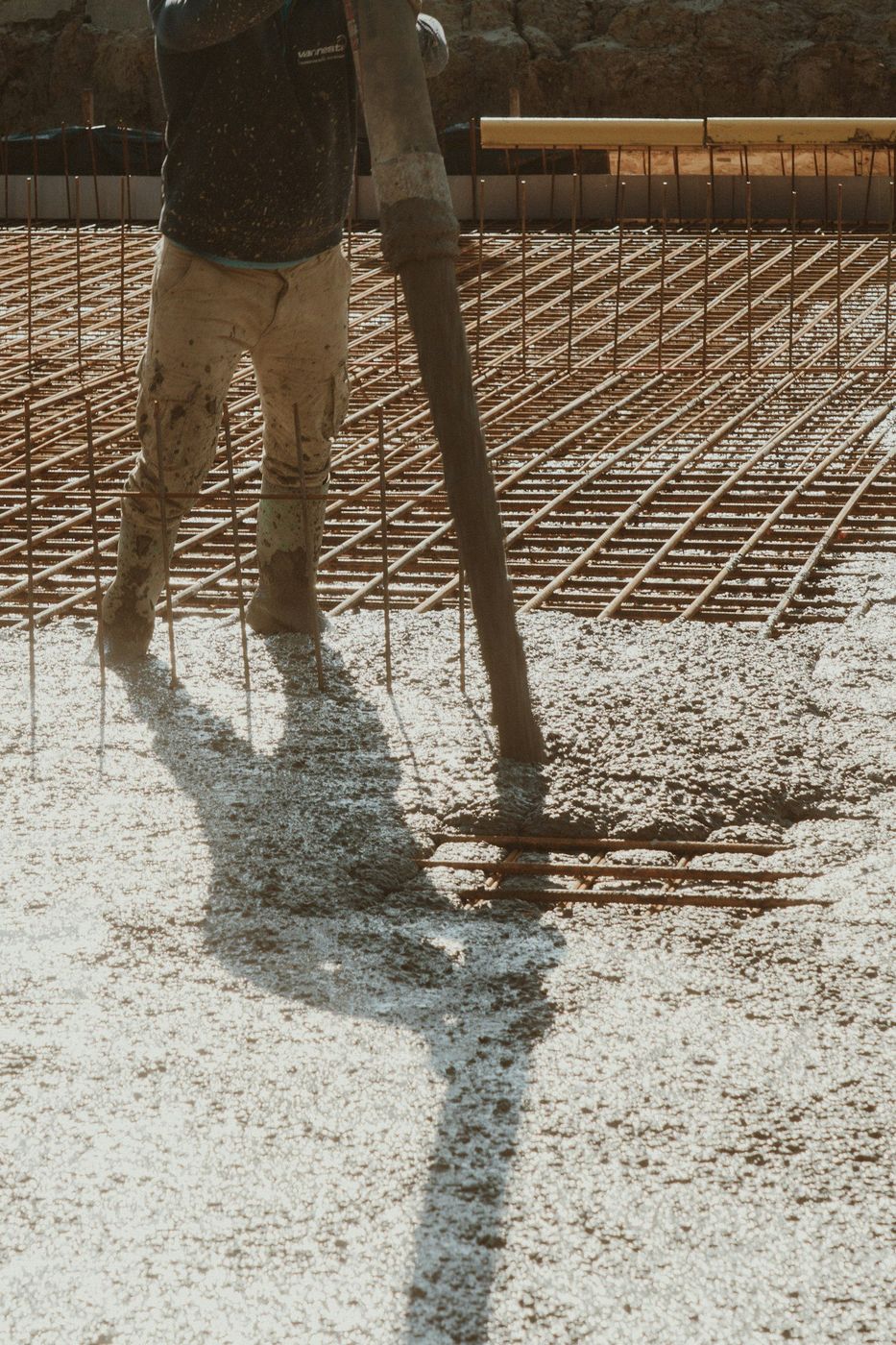
One flat plane, joints drawn around the lines, and a ball that bounces the same in every corner.
A court is the largest single piece of flatwork most homeowners ever buy, and the estimate surprises people for one reason: it's all surface. A patio has walls and furniture and planting to hide behind. A court is nothing but concrete, and every square foot has to be flat, sloped one way, and finished well enough that a bouncing ball doesn't argue with it.
The good news is it's also the least complicated thing we build. No masonry footings, no plumbing, no drainage structures. Base, steel, a big pour, and a lot of screed work. Which means the cost comes down to four decisions you make before we start: how big, how flat, how much dirt moves, and what goes on top.
Square footage is the lever, and it isn't subtle. A shooting pad to a scaled half court roughly doubles the concrete. Half court to a full high school court multiplies it again. Nobody feels that on a drawing, because a rectangle looks like a rectangle. Walk it out with a tape and it lands differently.
After size, the biggest variable is dirt. A flat backyard is cheap to prepare. Any real grade means cut and fill, and once you cut into a slope you usually need a small wall to hold the high side plus somewhere to put what you removed. On a wooded acreage lot there's room to spread spoil on site. In a tight yard in Idyllwilde or Reata, that dirt leaves in a truck and you pay for the trip.
Then there's flatness, the line item nobody expects. Flatness is finishing labor. Anybody can screed a slab flat enough for a patio. Getting a court flat enough that the ball behaves the same at the key as it does in the corner takes more hands and a crew checking with a straightedge instead of an eyeball. Pay for it. That's the whole reason you're pouring concrete instead of hanging a hoop over the driveway.
We'll come measure, check the grade, and lay out two or three footprints with paint so you can stand in them before you decide.
| Layout | Rough playing surface | What it gains you and what it costs |
|---|---|---|
| Key and arc only | Around thirty by thirty | The cheapest real court. Great for shooting, tight for a game. |
| Scaled half court | Roughly forty by thirty | The sweet spot for most yards. Three-on-three works and the arc fits. |
| Regulation half court | Forty-two by fifty | A true half court. Needs a genuinely large flat area. |
| Full high school court | Eighty-four by fifty | Acreage territory. Roughly four times a scaled half court. |
| Full regulation | Ninety-four by fifty | Rare on a home lot. Earthwork usually beats the slab for cost. |
| Any of these, striped for pickleball too | Same slab, two sets of lines | Nearly free at pour time. Awkward and pricey to add later. |
Joint layout is where a court is won or lost. A slab this size needs control joints or it cracks wherever it likes, but a joint under the free throw line is a dead spot you'll curse for twenty years. So we draw joints first and lines second, keeping cuts out of the key and off the arc wherever the panel sizes allow, running them parallel to the sidelines. Sawed the same day, deep enough to work.
Slope gets the same discipline. One plane, one direction, across the whole court. Crowning it to drain both ways feels clever and plays terribly, because a ball rolled from the corner curves. Pick the low side and hold that plane.
Orientation is free and worth a thought. A court running roughly north and south keeps low sun out of a shooter's eyes at the hours kids actually play. On the treed lots up around The Pinery you can sometimes catch afternoon shade across half the court, which is a gift in July at this altitude.
For scheduling, May through early October is the window and September is our favorite. Warm days, cool nights, and no afternoon cell building over the foothills while four people try to hold a flat plane across two thousand square feet. Rain during finishing hurts a court more than almost anything else we pour, since the top layer is the playing surface. Winter pours we'll discuss, but frozen subgrade is a no and coating trades won't work in the cold anyway. Established yards in Stroh Ranch usually mean tearing out an old patio to make room.
Still unsure about something?
Call the crew at (303) 569-4046 and we will talk it through.
Get a free, no-obligation estimate from a crew that knows Colorado soil, Colorado weather, and how to finish concrete that lasts.
Accessibility
Adjust the site to fit how you read and browse. Your choices are saved on this device.