
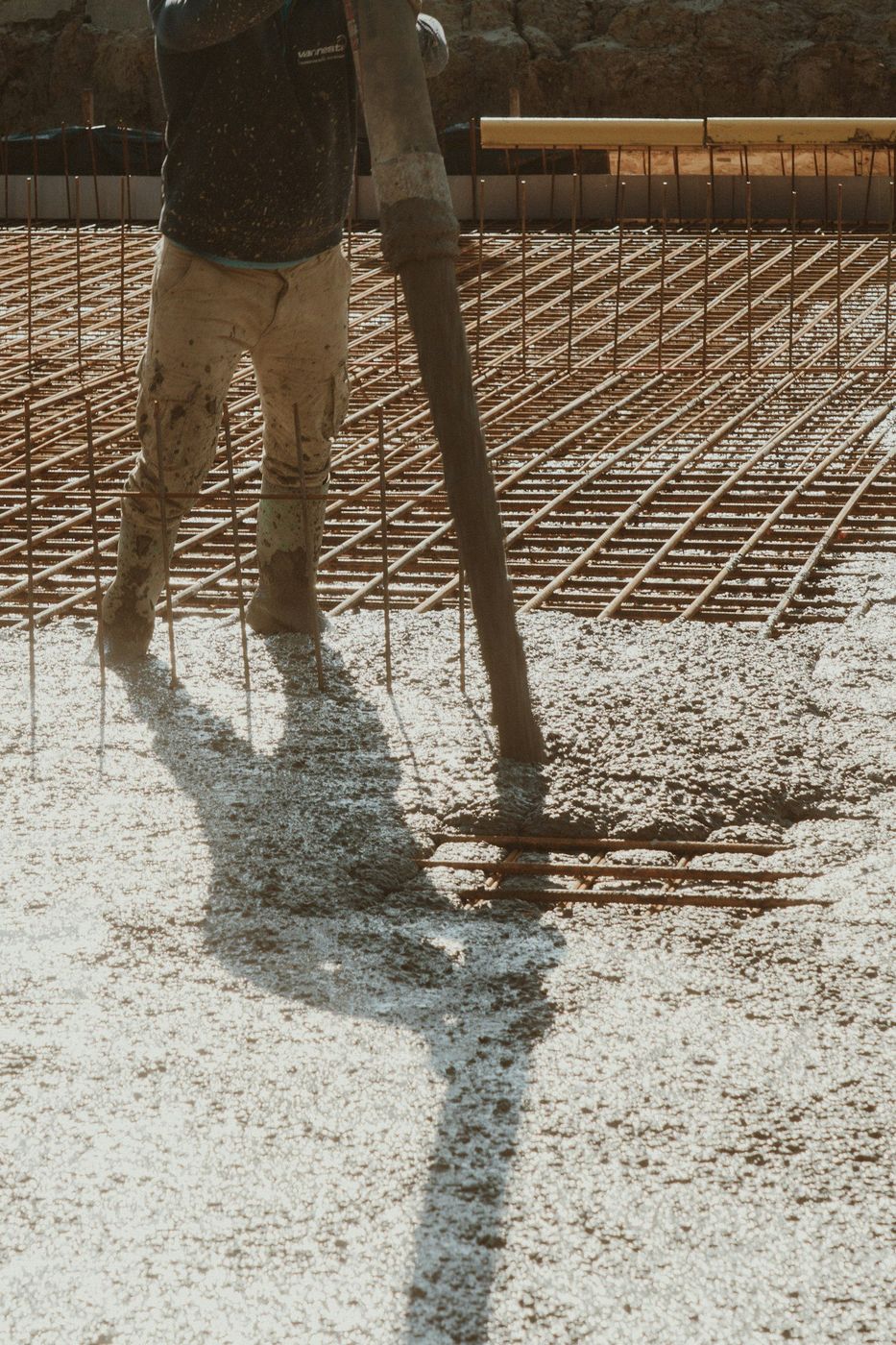
Flat slabs with the joints drawn where a dribble will never find them.
Pour day on a court starts before sunrise and it's the day everything is decided. Flatness, joint lines, hoop footing, slope. None of that can be adjusted later. A driveway that's an eighth of an inch off across ten feet is a driveway nobody notices. A court that's off by the same amount has a dead spot, and your kid will find it in about four minutes.
We've built courts in The Meadows and Cobblestone Ranch, half courts squeezed behind homes in Founders Village, and a few full-size slabs on Red Hawk lots with room to spare. The process below is the same every time, scaled to the footprint.
Layout gets drawn on paper and then chalked on the base. Not just the perimeter. We mark where every control joint will be sawed, where the hoop footing goes, and which direction the slab drains, all before a single yard of concrete shows up. That drawing is the reason our courts play true, and it's the step most crews skip because a slab is a slab to them.
Base comes first, obviously. Strip the organics, cut to grade, place road base in lifts, and compact each one. On Douglas County ground we go deeper than a patio would need, because a court is a big uninterrupted plane and any soft area under it will telegraph up as a low spot you can never fix. Then steel goes down on chairs, tied on a grid, and we walk the whole surface checking that no bar is sitting on the dirt.
Slope is the argument we have with homeowners. Everybody wants dead level. A court has to shed water, so we build in about an eighth of an inch per foot in one direction only, never a crown and never a valley. Ball players cannot feel that. Standing water in November absolutely can, and it will spall the surface within a few seasons.
Send us a photo from the back door and rough dimensions. We'll tell you what size court actually fits and where the hoop should stand.
Trucks start early because heat is the enemy of a flat finish at this elevation. Concrete placed at eight in the morning gives the crew a working window. Concrete placed at one in the afternoon in July starts stiffening while you're still screeding, and a rushed finish is a rough court forever.
Placing runs in strips. We screed off the forms and a wet screed line, bull float immediately, and then wait. That wait is the hardest part of the day for anyone watching. Troweling too early works bleed water into the surface and you end up with a court that dusts under sneakers by the second summer. So we stand around, we check the bleed, and we go back in when the surface says it's ready.
For finish, a light broom pulled in one direction is what we recommend and what most courts get. It gives shoes grip without being so aggressive that it eats a basketball. A hard steel trowel finish looks like a gym floor and turns lethal the moment it's damp. We'll do a fine burnish on a covered court. Outdoors, no.
Saw cuts go in the same day, following the chalk from the morning, timed by how the slab is setting rather than by the clock. Then the whole surface gets cured properly, and nobody plays on it for a week.
| Court | Playing surface | What it needs |
|---|---|---|
| Key and single hoop | Roughly 20 by 25 feet | A side yard or an extended driveway apron |
| Half court | 42 by 50 feet | A flat backyard with room behind the hoop |
| Three-quarter court | 42 by 62 feet | Acreage, or a graded terrace cut into a slope |
| Full high school court | 50 by 84 feet | Rare on a residential lot. We build these for schools and associations. |
| Multi-sport with pickleball | 30 by 60 feet at minimum | Two stripe colors, two net setups, one slab |
The joint layout is the whole game. Get it symmetrical and centered under the key, and nobody thinks about it again. Run one at a random angle through the top of the arc and you'll hear about it every weekend.What the crew sees on site
Still unsure about something?
Call the crew at (303) 569-4046 and we will talk it through.
Get a free, no-obligation estimate from a crew that knows Colorado soil, Colorado weather, and how to finish concrete that lasts.
Accessibility
Adjust the site to fit how you read and browse. Your choices are saved on this device.