
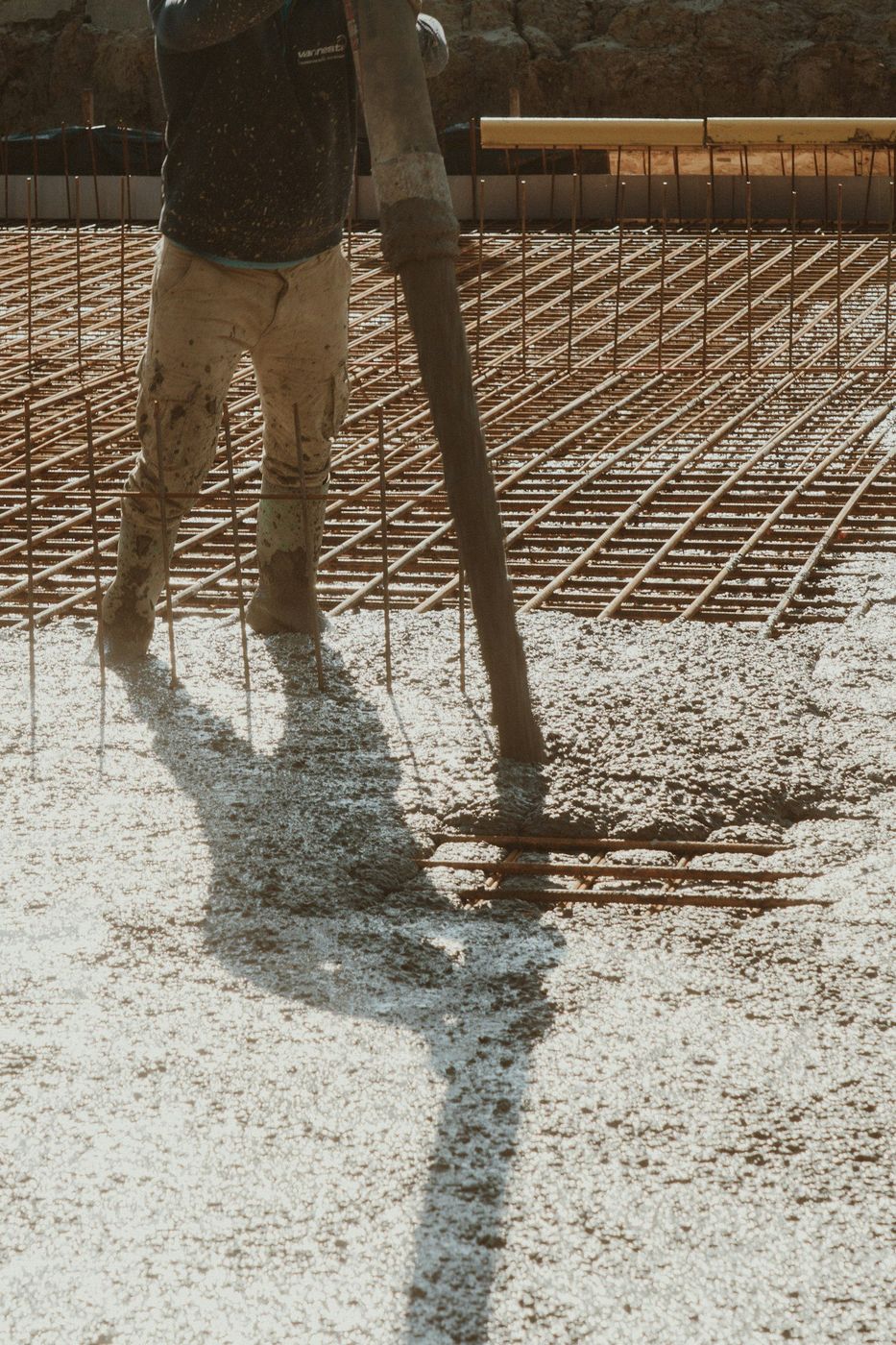
If you can see the problem from the sideline, the ball already found it months ago.
Crouch at one end of a home court and look down the surface at a low angle. That's the whole inspection, and it takes four seconds. A court poured right reads as one clean plane to the far baseline. A court poured wrong tells on itself immediately: a shadow where a panel dipped, a dark ring where water still sits two days after a storm, a coating lifting along a seam.
None of that is cosmetic. Every symptom out there changes how the ball returns to your hand, and players feel it long before anybody names it. We pour courts in a single plane, joints drawn where a dribble won't find them. We also fix the ones where somebody didn't bother.
Start with water, because water is honest. Anywhere a puddle lingers, the slab has a dish in it, and a dish means it wasn't finished in one plane. Those spots grow a film, stay slick, and become the corner nobody drives to. Then look at the joints. A crisp saw cut with tight edges is fine. One side sitting low is a panel that moved, and the ball tells you the second it crosses.
Check the hoop next. A pole off plumb by two degrees puts the rim out of height and shakes the backboard on contact, and that traces to the footing, never the pole. Then walk the perimeter. Crumbling edges look like nothing for a year, then become a border that swallows balls and rolls ankles.
| What you can see | What it does to play | What the fix takes |
|---|---|---|
| Water standing two days after a storm | That panel stays slick. Nobody drives that side | Grind and reslope if it's shallow, lift it if it settled, replace if the fall was never built in. |
| One panel low at a joint | Ball dies on the seam and kicks to the low side | Foam-lift it back to plane, then clean and reseal the joint. |
| Wide crack corner to corner | Unpredictable bounce, plus a lip that catches a toe | Route and fill while it's tight. Once the edges move, that section comes out. |
| Coating peeling in sheets | Loose flakes underfoot, and a surface that grabs a shoe wrong | Strip, profile, recoat. Peeling means a coating went over damp or unprepared concrete. |
| Hoop pole off plumb | Rim height is wrong, backboard shakes on contact | Dig out and repour the footing. A lean means it was too small or too shallow. |
| Crumbling perimeter edges | Harmless a season, then a border that eats balls and ankles | Saw back to sound concrete, pour a new thickened edge. |
A court is a big uninterrupted slab, so it has more room than most flatwork to argue with the ground under it. Our soils move with moisture, and a court poured without steel over a base nobody compacted telegraphs that movement as a crack straight through the key. Six inches of base and a real bar mat aren't upgrades here. They're the job.
Weather handles the rest. Freeze-thaw attacks any surface holding water, which is why single-plane drainage matters more here than in a mild climate. Sun at this height fades acrylic coatings faster than the brochure suggests, and hail dimples them. Deicers wreck the surface and the joint sealant both, so a court gets a poly shovel and nothing else.
Yard size decides the layout. Park Hill and Central Park lots often hold a real half court. Around Wash Park, Berkeley, and the tighter Highlands blocks we're pouring a key-and-arc pad or working the court into a wide driveway. University Hills falls in between.
A low-angle shot tells us more about flatness and drainage than any measurement read over the phone.
Pour spring through fall, and aim for the shoulder months if you can. Cool air and mild nights give a big slab a slower, kinder cure than a ninety-degree July afternoon, and a large pour in real heat is a race nobody enjoys. We start early, keep the surface wet, and watch the storm building over the mountains.
Coatings pin the schedule. Acrylic systems want warm dry days and a fully cured slab, so a court poured in late September gets its color the next spring. That's fine. Bare concrete plays well all winter and plenty of families never coat at all. Keep salt off it, clear snow with a plastic blade, and let the first season pass before anybody talks about paint.
Still unsure about something?
Call the crew at (303) 569-4046 and we will talk it through.
Get a free, no-obligation estimate from a crew that knows Colorado soil, Colorado weather, and how to finish concrete that lasts.
Accessibility
Adjust the site to fit how you read and browse. Your choices are saved on this device.