
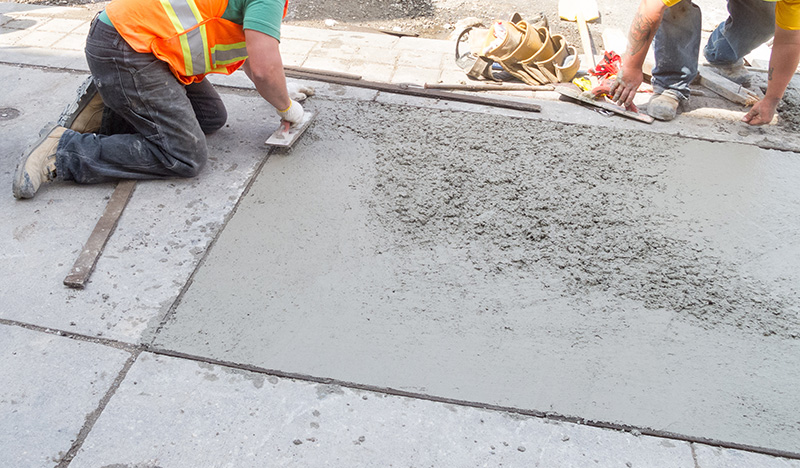
Trip-hazard correction, slab lifting, and sealing that keeps a property out of a claim.
Each line below is a scope we bid, schedule, and pour ourselves. Open one for specifications, sequencing, and the questions worth asking before award.
Every property manager keeps a mental folder of things that aren't broken enough to fix yet. Concrete sits in that folder longer than almost anything else, because a walk that's cracked and settling still holds people up. Right up until somebody goes down on it.
That's what separates concrete from most deferred maintenance. A failing roof costs you water damage. A failing walk costs you an incident report and a conversation about what you knew and when. This page is about reading the failure early: which correction fits which problem, what each one does to your operating hours, and how to keep a slab out of a claim.
Concrete repair pricing isn't a smooth ramp. It's a staircase, and every step up is a multiple of the one below it.
A quarter-inch offset at a joint is a grinder and twenty minutes. Let that joint reach an inch because the base is washing out and grinding stops being an option, so now you're lifting the panel. Let the panel crack apart and lifting stops being an option too, so now you're removing it, rebuilding the base, and pouring new. Same joint, three budget categories, and the only variable is how long it sat. A modest repair line every year beats a capital replacement every eighth year.
The usual mistake is picking a method by budget and hoping the failure cooperates. It doesn't. What matters is why the panel is sitting where it's sitting.
Small offsets on sound panels get ground down. The high edge comes off at a bevel so there's no lip left to catch a shoe, and the walk is back in service before the crew loads out. It's the cheapest correction on the list and it's the right answer more often than managers expect.
Bigger offsets mean the base moved, and grinding a panel that's still sinking buys you a season. Lifting treats the actual problem: fill the void, bring the slab back to grade, and it drains the way it was poured to drain. If the panel has broken up there's nothing left to lift, and replacement is the honest answer. The thresholds that trigger correction on an accessible route come from standards and your jurisdiction, so confirm those with your building department.
| Method | Right when | Back in service |
|---|---|---|
| Diamond grinding | Small offset, panel sound, base stable | Immediately, same visit |
| Slab lifting | Panel intact but settled, void underneath | Same day, often within hours |
| Partial-depth repair | Damage in the top layer or along one joint edge | Next day, depending on the patch material |
| Resurfacing | Widespread surface wear, structure still sound | Foot traffic in a day or two |
| Remove and replace | Panel broken through, base failed, or slope wrong | Foot traffic 24 to 48 hours, vehicles at seven days |
We'll walk it, rate it, and put the repairs in priority order with a written estimate. Free, no obligation.
| Consideration | Cement slurry | Polyurethane foam |
|---|---|---|
| Injection holes | Larger, patched after | Small, easy to hide in a broom finish |
| Weight added to the soil | Significant on soft subgrade | Almost none |
| Return to service | Several hours to a day | Minutes to an hour |
| Voids it handles best | Large washouts and open cavities | Tight voids, travels farther |
| Wet or unstable soil | Struggles where water still moves | Handles damp conditions better |
| Where we lean | Big voids, low-traffic areas | Entries and docks, where downtime hurts |
Most scaling we get called out to look at is chemistry, not construction. Deicing salts drive water into the top layer and freeze it there, and magnesium chloride is the worst offender on the shelf. The damage rarely shows in January. It shows in April, as flaking in exactly the pattern your snow crew salted.
New flatwork gets no deicer at all through its first winter; sand does the traction job without the chemistry. After that, a penetrating sealer on walks and drive lanes, renewed on the interval the product calls for, is the cheapest item on your maintenance calendar. Put all of it in the snow removal contract, because a plow contractor who doesn't know what's newly poured will salt the whole property the same way.
Cure time sets the calendar, not the crew. That's the piece managers most often plan around incorrectly, and it's worth getting right before you notify tenants.
We work entrances one half at a time so a door stays usable, run dock aprons overnight or on weekends when freight schedules allow, and phase drive lanes so there's always a way in and out. Grinding and foam lifting are the tools that let a repair happen during business hours. Anything involving a pour takes that spot out of service for a few days. Winter pours are possible with heated water, non-chloride accelerators, and blankets, at somewhat higher cost. Frozen ground is the hard stop.
Nine times out of ten the panel that generates the incident report is one we could have ground flat for almost nothing eighteen months earlier.
Go Denver Concrete crew lead
Still unsure about something?
Call the crew at (303) 569-4046 and we will talk it through.

Send drawings or a site address and we will walk it, mark the scope, and return a written per-unit breakdown.
Accessibility
Adjust the site to fit how you read and browse. Your choices are saved on this device.