
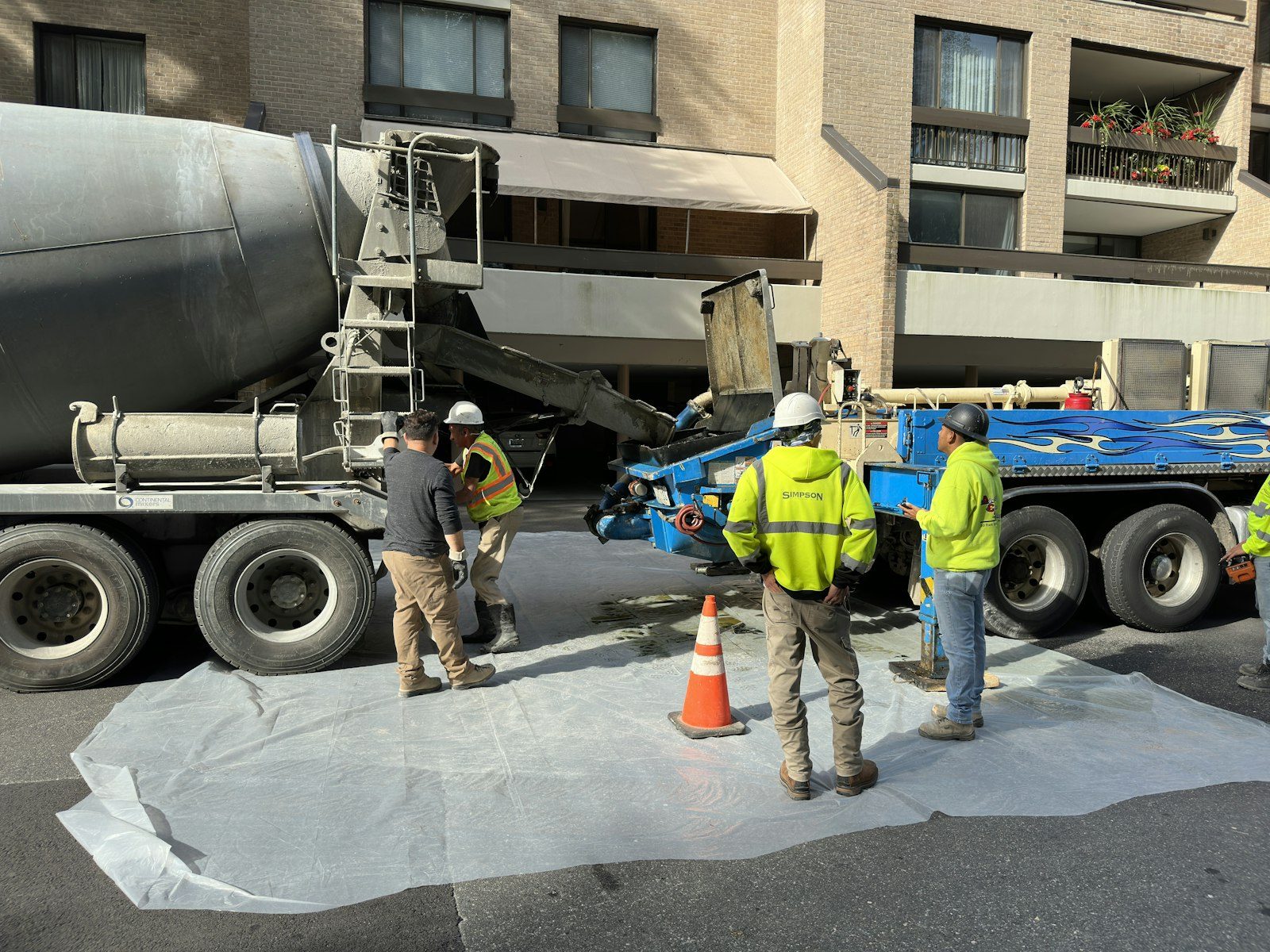
Forms set Tuesday, steel tied by dusk, and the first truck backing in before the street is awake.
A pad big enough for a fifth wheel is a lot of concrete to place in one continuous piece, and it has to go down without a cold joint anywhere in it. That means the whole day is a sequence, and the sequence starts long before the plant sends the first truck. By the time you hear the drum turning at the end of the street, we have already decided how many yards, in what order, spaced how far apart, and where each truck is going to sit.
Here is the day as it actually runs. Not a brochure version, the real one, including the parts where we stand around waiting on purpose and the parts where nobody stops moving for two hours.
Crew arrives while it is still cool. First thing is a walk of the forms with a level and a tape, because a board that shifted overnight is cheap to fix now and impossible to fix in an hour. We check diagonals so the pad is square, confirm the top of form against the grade stakes, and pull a string down the long side to catch any bow.
Then the steel gets a look. Every bar on a chair, every lap tied, nothing lying in the dirt waiting for somebody to hook it up mid-pour. That last habit is why so many older pads have steel sitting uselessly at the bottom of the slab. Access shapes that call. Deeper lots around The Ranch and Quail Creek usually let a truck reach the forms directly, while tighter side yards in Bradburn and Legacy Ridge mean buggies and an earlier start. Once forms and steel pass, we call the plant with a start time and a spacing between loads. Not before. Concrete that shows up to a job that is not ready starts setting in the drum.
We pour to a moving edge. The crew works across the pad in strips, always keeping fresh concrete against concrete that is still plastic, so the whole slab knits into one piece. If a truck is late and that leading edge starts to stiffen, we have a problem that no amount of finishing hides, which is exactly why load spacing gets negotiated with the dispatcher before anyone starts.
Screed follows the pour by minutes. Bull float follows the screed. Then everything stops. That pause is the part homeowners find strange, because the slab looks finished and nobody is touching it. We are waiting for bleed water to come up and evaporate off, and troweling before that happens seals water into the surface and guarantees flaking two winters later. When the sheen goes and a boot leaves a shallow print, we go back on with edgers, jointing, and the broom. Saw cuts go in the same day, usually that evening, spaced to the thickness we placed.
| On the ticket | What we want to see | What happens if it is off |
|---|---|---|
| Mix design | 4,000 PSI exterior mix matching what we ordered for the pad | Wrong mix goes back. A pad carrying axle loads is not the place to accept whatever was left in the drum |
| Air content | Air entrainment in the range the mix calls for, verified with a meter on the first load | Low air means no freeze-thaw protection. We adjust at the truck or reject it |
| Slump | Consistent load to load, stiff enough to hold a six-inch section without segregating | A wet load finishes easy and cures weak. Water added at the site is water taken out of the strength |
| Batch time | Placed well inside the window from batching, especially on a warm morning | Concrete that has been riding too long gets sent back rather than dosed into submission |
| Admixtures | Whatever we ordered for the conditions, and nothing containing chloride | Chloride accelerators are convenient and corrode the steel we just spent a day tying |
| Yardage | Matches the running total we are tracking against the volume we calculated | Short on the last truck is a cold joint. We order the tail load generously and waste a little on purpose |
Give us the length and width you have in mind and what will park on it. We will size it, price it, and tell you what the access looks like. Free estimate, no deposit to get one.
The question we get asked most on pour day is why we are standing still. The honest answer is that concrete sets on its own schedule and the only way to ruin a slab this size is to get impatient with it. Fifteen minutes of waiting saves a surface that would have started shedding in year three.Our crew lead, after the walkthrough
Still unsure about something?
Call the crew at (303) 569-4046 and we will talk it through.
Get a free, no-obligation estimate from a crew that knows Colorado soil, Colorado weather, and how to finish concrete that lasts.
Accessibility
Adjust the site to fit how you read and browse. Your choices are saved on this device.