
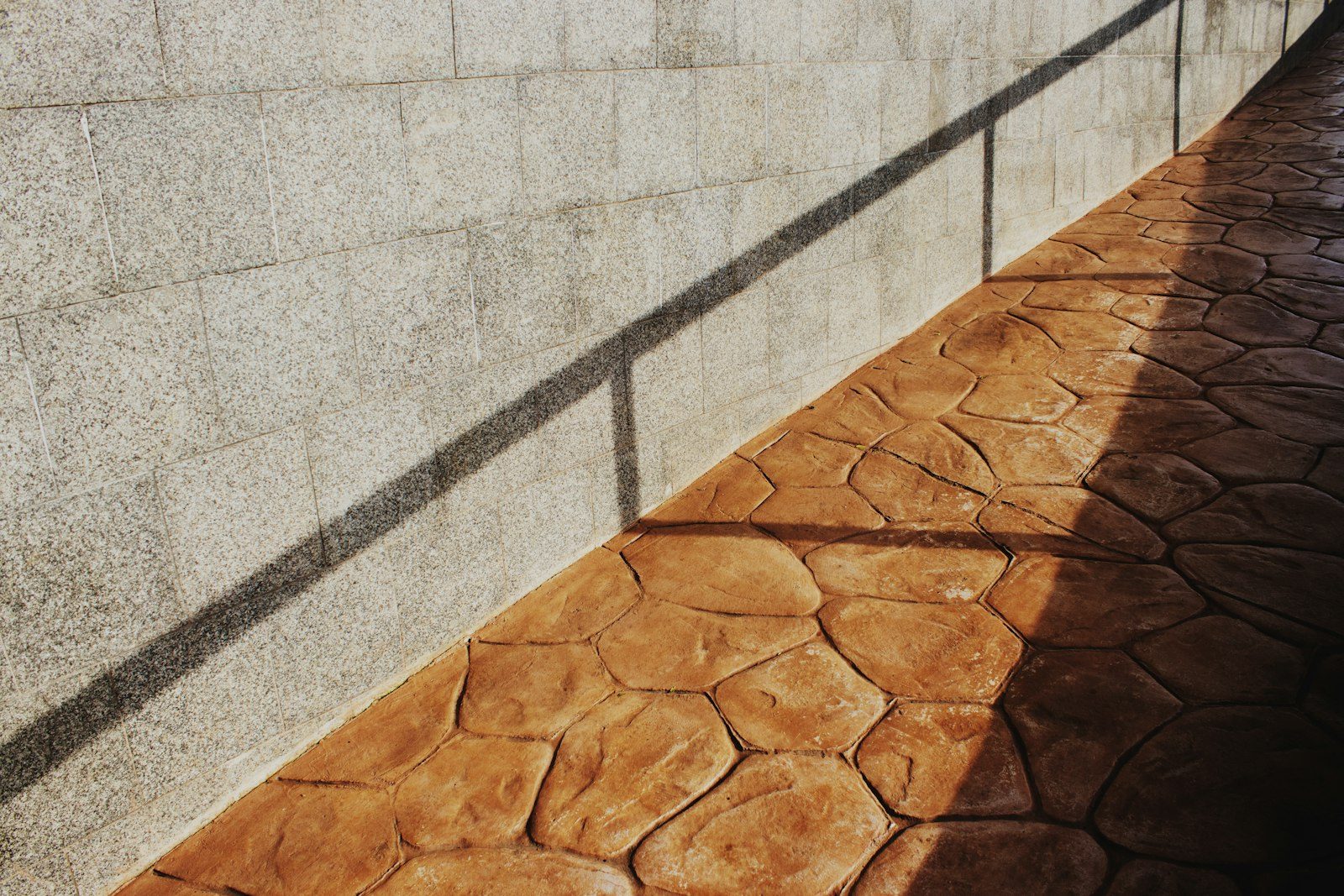
Photograph the front of your house and the walk lands dead center in the frame. That is the audit.
Take a picture of your house for any reason at all. A listing photo, an insurance claim, a holiday card. The front walk will be in it, running from the bottom edge of the frame right up to the door, and your eye will follow it whether you want it to or not. That strip of concrete does more visual work than the shutters, the porch light, and the mulch combined.
Which is convenient, because a walk also happens to tell on itself from a distance. You do not need a level or a flashlight. Stand at the curb, look for six or seven specific things, and you will know most of what we would know after a site visit. Here they are, in the order we notice them.
| What you see | What it usually means | Where it goes from here |
|---|---|---|
| Green or black film on one stretch only | That section stays wet long after the rest dries | Pitch problem or a settled panel. Cleaning is temporary. Correcting the fall is not |
| A chalky white bloom along the joints | Moisture is moving up through the slab and leaving mineral behind | Water is getting under the walk, usually irrigation overspray or a downspout aimed wrong |
| Lawn creeping over the edges | The walk has settled below grade, so sod grows across it | The path is narrower than it reads on paper, and the edges now trap water |
| A lip you can catch a shoe on | One panel heaved or its neighbor dropped. The base is not uniform | This is the one that becomes a liability. Lift it, swap the panel, or rebuild the run |
| Fine cracking spread like a road map | The top layer cured too fast or got rained on during finishing | Cosmetic today. It becomes flaking once deicers and freeze cycles work into it |
| Mulch washed across the concrete after storms | Runoff crosses the walk instead of running alongside it | Grading issue in the beds. Fix the walk alone and you get the same picture next July |
A driveway is wide, heavy, and reinforced, and it holds a lot of ground still just by existing. A front walk is a ribbon three or four feet across with edges exposed on both sides, which means frost can get at it from underneath and from the flanks at the same time. That is why walks heave when driveways twenty feet away sit perfectly flat.
The other factor is water, and around here it is almost always sprinkler water rather than rain. A lawn zone that throws a heavy pattern onto the same six feet of walk every other morning saturates the ground under that panel all summer, then that ground freezes in November with all that moisture in it and lifts. We see it constantly in the established parts of The Ranch and Quail Creek where the irrigation was laid out before the paths were widened. Newer streets in Bradburn and Legacy Ridge get a version of it too, usually where a builder set the walk on trench backfill that never got compacted properly.
Send a photo taken from the curb, straight on. That one picture tells us more than a phone call, and the estimate is free.
Thirty-six inches is the width a lot of older front walks were built to, and it is exactly one person wide. Two adults cannot pass. Someone carrying a laundry basket walks in the grass. Forty-eight inches lets two people walk side by side without a shoulder brush, and it is the number we push for on any main entry path. If the run has to stay narrow because of beds or a porch column, we widen it selectively at the door and at the driveway junction, where people actually stand around.
Pitch is the other one. A quarter inch of fall per foot, crossways, always toward the lawn and never toward the house. On a four-foot walk that is one inch of drop across the width, which nobody can perceive underfoot but which clears every drop of meltwater before it can sit and freeze. A dead-flat walk holds ice into March on the north side of a house. That is not a maintenance problem. It is a construction problem that got poured in.
Curved paths look easy and are not. Joints on a curve want to run perpendicular to the direction of travel, so the spacing changes across the width and the layout has to be marked by somebody who has done it before. Get it wrong and the slab cracks its own line through the middle of your radius. We snap every cut before the truck arrives.
Scheduling is simple, because a walkway is a short job. One truck, one day of placing and finishing, and we are gone. That makes it easy to slot into spring or fall between bigger jobs, and late September is our favorite week for it. Winter runs are workable with heated mix water, non-chloride accelerators, and blankets, though we will not place a narrow slab on ground that is still frozen underneath. Skinny concrete has no margin for error.
Stop watching the crack and start watching the joint next to it. A hairline that sits still is just concrete being concrete. A joint where one side has climbed above the other is the ground talking, and the ground never gets quieter on its own.The crew lead's read on it
Still unsure about something?
Call the crew at (303) 569-4046 and we will talk it through.

Get a free, no-obligation estimate from a crew that knows Colorado soil, Colorado weather, and how to finish concrete that lasts.
Accessibility
Adjust the site to fit how you read and browse. Your choices are saved on this device.