
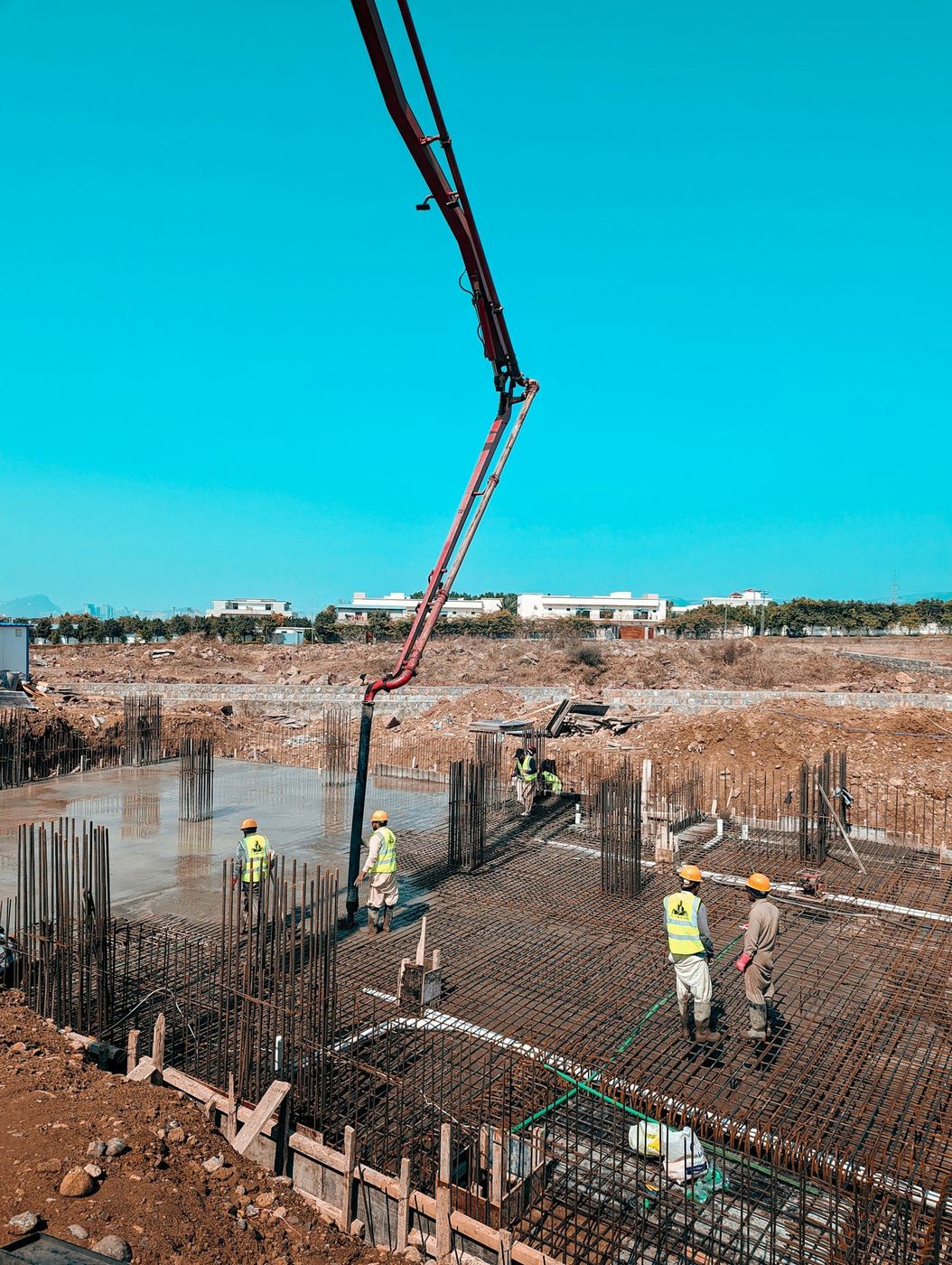
Two quotes for the same tear-out can be a third apart. The gap is almost always buried.
People forward us competing bids all the time and ask the same thing: why is one number so much lower? Fair question, and the answer is rarely cheaper concrete. Ready-mix costs what it costs, and every crew working the north metro buys from the same short list of plants at close to the same rate per yard.
The spread lives underground and in labor hours nobody itemizes. How deep the base goes. Whether the subgrade gets compacted in lifts or knocked flat with a bucket and called good. Steel, mesh, or nothing at all. How much of the old slab actually leaves your property instead of getting buried in the back forty. A replacement bid is mostly a bid on the two days between demolition and the pour, which happens to be the part you can never inspect afterward.
Think of the job as four buckets. Removal and disposal. Earthwork and base. Steel and forms. Concrete and finishing. Homeowners assume the last bucket is the big one. It usually is not. On a typical Westminster drive, the concrete itself is a smaller share of the total than the combined cost of getting the old slab out, hauling it away by weight, and rebuilding what is underneath.
That is why the low bid tends to shrink the middle two buckets. Nobody advertises three inches of base instead of six. Nobody writes down that the mesh got laid on the dirt and left there. But those choices show up on the invoice as a smaller number, and they show up in your yard about eight years later as a slab doing exactly what the old one did. We would rather sell you the boring part and let the finish take care of itself.
Send it over. We will read it line by line, tell you what is missing, and give you our own number to set beside it. No charge and no pressure.
| The line item | What the cheap version looks like | What you pay for it eventually |
|---|---|---|
| Subgrade prep | Old slab out, dirt raked level, forms set the same afternoon | Uncompacted soil consolidates under traffic and the new slab dishes in the wheel paths |
| Base depth | A skim of road base spread thin enough to see dirt through it | No drainage layer, so meltwater sits under the concrete and works on it every freeze cycle |
| Reinforcement | Mesh rolled out flat on the ground before the pour | Steel that sits at the bottom of a slab does close to nothing. Cracks open wide instead of staying tight |
| Disposal | Broken concrete stacked behind the shed or worked into a low spot in the yard | You inherit a rubble pile and a settling hole, and the next owner inherits both |
| Jointing | Cuts made the following morning, or tooled in shallow while finishing | Random cracking that ignores your joint pattern, because the slab already relieved itself overnight |
Two identical driveways on two different streets are not the same job. Access is the first variable. If a truck can back to the forms and pour straight off the chute, the labor is short. If we are running buggies around a corner or pumping over a fence, hours pile up fast. Older blocks in Quail Creek and The Ranch often have mature trees and narrow side yards that turn a simple pour into a relay.
Then there is what comes out of the ground. Newer construction around Bradburn and Legacy Ridge can hide utility trenches backfilled loose, and those need excavating and rebuilding rather than compacting in place. Slope matters too. A drive that falls toward the garage needs regrading, sometimes a trench drain, and that work is real even though none of it will ever be visible once the concrete goes down.
A replacement returns value whether you sell next year or stay for thirty. It is visible from the street, it is the first surface a buyer walks on, and an inspector cannot ding what is not broken. You also do not have to do all of it in one season. We will split a job at a joint line, take the failing half now, and come back when the budget recovers. Splitting costs a little more overall because we mobilize twice. It still beats waiting three years while the rest gets worse.
On timing, late spring through early fall is easiest, and September pours cure beautifully. Winter replacements happen with heated water, non-chloride accelerators, and blankets, and we refuse frozen subgrade every time. If the ground will not thaw, the honest answer is to wait.
Still unsure about something?
Call the crew at (303) 569-4046 and we will talk it through.

Get a free, no-obligation estimate from a crew that knows Colorado soil, Colorado weather, and how to finish concrete that lasts.
Accessibility
Adjust the site to fit how you read and browse. Your choices are saved on this device.