
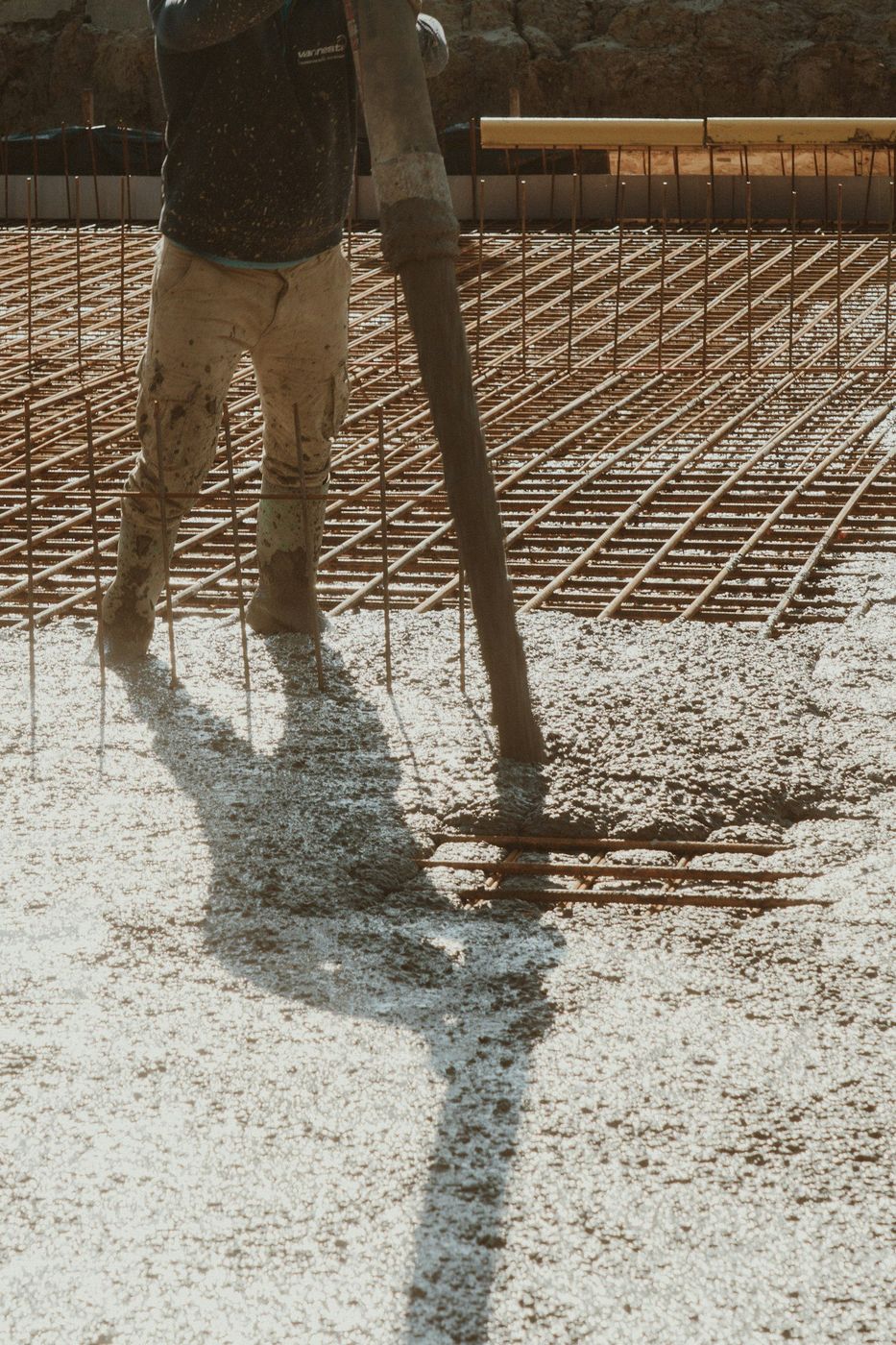
Pour day on a spa pad is four hours of ordinary work and about six minutes that decide everything.
A spa pad is a small pour. It is not a simple one. Several thousand pounds of water, shell, cabinet, and people press down through the frame at the corners and stay there, permanently, in a yard that freezes and thaws about a hundred times a year. That load never moves off. Ordinary patio concrete was never asked to do that.
What follows is what actually happens on the day we pour one, start to finish, because most of the questions we get are really questions about sequence. When does the conduit go in. When is it too late to move the pad a foot. When can the tub sit on it. Here's the morning as we run it.
We're on site early, and the first thing that happens is nothing at all. We stand where the tub will go, check the walking route from the door you'll actually use in January, and confirm the footprint one last time with you. That conversation costs nothing before the forms go up and quite a lot afterward.
Then the work. The excavation gets cut deeper than people expect, because six inches of concrete over six inches of compacted base means a real hole, not a scrape. Base goes in and gets packed in lifts. Forms get set and staked hard, since wet concrete pushes back. Grade gets shot so the finished surface carries a gentle fall away from the house rather than back toward it.
Steel is next: number four bar on chairs in a grid, sitting up inside the slab where it does something, not lying in the dirt where it does nothing. Conduit gets sleeved and stubbed on the equipment side and marked so nobody hunts for it later. Then we wait for the truck.
| Item | When it goes in | What it costs you to add later |
|---|---|---|
| Electrical conduit to the equipment side | Sleeved before concrete arrives | Coring a finished slab, or a surface run nobody wants to look at |
| Pad footprint and overhang for standing room | Decided at form-setting | A second pour with a cold joint through your standing area |
| Fall away from the house | Set by the screed grade | Nothing short of grinding or replacing the slab |
| Isolation joint at the house or patio | Formed in before placing | Cutting and caulking after cracks have already told you |
| Post footings for a cover or pergola | Poured with the pad, tied in | Breaking out squares of new concrete to dig them |
| Drain path for the seasonal drain-down | Graded before base goes in | Rerouting hundreds of gallons around finished hardscape |
Mix is 4,000 PSI with air entrainment, which is what survives freeze-thaw at this elevation. Concrete goes in from one end, gets raked to rough grade, and then screeded off the forms so the whole surface lands in one plane. Screeding is where flatness is won or lost.
Bull float follows, and then we stop and wait. That pause looks like laziness and it's the most important stretch of the morning. Bleed water has to rise and leave. Finish it too early and you trap water at the surface, which is how a slab ends up dusting and scaling by its second winter.
When it's ready, we edge, cut control joints, and put on a light broom, because a wet spa deck with a slick finish is a trip to urgent care. Last comes the straightedge, laid across the pad in several directions. A spa shell wants full, even support. A pad that dishes or tilts loads a shell the manufacturer never intended, and cabinets rack when that happens.
Give us the model and the delivery date. We'll work backward and name the last morning the pour can happen.
Everybody watches the pour and nobody watches the wait. That stretch where the crew is standing around drinking coffee, looking at the surface, that's the part we're getting paid for. Come back too soon and you've built the problem in.Straight from the crew
April through October is the comfortable stretch across the north metro, and the shoulder weeks are genuinely the best of it. Cool mornings hold the finishing window open longer than a hot July afternoon, when a slab can start setting faster than a crew can work it.
Summer pours start at first light for that reason, and because the storms that build over the plains here have ruined more than one finish. Rain landing on fresh concrete during finishing washes the paste out of the surface and leaves you a weak, dusty top layer, so we watch the radar and keep plastic ready.
Winter is a scheduling question, not a hard no. Heated mix water, non-chloride accelerators, and insulated blankets make a cold pour work, and strength comes slower so the waiting period stretches. Frozen subgrade is the actual stopping point. Yards around Bradburn and Quail Creek all get spa deliveries in spring, so if yours is booked for March, call us in the fall.
Still unsure about something?
Call the crew at (303) 569-4046 and we will talk it through.
Get a free, no-obligation estimate from a crew that knows Colorado soil, Colorado weather, and how to finish concrete that lasts.
Accessibility
Adjust the site to fit how you read and browse. Your choices are saved on this device.