
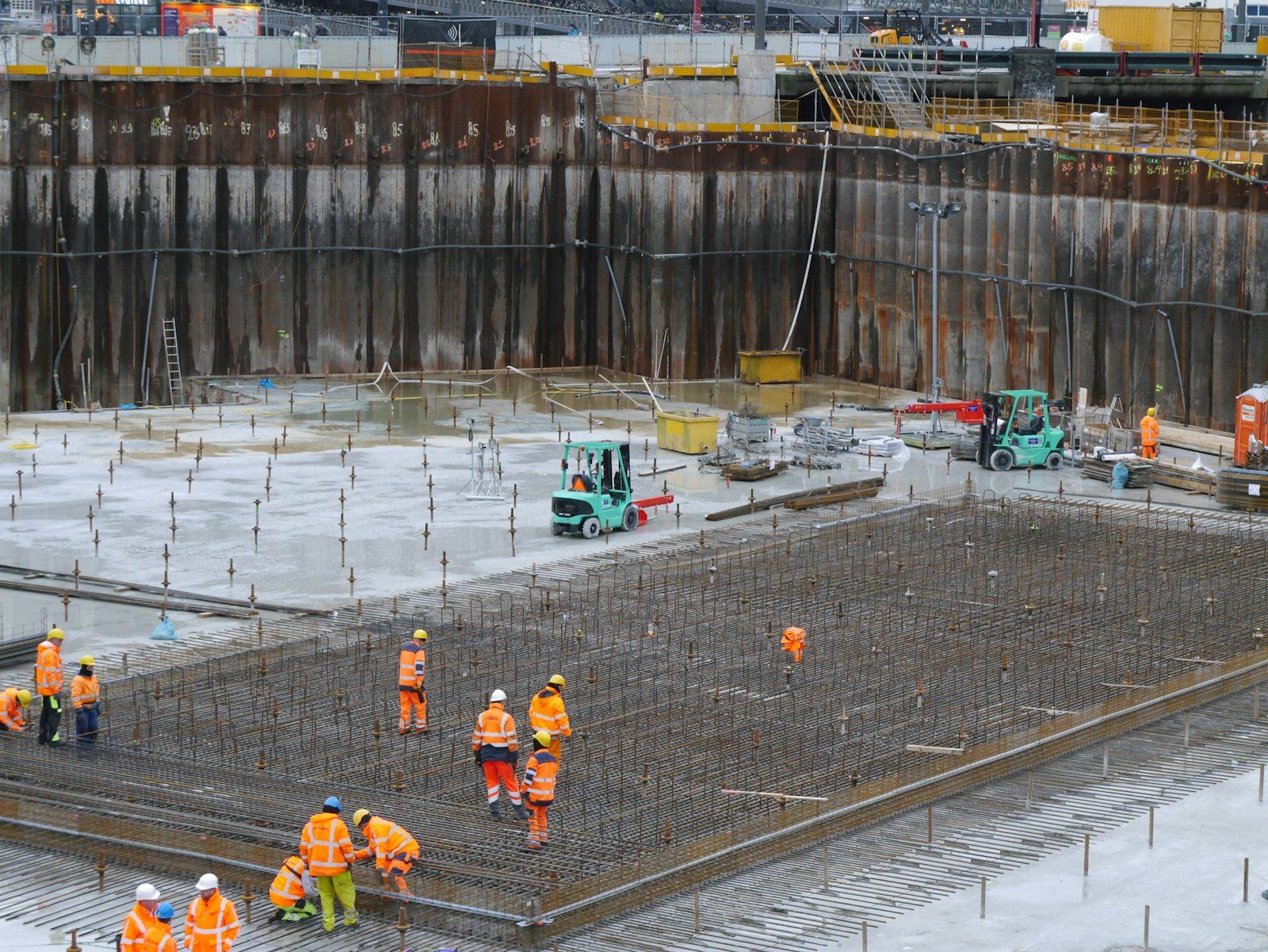
Pull up an old front walk and you don't find one kind of ground. You find three, in a row.
A front walk runs from your door to the street, and on that short trip it crosses three different kinds of ground. The first several feet sit on foundation backfill, loose dirt a machine shoved back into a hole. The middle crosses utility trenches, water and sewer and whatever the cable company added later. The last stretch lands on native soil nobody has touched since before the house went up.
Three zones, three settlement rates, one narrow strip of concrete trying to stay flat across all of them. That's the engineering problem with a walkway, and it's why the skinniest slab on your lot moves first. We build walks in Hunters Glen and around Eastlake with that in mind.
Foundation backfill is the worst of the three. It went in fast, in one big lift, and it keeps compressing under its own weight for years. That's why the panel closest to the porch is usually the one that drops. We over-excavate that zone and rebuild it with material we can actually compact.
Utility trenches are the sneaky one. A trench refilled with loose spoil is a channel running under your yard, and it carries water steadily to the ground beneath your walk. Where a trench crosses the walk line we dig it out and put base back in lifts, so it stops being a drain and starts being support.
Native ground is the most predictable, which isn't the same as good. Around here it's clay that changes volume with moisture, so the answer isn't to fight it. Keep water away from it. Drainage beats brute force on this soil.
Almost never the sky. Rain landing on a properly pitched walk is gone in minutes. What ruins walkways arrives from underneath and from the sides, and there are usually four sources: a downspout emptying near the walk line, an irrigation zone that runs long and soaks the same strip twice a week, a yard graded so runoff crosses the walk instead of going around it, and trench backfill wicking moisture along its length.
We check all four before quoting, because any one will undo a good pour. Downspouts get extended and buried past the walk. Heads spraying at the concrete get turned. Grade gets corrected so water crosses on the surface fast rather than underneath slowly. Unglamorous, and cheaper than pouring twice.
| Material | How it behaves under a narrow slab | Where we use it |
|---|---|---|
| Crushed road base | Locks up tight under a plate, drains, stays put | Our default under every walkway we pour |
| Recycled crushed concrete | Compacts nearly as well and drains when it's clean | Larger jobs where the gradation checks out |
| Squeegee or bedding sand | Doesn't lock together. Moves when water moves | Under pavers, never under poured concrete |
| Native clay, regraded | Holds water, swells, shrinks. Nothing rides on it well | Bottom of the excavation only, with real base above |
| Trench spoil put back loose | Settles for years and channels water along the line | Never. It comes out and gets replaced |
| Pit run or dirty fill | Fines and organics mean it keeps compressing | Not under flatwork of any kind |
We'll dig a test hole at the worst panel and tell you what's really down there. No charge for looking.
A walk loses heat from both sides at once. A driveway carries mass in every direction; a walk is thirty-six or forty-eight inches wide with edges everywhere, so frost gets a grip faster and deeper. That's the physics behind the thing homeowners always notice, where the path heaves while the driveway three feet away never moves. Wet base freezes and expands. Dry base doesn't. Which is why our answer to frost is drainage, not depth for its own sake.
Late April through October is the comfortable window, and we like May and September for narrow flatwork because the surface doesn't skin over before we can finish it. Cold-weather walks work with heated water, chloride-free accelerator, and blankets, and a small pour is easier to protect than a big one. Frozen subgrade is a hard stop.
Give it a day or two before anyone walks on it, a week before a wheelbarrow crosses, and no ice melt the entire first winter.
The panel by the porch is always the bad one. We dig it out and there it is: loose fill from the day the foundation went in, still finding its level thirty years later.From the crew lead on these jobs
Still unsure about something?
Call the crew at (303) 569-4046 and we will talk it through.

Get a free, no-obligation estimate from a crew that knows Colorado soil, Colorado weather, and how to finish concrete that lasts.
Accessibility
Adjust the site to fit how you read and browse. Your choices are saved on this device.