
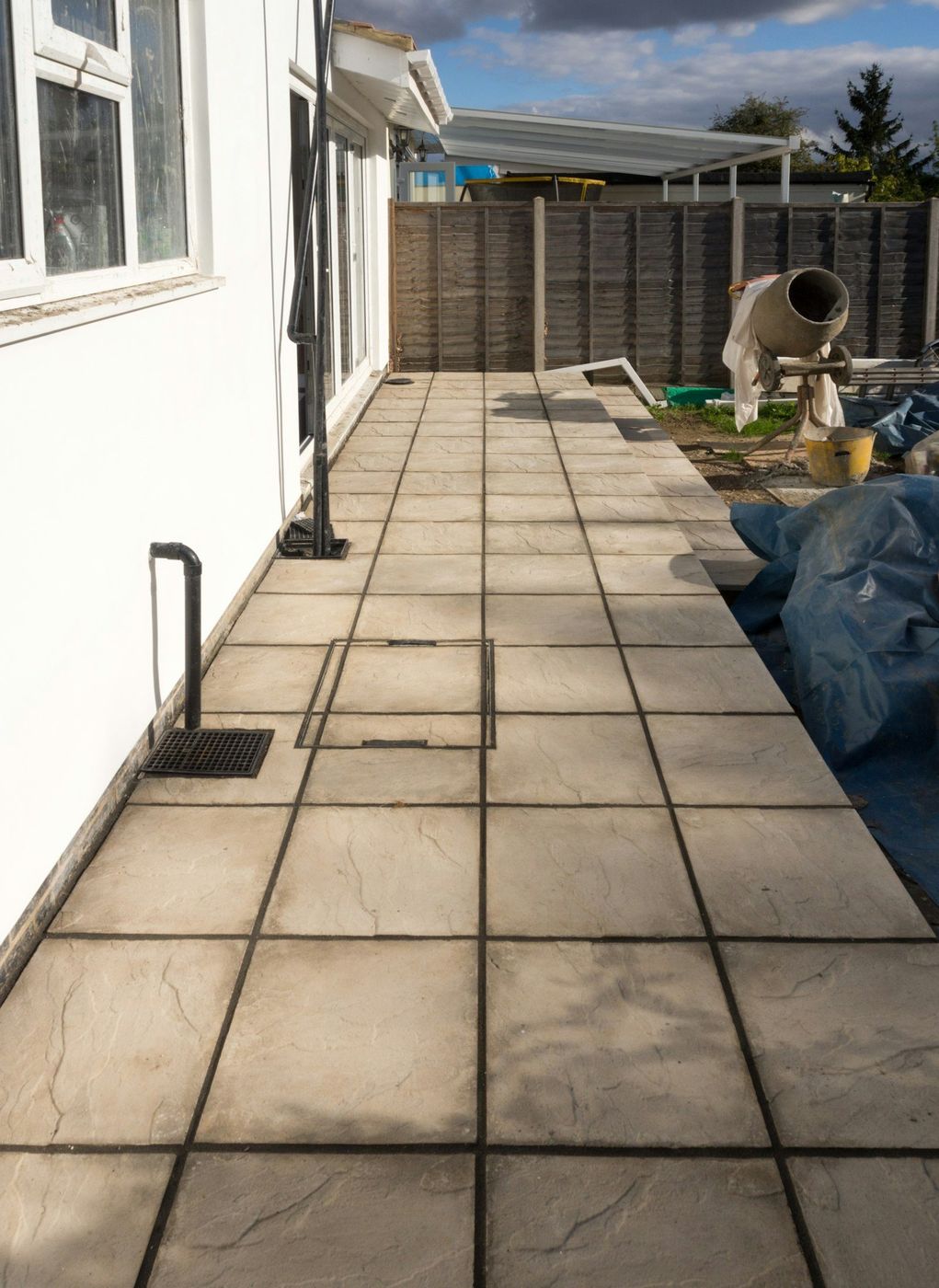
Stand at the back fence and look toward the house. A tired patio confesses everything from there.
Walk to the back of the yard and turn around. From forty feet away you stop seeing the broom marks and start seeing the shape of the thing, and the shape is where the truth is. Does the slab still read as one flat plane, or does it sag in the middle like a shallow dish? Is the line where it meets the house straight, or has one end drifted down? Is there a dark band along the foundation that never seems to dry out?
That's the walk we take first at every patio call in Thornton, from the yards in Quail Valley to the newer builds out in North Creek Farms. Adams County clay is behind most of what we find, and the correction is almost always drainage and base rather than more concrete. Then we talk about what you actually want back there.
First tell is the shadow line at the house. A patio poured right falls away from the foundation, so the joint where slab meets siding stays tight and dry. When the slab tips back the other way you get a dark strip that stays damp for days, and the caulk joint opens into a gap you could slip a coin into. That gap is a funnel aimed at your foundation, and it's the one symptom we treat as urgent.
Second is the furniture. Nobody notices a quarter inch of settlement, but everybody notices a table that's been moved twice and still rocks. Third is the grass line: when turf sits clearly higher than the concrete along a full edge, the slab didn't shrink. It dropped.
Fourth is what the yard looks like an hour after a July storm. Water should be long gone. A puddle still sitting there at five o'clock is an ice rink by November.
| Edge | What shows up first | The cause we usually find |
|---|---|---|
| The house edge | Open joint, damp band on the siding, efflorescence low on the wall | Backfill that was never compacted, so the slab settled toward the foundation |
| The lawn edge | Broken-off chunks, grass creeping over, a soft feel underfoot | No support beside the slab. Soil eroded away and the unsupported lip snapped |
| The downspout edge | Scaling, a green stain, and a scoured trench beside the concrete | Roof water dumped at one point, undermining the base a bucket at a time |
| The step-down edge | A wobbling top step and a crack running back into the slab | The step footing and the patio settled at different rates, so they pulled apart |
Here's our position, unsoftened. Pouring a new patio without solving the water is buying an expensive delay. Downspout emptying beside the slab? Extended and buried before we form. Yard sloping toward the house? Grade corrected before base goes down. Sprinkler zone soaking the same three feet twice a week? The heads move.
Then the build. Organics and topsoil out, soft pockets dug and replaced, compacted road base in lifts with a plate on each, steel tied on chairs so it rides mid-slab, four thousand PSI air-entrained mix, and joints sawed the same day at spacing that suits the panel shapes. Fall runs away from the house at a rate a level catches and your feet never will.
Do all that and the symptoms above don't come back.
That one angle tells us more than a close-up of the crack. We'll say what's going on before anybody drives out.
Since the slab is coming out anyway, size the new one honestly. A table with chairs pushed back eats more room than people picture, and a grill needs standing space in front that isn't the same square footage the chairs use. At five thousand three hundred feet the sun has real bite, so think about where shade lands at six in the evening. That's when the patio gets used. Most of the ones we widen were poured to whatever the builder had left in the truck.
May through early October is the window, and September takes the prize. Warm days that don't cook the surface, cool nights, and a long cure before the first freeze. Summer pours start early and we watch the storms build over the foothills, because rain on a slab we're still finishing is what causes dusting later. Cold-weather patios happen with heated water, blankets, and a chloride-free accelerator, though we'd usually steer you to spring. Frozen ground, never.
Still unsure about something?
Call the crew at (303) 569-4046 and we will talk it through.

Get a free, no-obligation estimate from a crew that knows Colorado soil, Colorado weather, and how to finish concrete that lasts.
Accessibility
Adjust the site to fit how you read and browse. Your choices are saved on this device.