
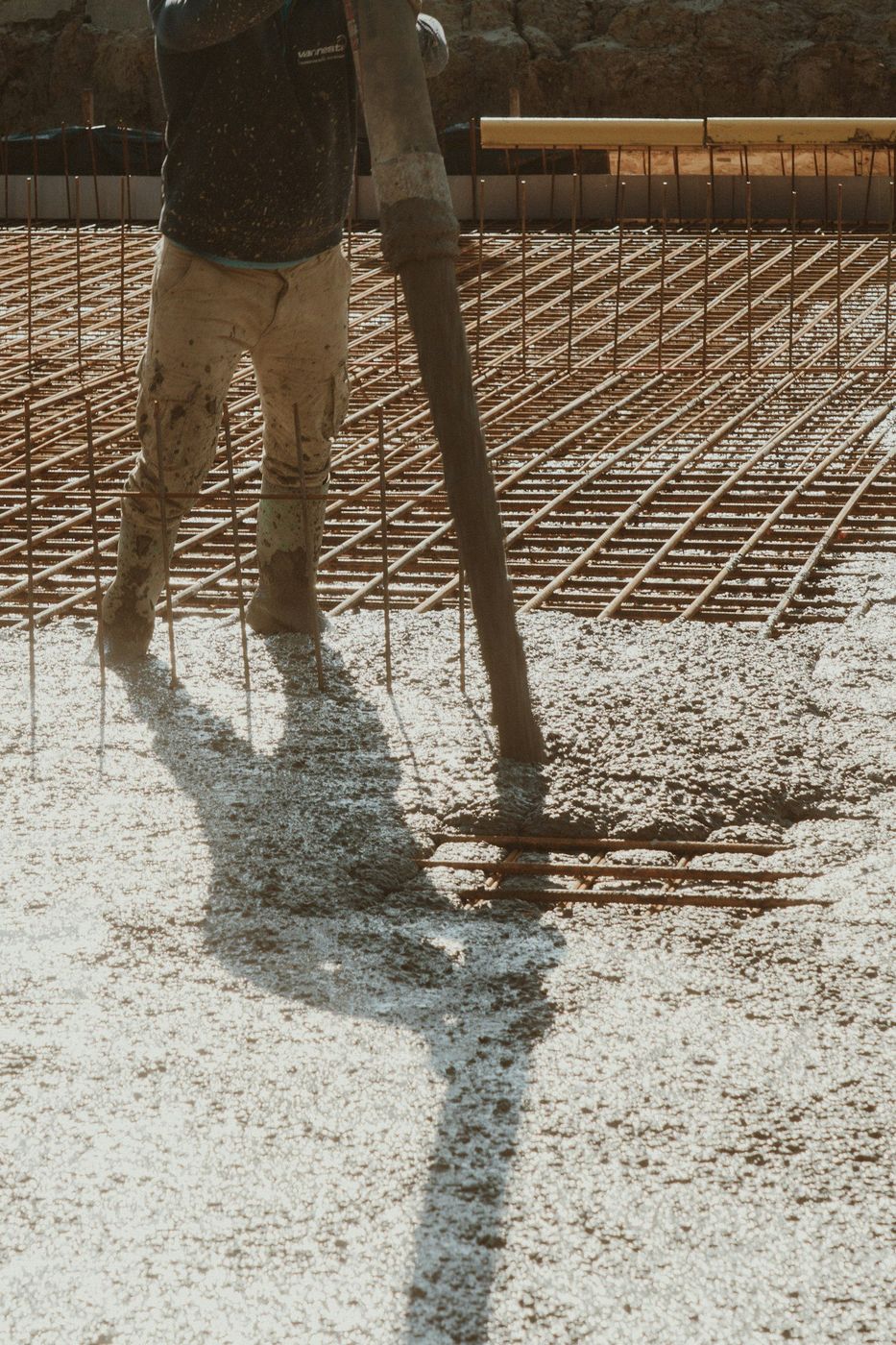
The clock starts when the chute swings, and every tool after that has a window it belongs in.
Sidewalk work looks simple from a car window. A crew, some forms, a truck. What you can't see is that once concrete leaves the chute, everything the finishers do is governed by a clock nobody controls, and each tool has a window measured in minutes. Come in too early and you work water into the surface. Come in too late and the tool won't touch it. Get that sequence right and the panel is still tight and sound after fifteen Thornton winters.
We replace public walk in front of houses all over town, on the older frontages near Eastlake and along the newer runs through Quail Valley. Right-of-way concrete has an audience your patio never will: every neighbor, every stroller, every mail carrier, and usually an inspector. So we build it to be looked at.
We saw the joints on either side of the failed panels before anything gets broken out. A saw leaves a straight vertical face to pour against. A breaker leaves a ragged, feathered edge that weakens the panel you're keeping and makes the new seam obvious from thirty feet. One extra step, and it's the difference between a repair that disappears and one that announces itself.
Then the old concrete comes out and the excavation goes past the bottom of the slab. That's where surprises live. A root the size of your forearm. Black, spongy soil where organics got buried instead of removed. Sometimes nothing at all, in which case we compact, add base, and move on happy. If what we find changes the plan, you hear about it before we spend your money.
| Tool | What it's doing | When it has to happen |
|---|---|---|
| Screed | Strikes the surface off to the grade the forms set | While the mix is fully plastic, right behind placement |
| Bull float | Knocks down high spots and closes the surface | Straight after screeding, before bleed water shows |
| Waiting | The hardest part, and the one crews skip | Until bleed water is gone. Working it wet is how surfaces fail |
| Edger | Rounds the perimeter so the lip won't chip | Once the slab holds a thumbprint but still takes a tool |
| Groover or saw | Puts the crack where we want it | Same day, with timing that shifts by temperature |
| Broom | Sets the texture that keeps people upright in January | Last pass, dragged across the width of the walk |
| Cure and cover | Holds moisture so the top gains strength with the rest | Right after the broom, sooner if wind picks up |
The number that gets a sidewalk rejected isn't thickness. It's cross slope, the side-to-side tilt across the width of the walk. Accessibility standards cap it, and the cap is tighter than people expect. Too flat and water sits on the panel through every freeze cycle. Too steep and a wheelchair drifts toward the street, which is the outcome the rule exists to prevent.
So we don't guess. Slope goes on the stakes before forming, gets checked on the forms, and gets checked again while the concrete is struck off. Running slope has its own limits and normally follows the street. Where a driveway crosses, that panel is thicker and jointed differently, because it carries vehicles and the walk beside it doesn't. None of this is complicated. It just has to be done with an instrument instead of an opinion.
We'll look at the run, tell you which panels genuinely need to come out, and quote it in writing. Free.
Street trees and sidewalks want the same six inches of ground, and the tree got there first. When a root has lifted a panel, we check whether it can be pruned cleanly at the edge of the excavation without hurting the tree. Often it can. Where it can't, we bridge over it with a thickened panel or shift the alignment slightly. Killing a shade tree to fix a trip hazard is a bad trade.
Winter is what actually destroys public walk. The plow throws slush and road brine onto the panels nearest the curb, that mix soaks in, and every night at five thousand three hundred feet it freezes again. Entrained air handles it and nothing else does. Keep magnesium chloride off entirely the first year and use sand.
April through October are the good months, and we favor spring and early fall so a fresh panel isn't gaining strength through a hard freeze. Cold-weather right-of-way work happens when a hazard can't wait, with heated water and blankets. Frozen ground, never.
Still unsure about something?
Call the crew at (303) 569-4046 and we will talk it through.
Get a free, no-obligation estimate from a crew that knows Colorado soil, Colorado weather, and how to finish concrete that lasts.
Accessibility
Adjust the site to fit how you read and browse. Your choices are saved on this device.