
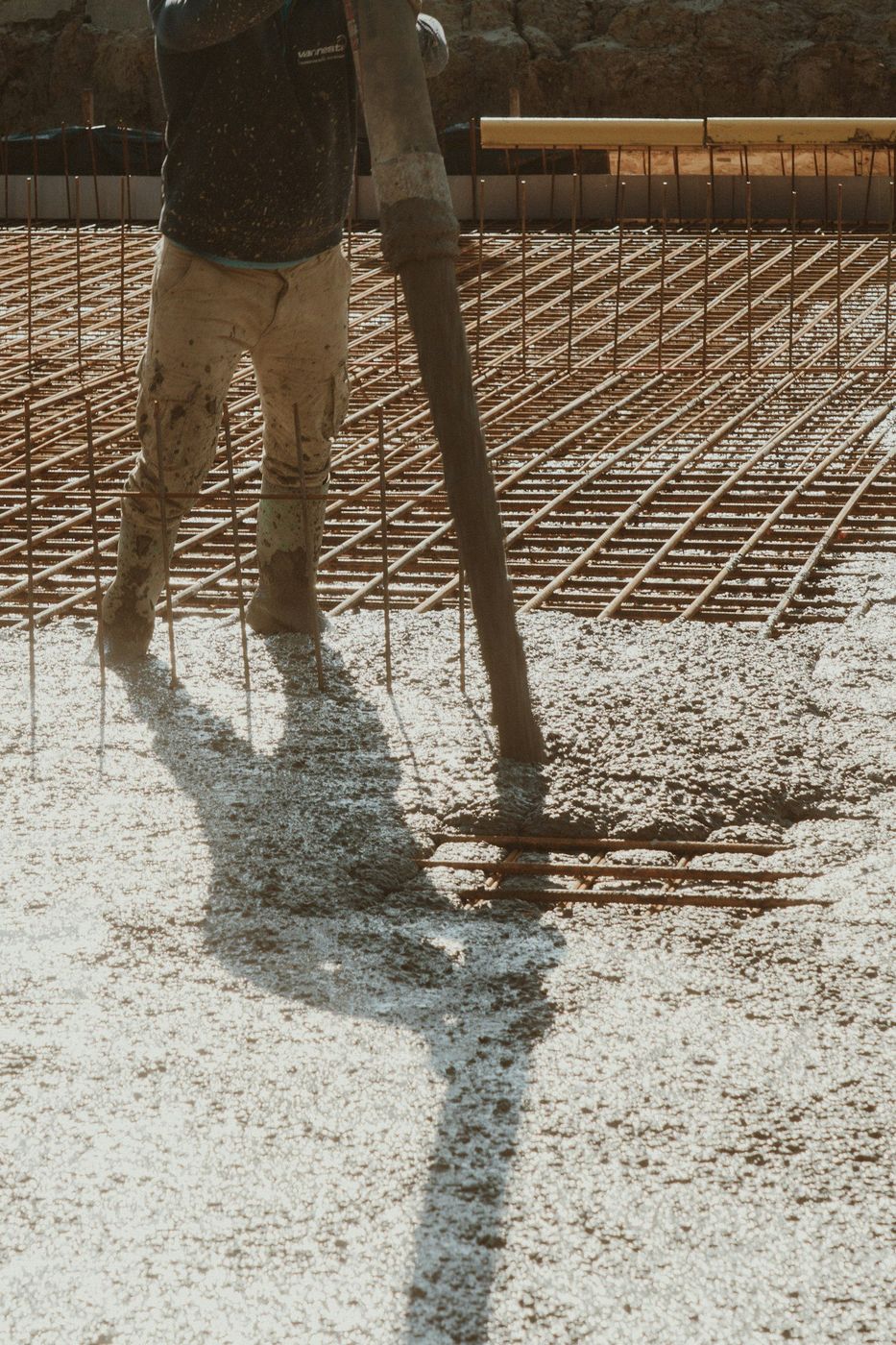
Where the money in a slab actually goes, and which parts of it you'd genuinely miss in ten years.
Concrete is the cheap ingredient in a slab. That surprises people. The trucks pull up, everybody watches the gray stuff come down the chute, and it feels like that's what the invoice is for. It isn't. Most of what you're paying for happened before the first truck showed up, and most of what determines whether the slab is still flat in fifteen years is buried where nobody will ever look at it again.
We get asked constantly which line items are worth keeping and which can go. Fair question, and we'd rather answer it straight than nod along while somebody deletes the thing that matters. So here's how a slab budget breaks down on Parker ground, what we push hard for, and what we'll actively talk you out of buying.
Run the numbers on almost any slab and the ready-mix itself lands well behind labor, excavation, base material, reinforcing, and forming. Which means the bids you're comparing aren't really competing on concrete. They're competing on how much dirt work and how much steel each contractor decided to include, and unless the scopes are written out you're comparing two different products with the same name.
The differences that matter: how deep the over-excavation goes and whether unsuitable material gets replaced, how many inches of compacted road base go under the slab and whether anyone tests the compaction, whether there's a vapor retarder and what thickness, and whether the reinforcing is rebar tied on chairs or mesh that ends up under a boot. Four contractors can bid the same square footage and one of them is quoting a slab that will move within three winters.
A slab-on-grade carrying walls needs extra depth where those walls land. Thickened edges, sometimes called turned-down edges, are just the slab getting deeper and picking up extra steel along a bearing line, and they're what keeps an addition or a shop from cracking along the wall it's supposed to hold up. They're also invisible on the finished floor, which is precisely why they're the first thing a low bid quietly leaves out.
Same story with the vapor retarder under conditioned space. Nobody sees it. Nobody thinks about it. Then someone glues down flooring three years later and the adhesive fails, because moisture has been rising through that slab the whole time. It's the best value item on any residential slab we pour, and we're not flexible about it under living space.
| Upgrade | What it actually buys | Do we push for it |
|---|---|---|
| Vapor retarder under conditioned space | Dry floor coverings, working adhesives, less humidity in the room | Hard yes. Cheapest insurance on the list. |
| #4 rebar on chairs instead of mesh | Cracks that stay tight instead of opening and offsetting | Hard yes on this soil. Mesh is fine on a light pad, not under a shop. |
| Thickened edge under bearing walls | No cracking along the line where the load comes down | Yes, wherever a wall lands on the slab. |
| Six inches instead of four | Capacity for a truck, a lift, a hoist, or a loaded trailer | Only where heavy wheels go. Paying for six inches under a storage room is waste. |
| Fiber in the mix | Slightly better control of early shrinkage cracking | Neutral. It's a supplement to steel, never a substitute for it. |
| Decorative finish on a shop floor | Looks good until the first oil drip and the first floor jack | Usually talk you out of it. Spend it on thickness. |
Send us what you've got. We'll show you where the scopes differ, line by line, and quote ours in writing for free.
In Stroh Ranch and The Pinery, the older housing stock, we're mostly replacing garage floors that have cracked and settled, and pouring shop or workshop slabs in detached buildings that were built on whatever base was handy at the time. Canterberry Crossing and Clarke Farms sit in the middle: additions, sunroom slabs, and basement floors that got poured thin and now telegraph every crack through the finished flooring. Stonegate, Idyllwilde, and Reata bring the newer work, which is usually a slab for something the builder didn't include.
Then there's the acreage, where the ask is nearly always a shop or barn floor. Those get the most careful conversation about thickness, because the owner usually knows exactly what will roll across it. Tell us the heaviest thing that floor will ever hold and we'll design to it.
The bid that comes in lowest is almost always the one that shorted the base. You can't see base thickness in a photo of a finished floor, so nobody gets caught until the slab starts telling on them a few winters later.What the crew sees on site
Still unsure about something?
Call the crew at (303) 569-4046 and we will talk it through.
Get a free, no-obligation estimate from a crew that knows Colorado soil, Colorado weather, and how to finish concrete that lasts.
Accessibility
Adjust the site to fit how you read and browse. Your choices are saved on this device.