
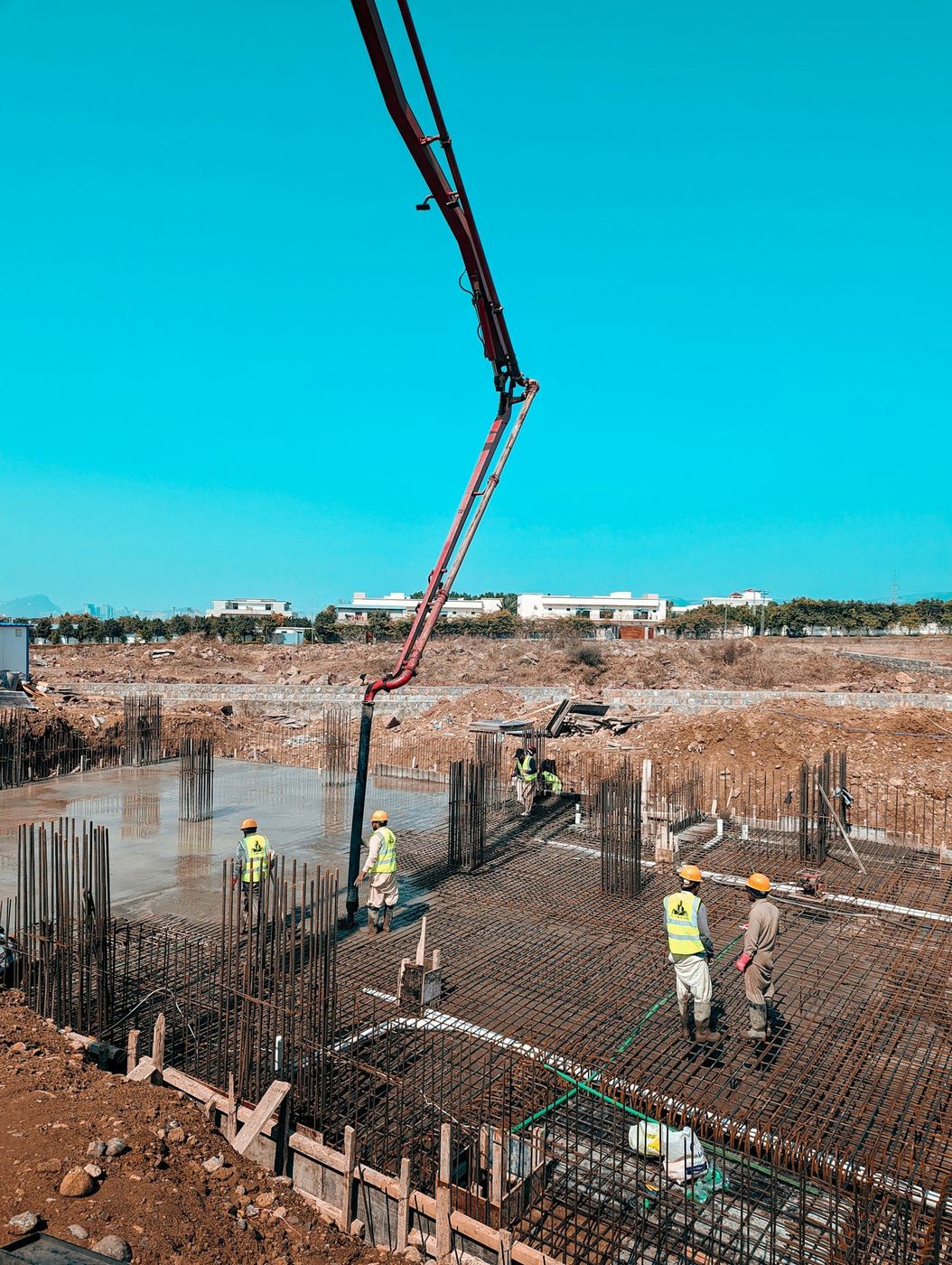
Cold fronts arrive on their own schedule. Your build doesn't have that luxury, so we plan the weather in.
Picture a Thursday in late October. Footing steel is tied and signed off, forty yards are ordered, and a forecast that read fifty-two on Monday now says thirty-four and falling with snow after midnight. On a house you push the pour a week. On a commercial building you can't, because the erector has a crane date, the shell has to close before the roofer loses his window, and every trade behind you is stacked up waiting.
That's the real gap between residential and commercial concrete here. Not the yardage. The cost of a lost day. We plan Parker commercial foundations with the calendar and the sky treated as design inputs, alongside soil bearing and column loads, so a cold front meets a procedure instead of a six-in-the-morning improvisation.
Here's how that October Thursday actually goes. We call the plant at five and confirm the mix carries heated water and whatever non-chloride accelerator the design allows. Blankets and poly are already staged, because they went on the truck Wednesday rather than getting chased at dawn. The crew clears frost off the forms and out of the trench with hot air instead of chipping at it, and the subgrade gets checked one more time, since frost in the bottom of a footing is an automatic stop.
Then we place, and we protect immediately. Blankets follow the finishers instead of waiting for quitting time, and we field-cure cylinders on site so we know what the concrete did overnight rather than what the air temperature suggested. The pour happens. The schedule holds. None of that is heroics. It's Monday's planning showing up on Thursday.
| Hold point | Who has to be there | What it costs when it slips |
|---|---|---|
| Subgrade and bearing | Geotechnical engineer of record | Everything downstream. Nobody covers dirt that hasn't been accepted. |
| Footing and wall steel | The jurisdiction's inspector, before concrete covers it | A pour date. Trucks get canceled and the plant reschedules you behind somebody else. |
| Sampling and cylinders | The independent testing lab | Your strength record, which turns into a closeout argument months later. |
| Anchor bolt layout | Us, with the erector's template in hand | Crane day. Bolts a half inch out turn one shift into a week of field fixes. |
| Vapor retarder and slab prep | Us, plus the inspector depending on scope | Floor finishes. Nobody sees this fail until a tenant's adhesive lets go. |
| Cylinder breaks before loading | The lab, on the schedule the specs set | Racking and equipment. Loading on assumption cracks a slab in week one. |
There's a lot of nonsense in circulation about winter pours. Calcium chloride is the big one. It accelerates nicely and it also goes after embedded steel, so we keep it away from a foundation full of anchor bolts and reinforcing. Non-chloride accelerators do the same job without the bill coming due in fifteen years. Heated mix water is standard from us once nights drop, blankets are standard too, and on tight schedules we'll tent and heat a footing trench outright.
The number that matters isn't the thermometer by the job trailer. It's the temperature of the concrete itself while it gains strength. Fresh concrete that freezes early never recovers: the surface scales, the paste stays weak, and warm weather in April repairs none of it. So we measure, we protect, and we pull the plug when the numbers say to.
Send the drawings and the geotech report. You'll get a written scope, a placement plan, and an honest read on the schedule.
Ask any erector what ruins a week and you'll hear the same answer: base plates that don't match what's sticking out of the concrete. Every hour spent on anchor bolt layout comes back doubled on crane day. We set bolts to templates from the steel fabricator, hold them with rigid assemblies rather than wire and optimism, and survey the pattern after placement while there's still time to do something about it.
Coordination runs the other direction too. Column locations drive footing sizes, footing sizes drive excavation, and excavation drives haul-off. Steel packages change late, and we'd rather hear it with the trench open than after the wall is up. On Parker sites near newer residential like Reata or Idyllwilde, haul routes and working hours get settled with the general contractor before the first truck rolls.
The winter jobs that go badly aren't the ones where it got cold. They're the ones where nobody decided who was responsible for the blankets. Cold is predictable. Confusion isn't.The crew lead's read on it
Still unsure about something?
Call the crew at (303) 569-4046 and we will talk it through.

Get a free, no-obligation estimate from a crew that knows Colorado soil, Colorado weather, and how to finish concrete that lasts.
Accessibility
Adjust the site to fit how you read and browse. Your choices are saved on this device.