
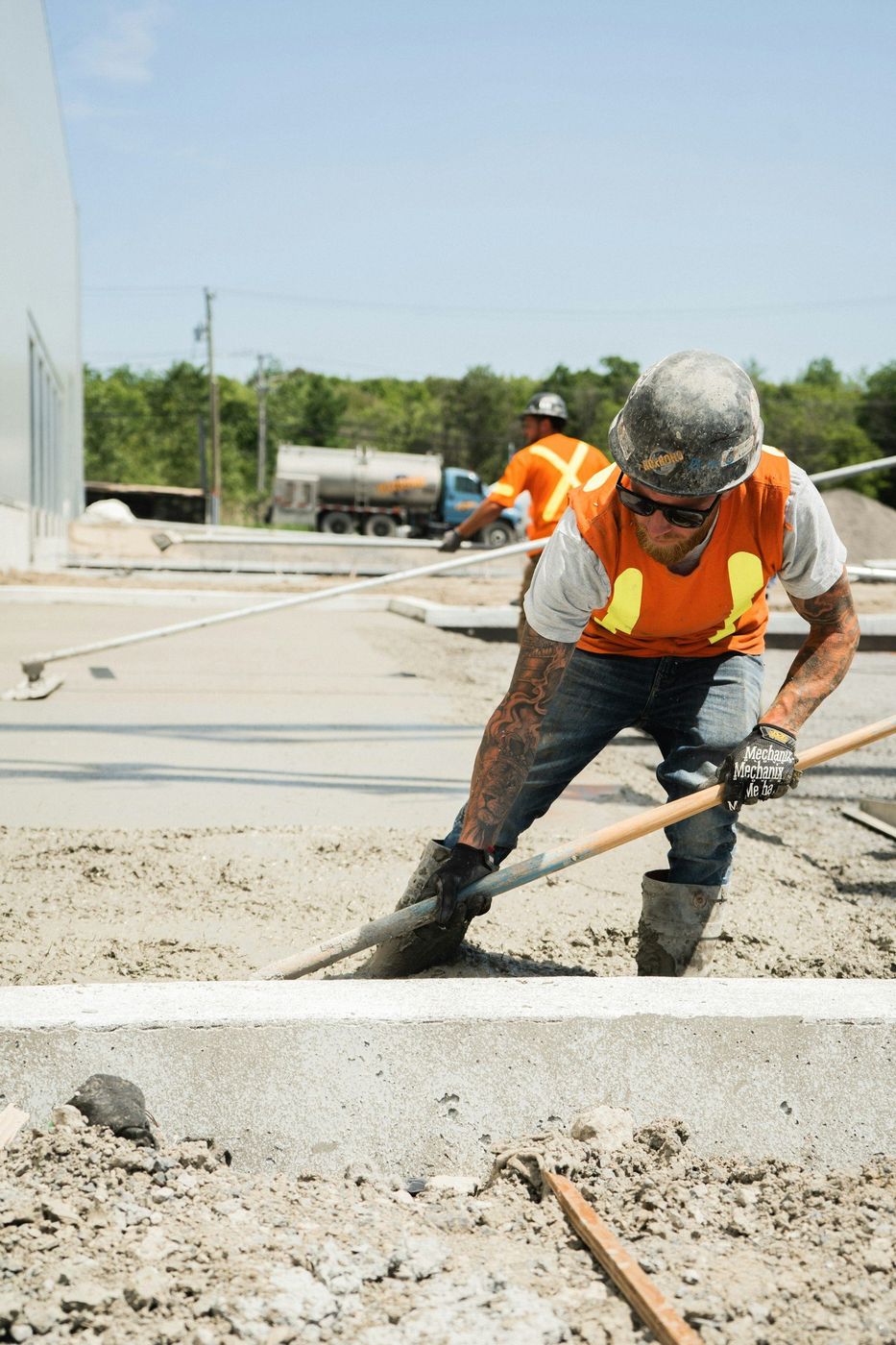
Everyone watches the panels go up. The floor they were cast on decided how they'd turn out.
Tilt-up gets sold on the picture: a crane, a panel swinging up, a wall that appeared in an afternoon. Fair enough, it's a good picture. But whether that afternoon goes well was decided weeks earlier, six inches below where anybody was looking.
Panels are cast face down on a temporary or permanent floor slab. Every dip, soft spot, and settled corner in that slab shows up in a finished wall you'll be looking at for decades. On a Larkspur site, whether that's a shop lot toward Sage Port or a bench cut in the hills above Perry Park, the pad is carved into a slope and half the ground under it is engineered fill placed last month. Getting that floor right is most of the job.
It has to be three things at once, and they pull in different directions. As a mold it needs to be flat and smooth, because whatever texture the slab has becomes the outside face of your building. As a work deck it carries crews, rebar, embeds, and forms for weeks. As a crane pad it has to survive an outrigger dropping serious load on a small footprint.
That last role is the one people forget. A slab poured perfectly for casting and never designed for wheel and outrigger loads can crack under the crane, which is a bad day if that slab is also your finished floor. We design for the heaviest thing that will ever sit on it, then decide whether the casting surface is temporary or permanent. Both are fine. Guessing is not.
| What's down there | Why the panels care | What goes wrong when it's short |
|---|---|---|
| Compaction on the fill half | Uniform support so the slab doesn't settle differentially under load | One panel casts on a slab that dropped, and its face carries the dip forever |
| Aggregate base depth | A consistent cushion that spreads crane and stacking loads | Cracks under outriggers, on the day you least want them |
| Moisture in the subgrade | Stable support and a slab that cures at a predictable rate | Curling at slab edges, which telegraphs into the panel edge |
| Drainage around and under the pad | Ground that stays put between the pour and the lift | Saturated subgrade in a wet spring, and a soft spot mid-lift |
| Flatness of the finished casting surface | It becomes the exterior face of every panel cast on it | Waves and trowel marks you'll see in raking afternoon light |
| Edge support at the pad perimeter | Panels cast near the edge need the same support as ones in the middle | The outermost panel is always the one that comes out wrong |
Send the site plan and a rough footprint. We'll tell you what the ground has to do first and whether the method fits the lot.
Every hillside pad has an uphill cut face, and that face will seep. Not always, not immediately, but after a big melt or a wet week it delivers water sideways into the base course under your slab. Base course is the most permeable thing on the site, so it accepts that water happily and holds it. Then the subgrade softens under one part of the pad and nowhere else.
The fix is unglamorous and cheap compared to the alternative: a subdrain along the cut, a swale that carries surface water around rather than across, and a base section that's continuous so nothing dams up inside it. We'd rather spend a day on that than watch a panel casting bed go soft in April.
Panels have to reach a specified strength before anyone picks them up, and that number comes from the engineer running the lift stresses, not from a calendar. Cold slows strength gain, so a November casting means blankets, heated enclosures where they fit, and cylinders broken on a schedule so the decision to lift is made off data. We've stood down a crane over a low break. Nobody enjoys it. Everybody prefers it to a cracked panel.
Summer at 6,720 feet brings the other problem: fast surface drying, thin dry air, and afternoon storms that arrive with about ten minutes of warning. We cast early, cure aggressively, and keep protection staged. The comfortable stretch for a tilt-up program up here runs late spring through early fall, and if crane day matters to your schedule, book it around that window rather than against it.
Still unsure about something?
Call the crew at (303) 569-4046 and we will talk it through.
Get a free, no-obligation estimate from a crew that knows Colorado soil, Colorado weather, and how to finish concrete that lasts.
Accessibility
Adjust the site to fit how you read and browse. Your choices are saved on this device.