
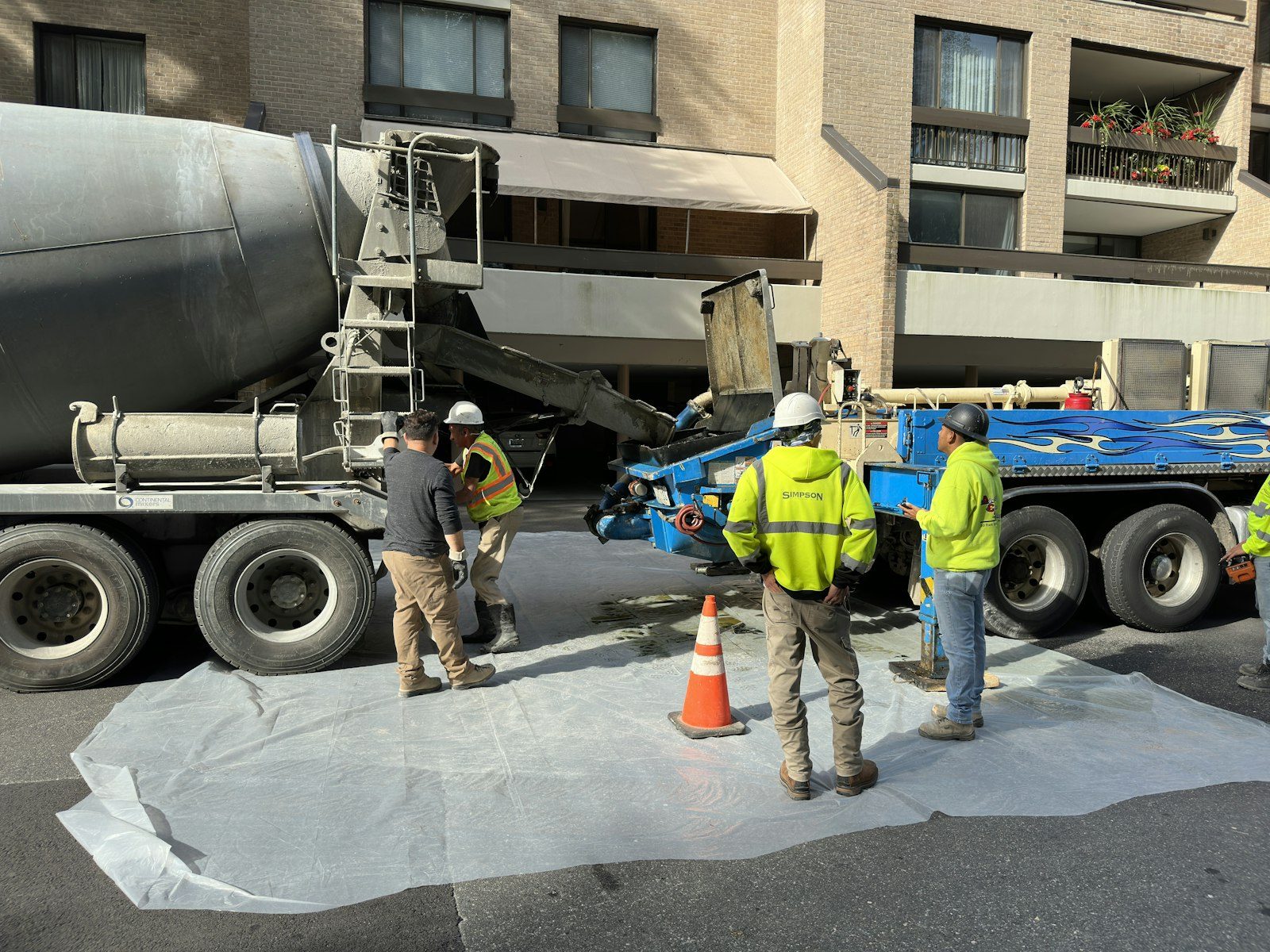
A walkthrough of the day itself, from the six a.m. stake check to the saw cuts after dark.
Pour day starts before sunrise. Our foreman walks the stakes with a flashlight, checks that nothing moved overnight, confirms the barricades are where we said they'd be, and calls the batch plant to lock the first truck. By the time your first customer pulls in, half a day of work is already behind us.
The lots we build around Larkspur are not shopping center acreage. They're small business frontage, church and event parking, association overflow, gravel yards that finally earned a hard surface, and the working aprons at contractor shops and equipment yards. Small lots on hilly, wooded ground at almost 6,700 feet, which means the drainage plan and the pour sequence matter more here than raw square footage ever will.
Concrete is the last thing to happen. Before it, we strip the old surface or the existing gravel, dig out anything soft, and rebuild the section in compacted lifts. Grades get shot to the inlets or the discharge point you've approved, and on sloped sites around Bear Dance and Perry Park that grade work is where the whole design lives. Water has to leave in a direction that doesn't undercut the edge of your new lot or dump onto a neighbor.
We set the joint layout on paper first. Panels that are close to square hold up better than long skinny ones, and joints placed to line up with columns, light bases, and inlet corners crack where we want them to instead of wherever they feel like it. Forms go in the day before. Steel gets tied on chairs, not dropped on grade and hooked up during placement, which is a shortcut that shows up seven winters later as a lot full of unreinforced panels.
Then we talk hours with you. A lot that serves a business gets phased so at least one entrance and a workable count of stalls stay live. A yard at a contractor shop might be easier to close for two days than to split into thirds. Both are fine. What matters is deciding before the trucks are rolling, not during.
| Time of day | What the crew is doing | What you'll notice |
|---|---|---|
| Before sunrise | Stake and form check, barricades verified, first truck ordered | Cones already set, entrance routing in place before staff arrive |
| Early morning | Concrete placed, screeded, and bull floated behind the trucks | Steady truck rotation, one in and one out, short backup times |
| Late morning | Edging, jointing pattern marked, bleed water coming to the surface | A pause that looks like nothing is happening. It's the most important hour. |
| Midday | Float and broom finish worked as the surface takes weight | Texture appears. Crew works backward off the slab in sequence. |
| Afternoon | Curing compound applied, forms checked, site swept and staged | Barricades stay up. Slab looks done and is nowhere near ready. |
| Evening or next morning | Control joints sawed to depth on the marked layout | Saw noise and slurry. Joints appear on the pattern we showed you. |
Tell us your busy hours and delivery windows. We'll draw the phase lines around them and send back a schedule.
Summer afternoons out here build fast. We start placement early for that reason, and if radar looks wrong at the wrong hour we'd rather move the pour than finish a surface in rain. Rain during finishing works extra water into the top of the slab and you pay for it later in dusting and flaking. Rain two hours after the finish is done, with plastic over the fresh work, is a non-event. The difference is timing, and it's why our foreman is checking the sky as often as the screed.
Heat runs the other direction. On a dry, windy June day the surface can crust while the concrete below is still plastic, so we mist, shade, and shorten the run between trucks. Cold pours happen too, with heated water, non-chloride accelerator, and blankets down before the crew leaves the site. What we will not do is place on frozen ground, no matter whose schedule it wrecks.
The best stretch for lot work here runs late spring through early fall, and September pours cure beautifully.
Still unsure about something?
Call the crew at (303) 569-4046 and we will talk it through.

Get a free, no-obligation estimate from a crew that knows Colorado soil, Colorado weather, and how to finish concrete that lasts.
Accessibility
Adjust the site to fit how you read and browse. Your choices are saved on this device.