
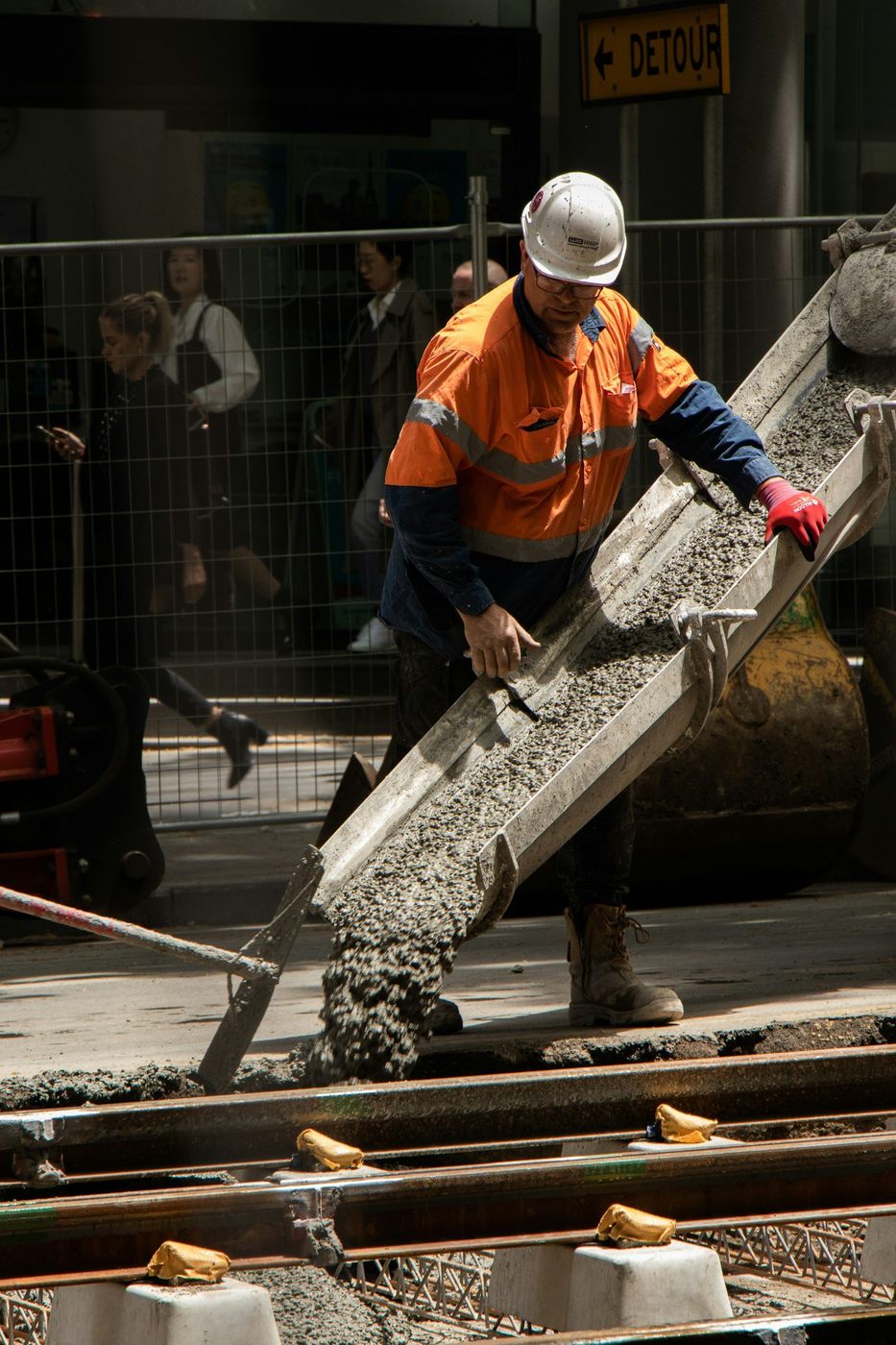
The approach slab is where the money goes, and it's the piece most bids underbuild.
Larkspur doesn't have a warehouse row, and we're not going to pretend it does. What it has is contractor shops, feed and supply operations, equipment yards, and small businesses that take semi deliveries at a door built for a pickup. The work we get called about is the approach: sixty or eighty feet of concrete a loaded tractor trailer backs across, plus the dock or the truck-level door it backs into. That slab is where the whole budget concentrates, and it's the exact piece that gets thinned out when a contractor is trying to win a bid.
So let's talk about what actually drives the number. Not dollars, since every site is different and quoting a figure sight unseen is how people get surprised. Drivers. The four or five conditions on your property that decide whether this is a straightforward pour or a project with an excavator in it for a week.
A tractor trailer backing to a door does something no parking stall ever sees. The drive axles push while the trailer tandems drag sideways across the surface, all of it concentrated in a strip maybe fifteen feet wide. Then the rig sits there loaded while a forklift runs in and out, bouncing the same square yards over and over.
That's why we build approach slabs at eight inches with number four bar on chairs at a tightened grid, thickened at the edges and at the transition into the dock. Six inches is a parking lot number. It'll hold a delivery van and it will not hold a fully loaded trailer's tandems making a hard turn in the wet. When we see a cracked apron on an existing property, it's almost always four or five inches over marginal base, and the crack pattern draws the trailer's path like a diagram.
Grade adds cost here that flatter towns don't deal with. Approaches want to be close to level so a trailer sits square to the door and the leveler plate lands right, but properties out toward Perry Park and Sage Port sit on rolling ground. Cutting a level pad into a slope means retaining somewhere, drainage uphill, and fill compacted properly rather than dumped.
| Cost driver | Why it moves the number | What you can do about it |
|---|---|---|
| Slab thickness and reinforcement | Trailer tandems and forklift traffic set the spec, not preference | Nothing. This is the one place we won't cut. It's the whole point. |
| Cut and fill to get a level pad | Sloped sites need excavation, retaining, and engineered fill | Pick the flattest workable door location if you have a choice |
| Subgrade condition | Soft or wet ground has to be removed and replaced, not compacted in place | Let us test-hole early so it's priced, not discovered mid-job |
| Dock pit and leveler coordination | Pit walls, drainage, and embeds have to match the equipment exactly | Have the leveler model selected before we form anything |
| Drainage and uphill runoff | Water arriving at a dock has nowhere to go and undermines the approach | Handle it in the same scope. Retrofitting it later costs more. |
| Site access for trucks and pumps | Long or steep hauls slow every load and can force a pump | Clear a staging area and a turnaround before we mobilize |
Send them over. We'll tell you which one specified the slab thickness and base your trucks actually need.
The stretch from May to early October is our comfortable window at this elevation, and the value of a September pour is the long cool cure that follows it. Concrete gains strength for weeks, and weeks of moderate weather beat a rushed August pour under a hot dry wind. Summer works fine when we start at first light and watch the afternoon build over the foothills. A cloudburst that lands while a finisher is still working the surface is the one weather event that costs you real service life.
Winter pours happen with heated water, non-chloride accelerator, and blankets, and they cost more because the protection is real work. Frozen subgrade is where we stop. An approach slab set on frost will settle unevenly, and an approach that settles puts the trailer bed at the wrong height relative to the dock, which is the expensive kind of wrong.
Here's the value framing we give owners. The concrete is a modest share of what you'll spend on this property over twenty years. Downtime is not. A dock rebuilt in year eight costs you the concrete twice plus the weeks your receiving is disrupted.
You can read a bad approach slab like tire tracks in snow. Two curved cracks where the tandems sweep, a low spot right where the trailer parks, and the concrete broken clean off at the dock face. Nobody drove on it wrong. It was just never built for what backs into it every Tuesday.The crew lead's read on it
Still unsure about something?
Call the crew at (303) 569-4046 and we will talk it through.

Get a free, no-obligation estimate from a crew that knows Colorado soil, Colorado weather, and how to finish concrete that lasts.
Accessibility
Adjust the site to fit how you read and browse. Your choices are saved on this device.