
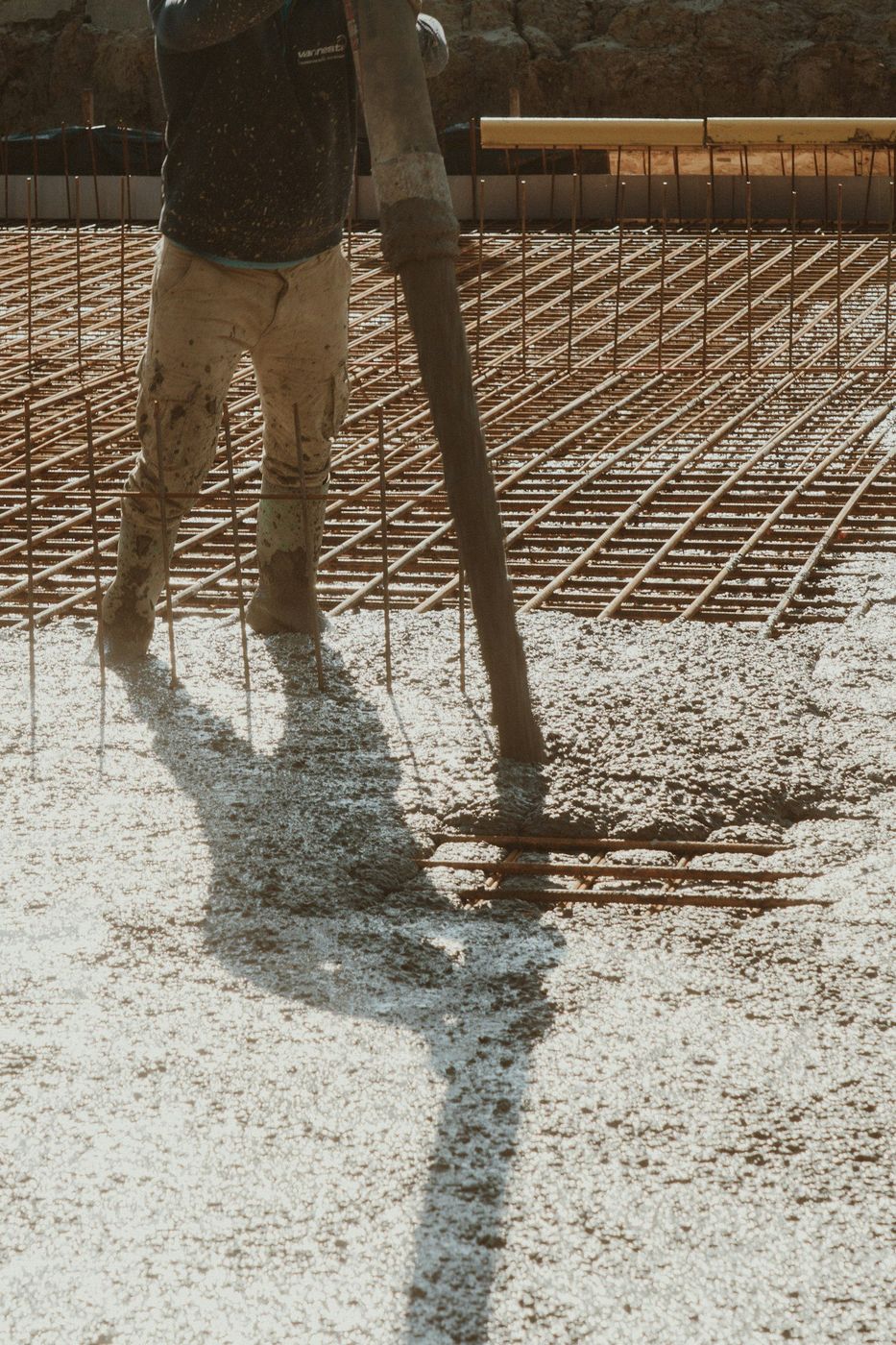
Two panels on the same walk, poured the same week, and only one of them failed. The difference is underneath.
Boards ask us a version of the same question every time. Why is a third of this walk falling apart when the rest of it is fine? Same contractor, same week, same mix. The answer is almost never the concrete. It's what each stretch is sitting on and where the water goes, and on the rolling, wooded ground around here those two things change dramatically over a couple hundred feet.
We do bulk concrete work for associations across Douglas County: shared drives, common walks, mail and amenity pads, stairs, curb runs, and the connector paths that residents use daily. Communities like Perry Park, Sage Port, and Bear Dance sit on ground with real slope and real tree cover, so a single association can own five different soil and drainage situations without anyone realizing it. Bidding all of it at one square foot number is how boards end up replacing the same section twice.
Walk a community with us and the pattern shows up fast. The bad sections sit at the bottom of a slope, along a shaded north wall, next to a downspout, near an irrigation head that's been running into the same square yard for a decade, or where a swale was regraded during landscaping and nobody thought about what it now aims at. The good sections are the ones where water never lingers.
Underneath, that difference is physical. Water working through a joint carries fine material out of the base a little at a time. The slab keeps its shape for years, then reaches the point where it's bridging a void instead of resting on ground, and a single loaded truck or a hard freeze finishes it. What the board sees is a panel that cracked suddenly. What actually happened took eight years.
Shade compounds it at this elevation. Under heavy tree cover the ground stays damp weeks longer and frost drives deeper, so a panel in the trees goes through a more punishing cycle than an identical panel forty feet away in full sun. That's why a replacement program organized purely by appearance misses the point. Some ugly panels have decades left. Some clean-looking ones are already floating.
We survey before we bid. Every panel gets marked keep, level, or remove, and we note the reason next to it, because a board reviewing a proposal deserves to know whether a panel is on the list for a trip hazard, a drainage problem, or a base that's gone. Then we pull test holes at the worst clusters, since ten minutes with a shovel settles what guessing never has.
What we find drives the recommendation. Sound base under a lipped panel means lifting is a real option and it's dramatically less disruptive than tear-out. Soft, saturated material under a cracked run means replacement plus base correction, and replacing that panel without touching the ground is throwing away the association's money on a schedule. Where the cause is upstream, a downspout, a broken irrigation line, a swale pointed the wrong way, we say so plainly even when the fix belongs to another trade.
Matching existing work matters to boards and we treat it seriously. New concrete never matches old concrete on day one, and anyone who tells you otherwise is selling. What we can control is joint alignment, panel size, finish direction, and edge detail, so the new work reads as intentional rather than patched. Color evens out over a couple of seasons of weathering.
| Condition found | Where it lands in the plan | Reasoning |
|---|---|---|
| Trip hazard on a route residents use daily | First, regardless of budget year | Liability. Lifting or grinding can address it fast while the plan catches up. |
| Water actively running toward a building | First phase, with the drainage work included | The concrete is a symptom. Fixing it alone guarantees a repeat. |
| Panels rocking under vehicle traffic | Next phase, with base correction priced in | Base is already gone. Delay adds adjacent panels to the scope. |
| Cracked but stable, flat, fully supported | Later phase or monitor | Cosmetic. Money spent here is money not spent on the moving panels. |
| Surface scaling with sound structure underneath | Overlay candidate, grouped with nearby work | Fixes the appearance for a fraction of replacement cost. |
| Sections in shade and damp all season | Watch list with an annual walk | These change faster than the sunny runs. Reassess before each budget. |
We'll walk the property with your board or manager and mark every panel keep, level, or remove. No charge for the survey.
Still unsure about something?
Call the crew at (303) 569-4046 and we will talk it through.
Get a free, no-obligation estimate from a crew that knows Colorado soil, Colorado weather, and how to finish concrete that lasts.
Accessibility
Adjust the site to fit how you read and browse. Your choices are saved on this device.