
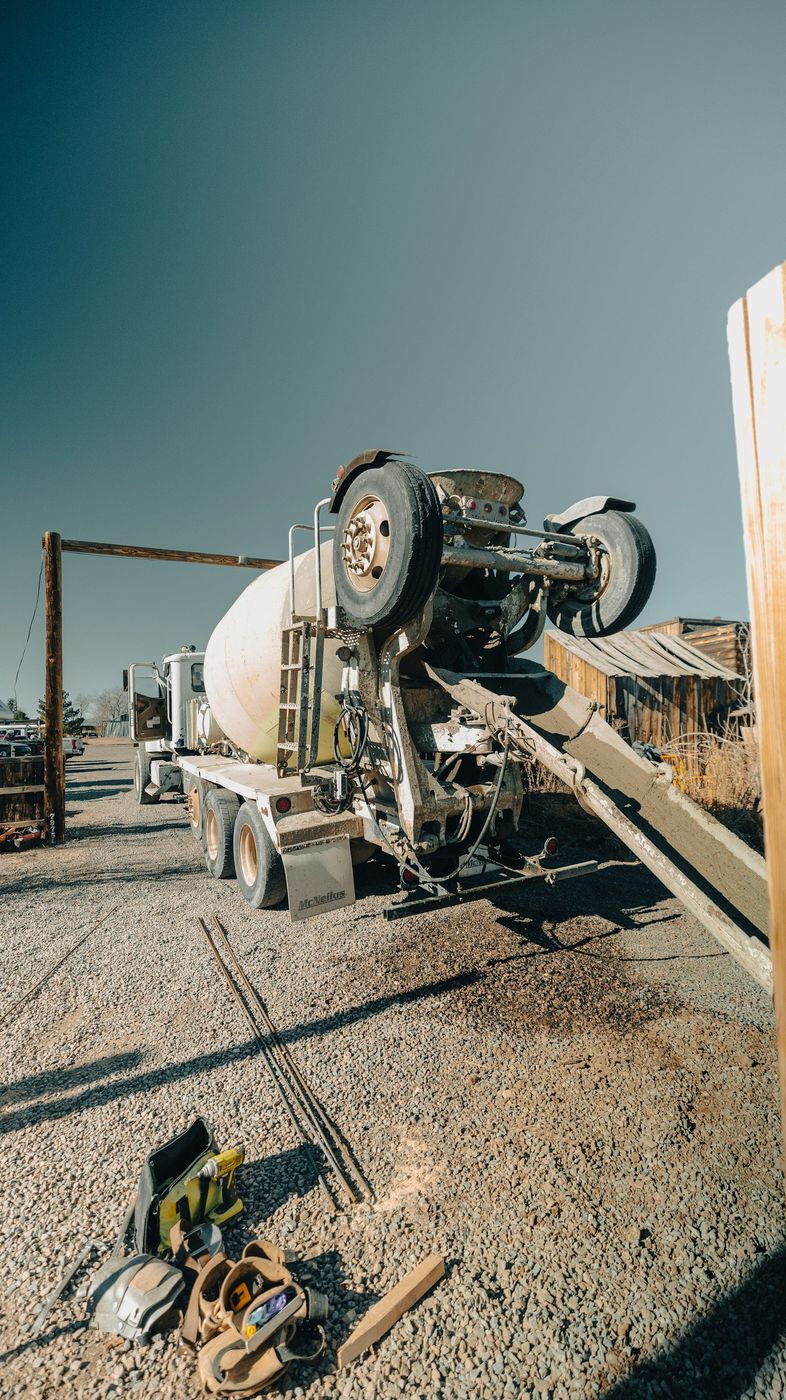
Concrete the grades and the turns, keep gravel on the flat runs. That's usually the right answer.
Almost nobody out here needs a concrete road end to end. What they need is concrete in the four or five places where gravel keeps failing. The steep pitch that washes out every spring. The turnaround where a loaded truck grinds a hole. The approach to the shop where mud tracks inside all winter. Spend the money there and leave the flat straight runs in compacted road base, and you get a road that works for a fraction of what a full hard surface would run.
That's the conversation we have with most ranch owners, contractor shops, equipment yards, and boards managing shared drives around Larkspur. Long approaches, real grade, trees close to the edge, and a mud season that shows up whether or not it's convenient. The question is never concrete or nothing. It's which segments earn it.
| Surface | Where it earns its keep | What you give up |
|---|---|---|
| Compacted road base | Long flat runs, light traffic, budgets that need to stretch | Annual grading, washboard, dust, and a mud season every spring |
| Recycled asphalt millings | Straight stretches where you want less dust than raw gravel | Softens in summer heat, still rutted by turning loaded axles |
| Asphalt | Moderate grades with steady traffic and a smooth ride | Deforms where trucks turn or park, and hates the melt-freeze cycle here |
| Concrete on the grades only | Any pitch that washes, plus the crown of a steep approach | Higher cost per foot. It's also the only surface that stops the washing. |
| Concrete at turns and pinch points | Turnarounds, shop approaches, gate areas, scale or wash pads | Small pours with mobilization cost. Best value on the whole road. |
| Full concrete road | Continuous heavy equipment traffic or a route you cannot afford to close | The biggest number by far. Rarely the right call on a rural property. |
A pickup does almost nothing to a gravel road. A loaded feed truck, a lowboy with a dozer on it, a concrete truck, or a fuel delivery does plenty, and it does most of it in two places: where the wheels turn and where the grade changes. Turning loads shear the surface sideways, which gravel cannot resist at all. Grade changes concentrate braking and acceleration, which pushes material downhill a little at a time until the crown is gone and the road is a channel.
Add water and it accelerates. On the slopes around Perry Park and Bear Dance, a summer cloudburst can cut a gravel drive in one afternoon, and the melt cycle in March does the slower version of the same thing for six weeks. Once the crown is lost the road carries the water instead of shedding it, and after that no amount of grading holds for a season.
Concrete stops that where you put it. A properly built concrete segment on a steep pitch does not wash, does not rut, and gives your winter traction something consistent to work with. Just as important, it gives the gravel above and below it a fixed edge to grade against, so the annual maintenance on the rest of the road gets easier too.
Send us a photo of the washed pitch and rough length. We'll tell you what a concrete segment there would take.
Thickness follows the load. Six inches with number four bar on chairs handles pickups, trailers, and delivery trucks. Where a lowboy, a loaded water truck, or a tracked machine travels, we go eight and tighten the bar spacing, and we thicken the edges because that's where a heavy wheel finds the weak spot. Under all of it goes free-draining compacted base, deeper than most people expect, because a road segment carries the same wheel path thousands of times and gets no chance to recover.
Cross slope is deliberate. We crown or slope every segment so water leaves quickly, and we tie the concrete edge into the adjacent gravel with a compacted shoulder so vehicles that drift off the edge don't carve a drop-off. Where the segment meets an existing gravel run we build a short transition rather than a hard lip, since a lip gets hammered by every axle that crosses it and starts breaking down within a year.
Timing is straightforward. Late spring through early fall is when the ground cooperates at this elevation, and September pours cure with plenty of runway before the cold. Mud season is the worst possible time to work a rural road, so if your drive is impassable in April, that's the year to get on the summer schedule rather than trying to fix it while it's wet. Winter placement is possible with heated water, accelerator, and blankets, though frozen subgrade is a hard stop for us and always will be.
Still unsure about something?
Call the crew at (303) 569-4046 and we will talk it through.
Get a free, no-obligation estimate from a crew that knows Colorado soil, Colorado weather, and how to finish concrete that lasts.
Accessibility
Adjust the site to fit how you read and browse. Your choices are saved on this device.