
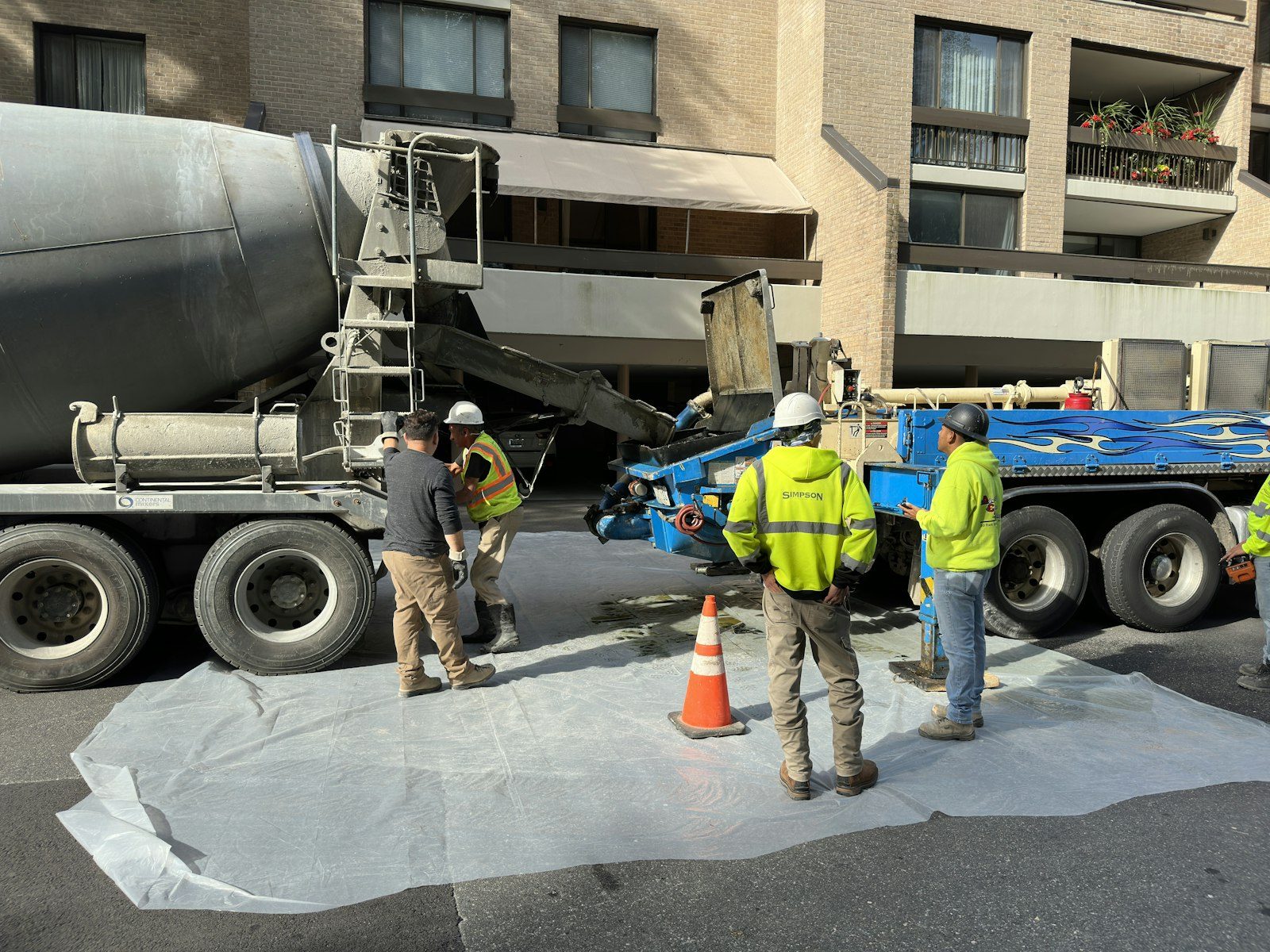
A dock apron gets hit by the same trailer, in the same spot, four times a day. We build for the repetition, not the average.
Nobody photographs a loading dock. It's the back of the building, the part that only matters when it stops working, and then it matters a lot, because freight doesn't reschedule itself. What breaks a dock apron isn't one heavy truck. It's the same trailer, backing into the same position, dropping its landing gear onto the same two square feet, for years.
We rebuild dock aprons, pits, and drive lanes for distribution, retail, and service buildings around Denver, from single-position docks behind older buildings near Berkeley and Park Hill to multi-door facilities on newer parcels past Central Park. The concrete question never changes. Where do the loads concentrate, and is anything under the slab at that spot?
Six in the morning, first tractor swings wide off the drive lane and cuts the corner. That tire scuffs the same radius daily, and it's usually the first place you see surface tearing. The trailer backs in, tandems dragging sideways through the correction, then the driver pulls the pin and the landing gear drops. Two steel pads, no cushion, carrying a loaded nose. Highest concentrated pressure anything on your property puts on concrete, landing within a couple feet of yesterday's spot.
Then a forklift runs the leveler lip forty times, shocking the slab edge at the pit on every pass. By evening the trailer pulls out, and if the fall is wrong the day's water sits in the pit until it freezes. Repeat five days a week. Nothing about that day is unusual, and it's the entire structural design brief.
| Zone | What it takes daily | How we build it |
|---|---|---|
| Drive lane approach | Straight-line truck traffic and turning shear at the entry radius | Six to eight inches, reinforced, with the radius widened wherever tractors are cutting the corner |
| Maneuvering apron | Backing, correcting, tandem drag across the surface | Eight inches minimum, jointed on a square panel plan, dowelled at every construction joint |
| Landing gear zone | Concentrated point loads from parked trailer noses | Thickened section with added steel, positioned from actual trailer geometry instead of a guess |
| Dock face and pit | Forklift shock at the leveler lip, bumper impact, standing water | Reinforced edge, embedded angle where specified, and drainage that pulls water out of the pit |
| Trailer storage area | Long-duration static loads from dropped trailers | Thickened pads under the landing gear line rather than a heavier slab everywhere |
We'll come look while your docks stay in service and tell you whether it's an edge repair or a settled approach slab.
Almost always at the building line. The apron next to the dock wall is the most heavily loaded, least supported concrete on the site, because backfill against the foundation went into a trench and rarely got compacted to the standard the open yard got. Add roof runoff and truck traffic and that strip settles. Once it drops, the leveler lip stops meeting the trailer bed cleanly, and your forklift drivers feel it long before anybody files a work order.
Second is the landing gear footprint, showing as punched divots or a spider of short cracks in an otherwise fine slab. Third is joint edge spalling at the pit from forklift wheels hammering an unprotected edge. All three are fixable in place if the base is sound, and all three come back within a year if it isn't. So we probe the subgrade before quoting anything at a dock.
You can find the bad spot without any tools. Stand at the dock door and watch one trailer back in. Wherever the driver has to correct twice, and wherever the nose settles, that's where the slab is going to tell on itself.Straight from the crew
The pouring season on the Front Range runs late April into October, and September is the best of it: warm ground, cool nights, and time to reach full strength before a hard freeze. That's the ideal. Freight schedules rarely care about ideal, so most dock work we do is sequenced instead of scheduled, one position at a time with the neighboring doors running.
Winter is possible: warm the mix water, run a non-chloride accelerator, keep blankets on longer than most crews bother with. We won't place over frozen backfill, since that ground drops the moment it thaws. If a dock goes down in January, a plate or a temporary repair usually keeps trailers moving until spring. One rule your yard crew needs: no ice melt on a new apron the first winter. Sand only.
Still unsure about something?
Call the crew at (303) 569-4046 and we will talk it through.
Get a free, no-obligation estimate from a crew that knows Colorado soil, Colorado weather, and how to finish concrete that lasts.
Accessibility
Adjust the site to fit how you read and browse. Your choices are saved on this device.