
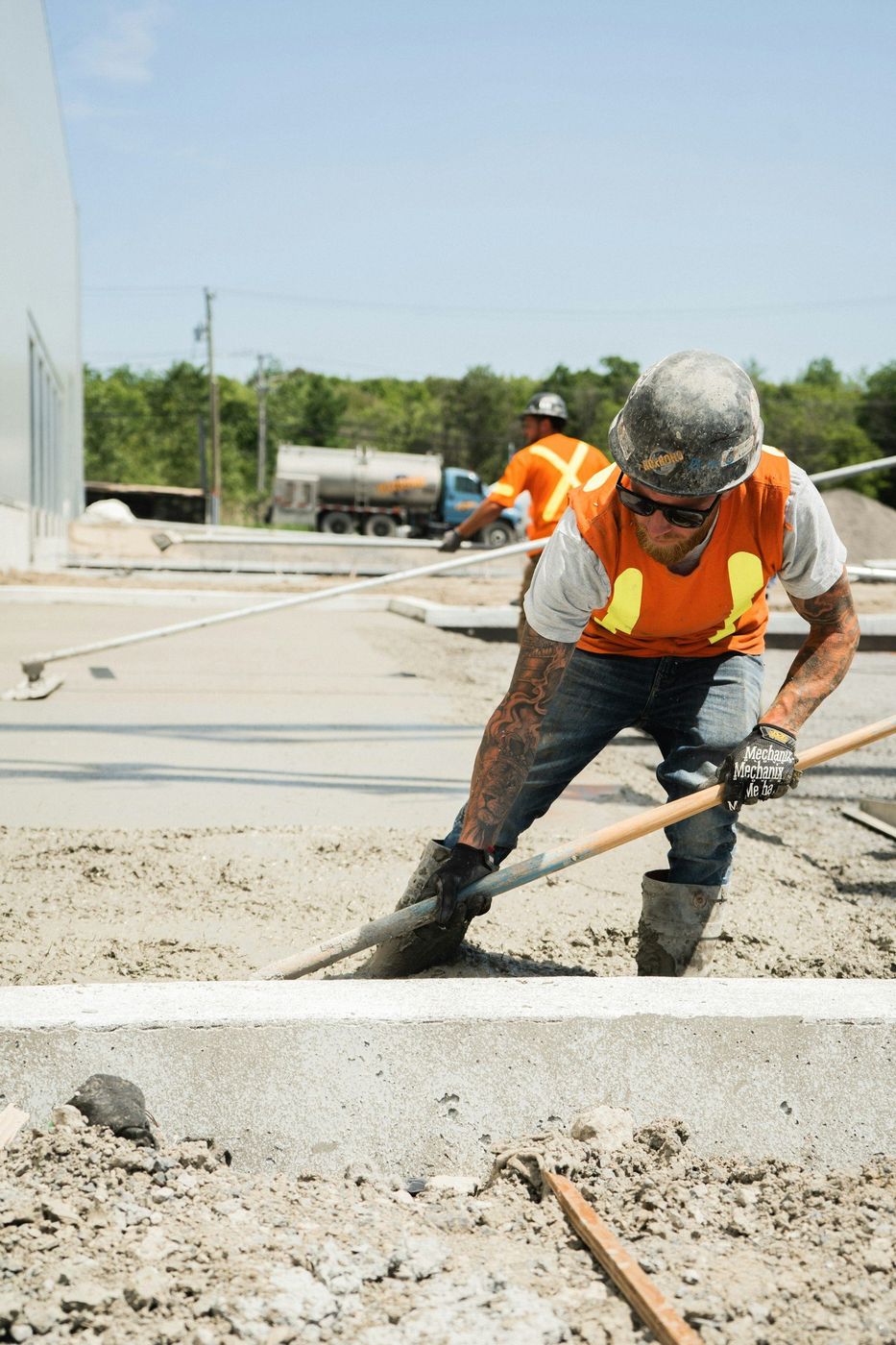
One day on site, one pour, and an enclosure pad that stops breaking under the front-load truck every eighteen months.
Six fifteen in the morning behind a Castle Rock retail building. The enclosure gates are already tied open, the containers were pulled the afternoon before, and our saw operator is cutting the perimeter line while there's still frost on the truck. First ready-mix load is scheduled for nine. By the time your tenants open their doors, the old pad is in a dump trailer and the base is going down.
That's the shape of most dumpster pad jobs: one focused day, sometimes two, on the worst-abused twenty feet of concrete on the entire property. We pour these all over town, from the small enclosures serving mixed-use near The Meadows to multi-container pads at larger centers. Below is what the day actually looks like, hour by hour.
A dumpster pad takes a beating nothing else on your property comes close to. A front-load truck rolls in, drops its forks, lifts several tons over the cab, and slams the container back down onto the same square yard. Every single time. Roll-off trucks are worse in a different way, dragging steel wheels and rails across the surface as the box is winched on and off.
Then add what leaks out of the containers. Organic waste, grease from a restaurant tenant, wash water, all of it soaking into concrete and sitting in joints. And in a Castle Rock winter that liquid freezes inside the surface overnight and expands. Between the impact loads and the chemistry, a pad built to parking lot spec has no chance. Most of the ones we replace were four inches over dirt.
| Setup | Pad footprint we plan | Slab and steel |
|---|---|---|
| Single front-load container, light retail | Container plus the truck approach in front of it | 8 inches, reinforced through the fork drop zone |
| Two or three containers with recycling | Full enclosure floor plus a shared approach apron | 8 inches continuous, no joint under the wheel path |
| Restaurant tenant with organics | Enclosure floor sloped to a contained low point | 8 inches, sealed joints, curb the wet side |
| Roll-off box, construction or bulk | Long pad the full length of the box plus tail swing | 8 to 10 inches with heavier bar and dowelled joints |
| Compactor unit | Pad sized to the unit plus the haul truck approach | Thickened footing under the unit, conduit sleeved before the pour |
Send a photo of the pad and tell us who hauls for you. We'll size the replacement to the truck that's actually beating it up.
The scheduling puzzle is always the same. Your containers get serviced on fixed days, tenants generate waste every day, and the pad needs a week before a truck touches it. So we plan backward. We pick a pour date right after a scheduled pull, arrange temporary container placement somewhere on the lot that doesn't block fire access, and notify your haulier of the window where the enclosure is unavailable.
Season matters less here than on big flatwork because a pad is small and we can protect it easily. Late spring through October is still the smooth path. In cold months we warm the mix, keep blankets over the slab through the nights, and hold the return date longer than usual. Frozen ground still stops us cold, and the seven days before that first truck never gets shortened.
Where a pad drains is not a small detail. Liquid coming out of a container shouldn't run across your lot and into a storm inlet, so we shape enclosure floors to hold the flow at a low point or route it the way your site's plan calls for. Restaurant enclosures get extra attention on this, because grease that reaches a storm drain becomes somebody's violation.
We also curb the sides where posts and gates go, so a container being winched around doesn't push the bollards, and we keep joints out of the paths where wheels and forks land. Small choices. They're the difference between a pad you forget about and one that lands on the maintenance list twice a year.
Still unsure about something?
Call the crew at (303) 569-4046 and we will talk it through.

Get a free, no-obligation estimate from a crew that knows Colorado soil, Colorado weather, and how to finish concrete that lasts.
Accessibility
Adjust the site to fit how you read and browse. Your choices are saved on this device.