
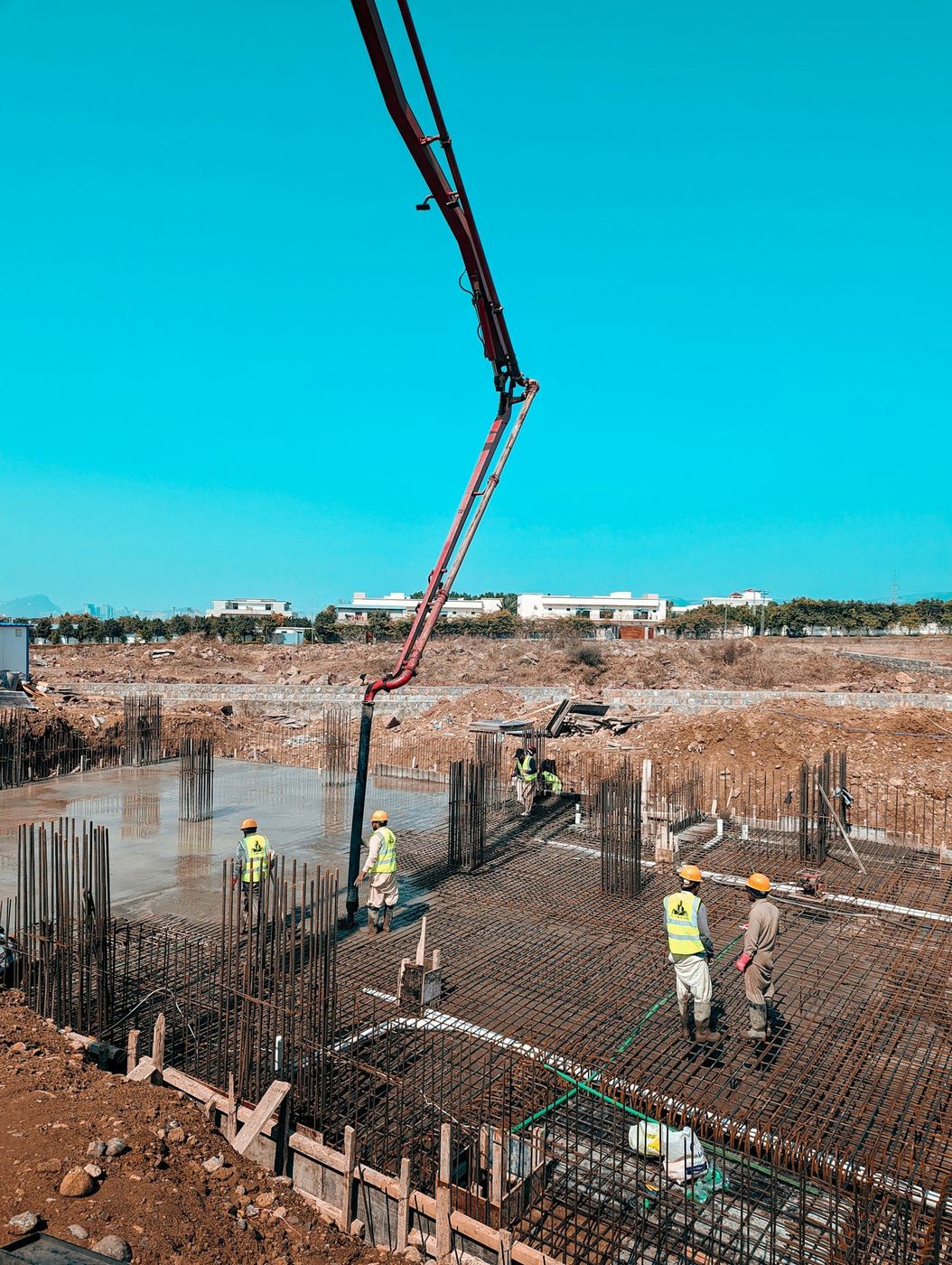
Service drives, walks, and pads poured to the load your property actually carries, not the load a spec sheet assumed.
Castle Rock's commercial property didn't arrive in one wave, and you can read that in the concrete. The older retail and light industrial buildings around Plum Creek were built when a delivery meant a panel van, so their service walks and aprons were poured accordingly. Then the town grew. Now a semi backs across a four-inch apron twice a week, and the corner is broken out to the base.
Newer property has the opposite problem. Buildings that went up with the rooftops in The Meadows and Cobblestone Ranch got flatwork priced into a shell budget, which usually means thin panels over whatever the grading contractor left behind. It looks correct for about four years. We pour the replacement, and we pour it once.
Two things beat up commercial slabs in this town, and neither of them is the concrete itself. First is the daily temperature swing. Up here a February afternoon can run forty degrees warmer than the same morning, so a slab that soaked up snowmelt during lunch is freezing solid by dinner. Do that eighty times a winter and any water sitting inside the top layer starts prying the surface apart.
Second is your snow contractor. Plow blades find every lipped joint, and the deicer they spread to keep your entry safe is chemically hard on young concrete. We plan around both. Air-entrained mix gives the freezing water somewhere to go, joints get cut clean and on time so nothing lips, and grades get set so meltwater leaves the site instead of pooling at your door.
Multi-tenant retail is mostly about the back of the building. Trash enclosure aprons, the walk along the rear doors, the transition where asphalt meets the concrete drive lane. That transition is where we get most of our calls, because asphalt settles first and the concrete edge is left standing proud until a hand truck catches it.
Office and medical buildings around Metzler Ranch and Sapphire Pointe are the opposite. Almost nothing heavy crosses them, but every square foot is public, so the failure that matters is a walk panel that dropped a half inch at a joint. Self-storage and contractor yards over toward Founders Village need thickness above everything else. And the newer mixed-use near Crystal Valley usually needs a fix for builder flatwork that was never compacted under.
We'll meet you on site, mark what's failing and what isn't, and hand you a written scope you can put in front of a board.
| Traffic across the slab | Thickness we pour | Reinforcement |
|---|---|---|
| Staff and customers on foot only | 4 inches | Wire mesh held mid-slab, or fiber in the mix on narrow walks |
| Cars and light vans, parking stalls | 5 inches | #4 bar on a two-foot grid, chaired off the base |
| Box trucks, shuttle vans, daily deliveries | 6 inches | #4 bar tightened through the drive lane, doweled at cold joints |
| Semi tractors, roll-off trucks, fire lane | 8 inches | Heavier bar and dowels, with a thickened edge where wheels track |
| Standing equipment or a compactor | 8 inches with a footing | Designed to the point load, not to a rule of thumb |
Nobody hires a flatwork crew hoping to lose a week of revenue. So we phase. We break the site into pours that each restore access by the time you open, we pour the drive lane in halves so trucks always have a route, and we set barricades and cone paths the night before so your staff isn't improvising at seven in the morning.
Night and weekend work is normal for us on occupied property. A Saturday pour on a retail pad gives concrete two quiet days before Monday foot traffic, and a Sunday night pour behind a restaurant clears in time for the Tuesday produce delivery. Late April through October is the easy season for this. Cold months still work: hot mix water, a non-chloride accelerator, blankets left over the slab overnight. Frozen subgrade is our one hard stop, whatever the calendar says.
The tell on an old retail apron is always the same corner. Truck swings wide, back tire clips the edge, and there's no thickened section under it. We pull it out and find three and a half inches sitting on dirt. New one gets eight inches and a stiff edge, and that corner stops being a line item.The crew lead's read on it
Still unsure about something?
Call the crew at (303) 569-4046 and we will talk it through.
Get a free, no-obligation estimate from a crew that knows Colorado soil, Colorado weather, and how to finish concrete that lasts.
Accessibility
Adjust the site to fit how you read and browse. Your choices are saved on this device.