
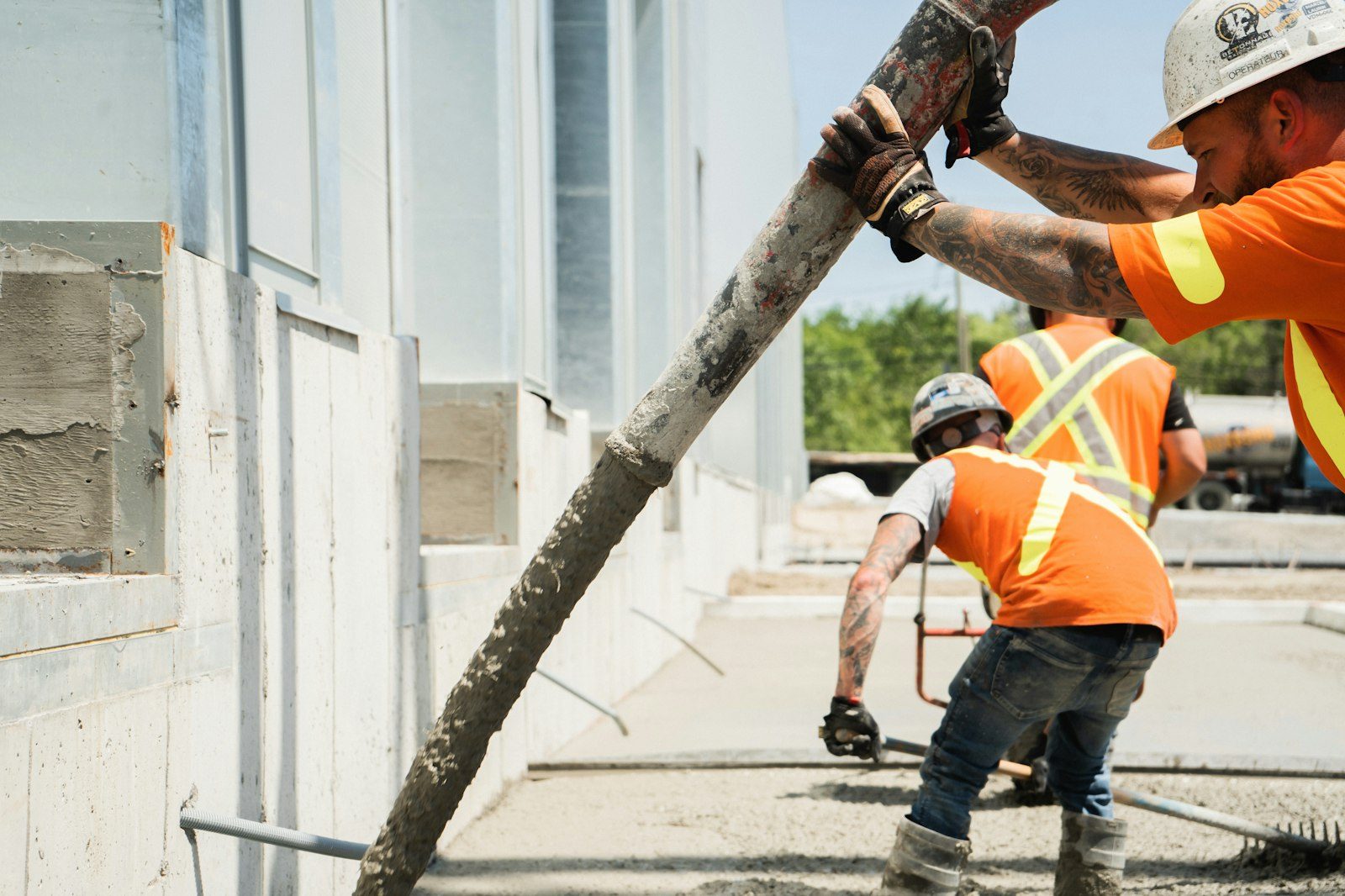
Curb is a small share of the site budget and the piece that decides where every gallon of water on your property ends up.
Curb is cheap per foot and expensive per mistake. It's a thin ribbon of concrete that costs a fraction of what the paving next to it costs, and yet it controls the grade, holds the asphalt edge together, keeps landscape material out of the drive aisle, and tells stormwater where to go. Get the flowline wrong by a half inch over a long run and you've built a pond nobody budgeted for.
We run curb across Castle Rock commercial and community property: retail frontage, apartment drives, medical office islands, and the miles of it that thread through the newer neighborhoods out toward Cobblestone Ranch and Sapphire Pointe. Property managers usually call us for one of two reasons. The curb is broken and the paving contractor won't touch it, or a site is being rebuilt and somebody finally wants the drainage fixed.
Owners assume the concrete is the cost. It isn't, not mostly. Material is a modest slice of a curb number. The rest is mobilization, layout, grade work, demo of whatever is there now, and the labor to shape radius sections and transitions by hand. That's why a hundred feet of straight curb in an open lot prices very differently per foot than the same hundred feet split into six short scattered patches around an occupied center.
Which leads to the single best piece of advice we give: batch the work. If your reserve plan says four areas of curb need attention in the next three years, doing all four in one mobilization costs meaningfully less per foot than doing one a year. Same crew, same setup, same traffic control, four times the production.
| Driver | Which direction it pushes cost | Why |
|---|---|---|
| Total linear footage in one mobilization | Down, sharply | Setup and traffic control get spread across more production |
| Scattered short patches | Up | Every patch is its own layout, its own demo, its own tie-in |
| Radius and transition work | Up | Curves, ramp returns, and inlet throats get shaped by hand |
| Condition of the base under the old curb | Up if it's failed | Curb set on soft material is curb you'll replace again |
| Access for the machine and trucks | Up when tight | Confined sites mean hand work and smaller equipment |
| Coordination with paving and striping | Down when planned | Sequencing once beats mobilizing three trades twice |
| Winter versus summer placement | Up in the cold | Heat, blankets, and shorter working windows all cost something |
Machine-extruded curb is fast, consistent, and the right answer for long straight runs and gentle sweeps in a parking field. Formed curb costs more per foot and earns it on tight radii, on gutter sections that have to hit an exact flowline, and anywhere the profile changes. Most of our commercial jobs use both on the same site, and we're glad to explain which is going where.
Either way the enemy is the same. Curb has more exposed surface per pound of concrete than any flatwork on your property, so it freezes harder, thaws faster, and takes deicer from three directions. Add a plow blade catching the face every storm and you understand why curb ages faster than the lot beside it. Air-entrained mix and a properly compacted base are what buy the years back.
We'll walk the site with you, mark the runs by priority, and give you footage and pricing you can defend line by line.
Half the curb we replace didn't fail from traffic. It failed because water was running the wrong way along it for years and nobody read the puddle. Shoot the grade first. If the flowline is flat, replacing the concrete just buys you a prettier version of the same problem.What our crew lead tells homeowners
Still unsure about something?
Call the crew at (303) 569-4046 and we will talk it through.

Get a free, no-obligation estimate from a crew that knows Colorado soil, Colorado weather, and how to finish concrete that lasts.
Accessibility
Adjust the site to fit how you read and browse. Your choices are saved on this device.