
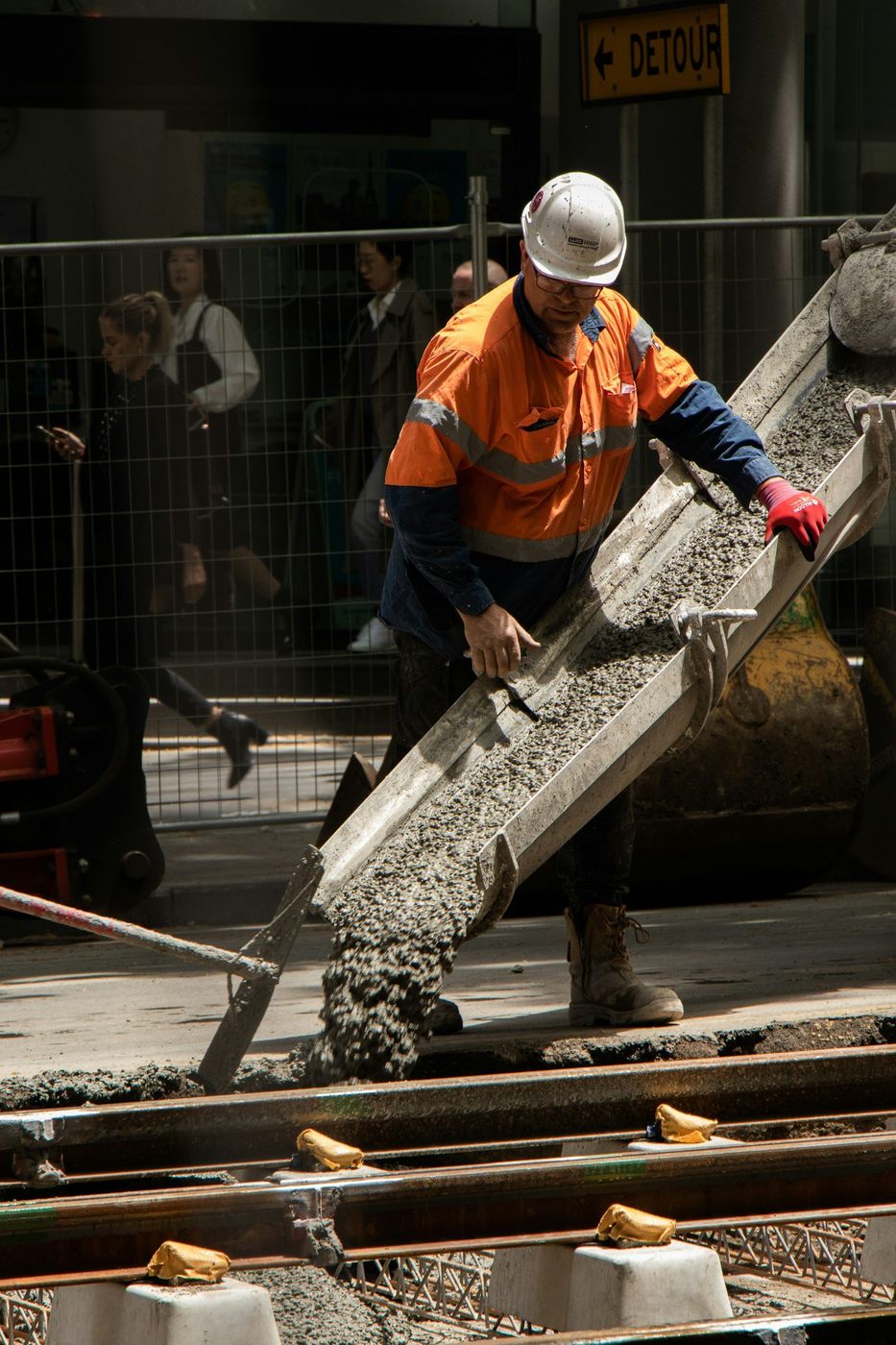
Roads that carry loaded trucks and tracked equipment onto a working site, built on a base sized for the weight.
After a wet week, an access road confesses. The ruts hold water in exactly the wheel paths, the shoulders are pushed out into soft ridges, and there's a fan of fines washed across the low end where the road has been quietly dissolving into the ditch. Nobody had to dig anything up to learn that. It's all sitting there in plain view from the gate.
We build and rebuild access roads for working property around Castle Rock: contractor yards and storage sites toward Plum Creek, utility and maintenance access on the edges of Castlewood Ranch and Red Hawk, and the long entrance drives on larger parcels out past Crystal Valley. The failures repeat, and they're almost always about the material under the surface rather than the surface itself.
Start with the edges. A road that's breaking down loses its outside eighteen inches first, because that's where the wheel load has the least support beside it and the most water running along it. You'll see the pavement edge gone ragged, chunks working loose, grass creeping into the gap. That's not a cosmetic problem. That's the road getting narrower every season while the trucks stay the same width.
Then look at the wheel paths. Two parallel depressions mean the material below is compressing, not the concrete wearing. And check the corner where trucks turn in from the street. If that corner is spider-cracked or shoved while the straight sections look fine, the road isn't failing; the turn is, because a loaded trailer puts more torque into that one spot than the entire straightaway combined.
| What you can see | What's happening below | The fix |
|---|---|---|
| Ragged, crumbling outside edge | No shoulder support and water running the edge line | Rebuild with a thickened edge and a graded shoulder that drains away |
| Two parallel ruts in the wheel paths | Base compressing under repeated axle loads | Deeper compacted base, thicker section, sometimes a stabilizing layer |
| Cracked, shoved concrete at the entry turn | Turning torque exceeding what the section was built for | Thicken and reinforce the radius, widen the turn to fit the trucks |
| Fines washed out at the low end | Water traveling down the road instead of off it | Crown the surface, add cross fall, cut a proper ditch line |
| A hump or dip over a buried line | Trench backfill settling under the road | Excavate the trench zone, recompact in lifts, then repave |
| Standing water days after a storm | Flat grade with nowhere for water to go | Regrade to positive fall before a single yard of concrete is ordered |
An access road is a structure, and the concrete is the smaller half of it. Under the slab we want proof-rolled subgrade, then aggregate base placed and compacted in lifts, deep enough to spread axle loads out before they ever reach native soil. Cheap out there and you get the ruts described above, no matter how good the concrete is.
Douglas County soils don't help. Ground here moves with moisture, and a road holds water along its whole length, so drainage is structural work rather than landscaping. We crown the surface, carry water off to a ditch or an inlet, and keep the shoulder built up so the edge has something to lean on. Then we reinforce: steel through the full width, dowels at construction joints, extra bar and thickness at the turns and anywhere equipment stops and pivots.
We'll walk the length with you, mark what needs a rebuild and what only needs drainage, and price it in stages you can schedule.
Owners want to talk about thickness. Fair enough, but I've seen a ten-inch slab rut because it sat on four inches of dirty base, and a properly built eight-inch road under the same trucks that hasn't moved in years. What's under it decides how long it lasts. The concrete just decides how it feels to drive.Straight from the crew
Still unsure about something?
Call the crew at (303) 569-4046 and we will talk it through.
Get a free, no-obligation estimate from a crew that knows Colorado soil, Colorado weather, and how to finish concrete that lasts.
Accessibility
Adjust the site to fit how you read and browse. Your choices are saved on this device.