
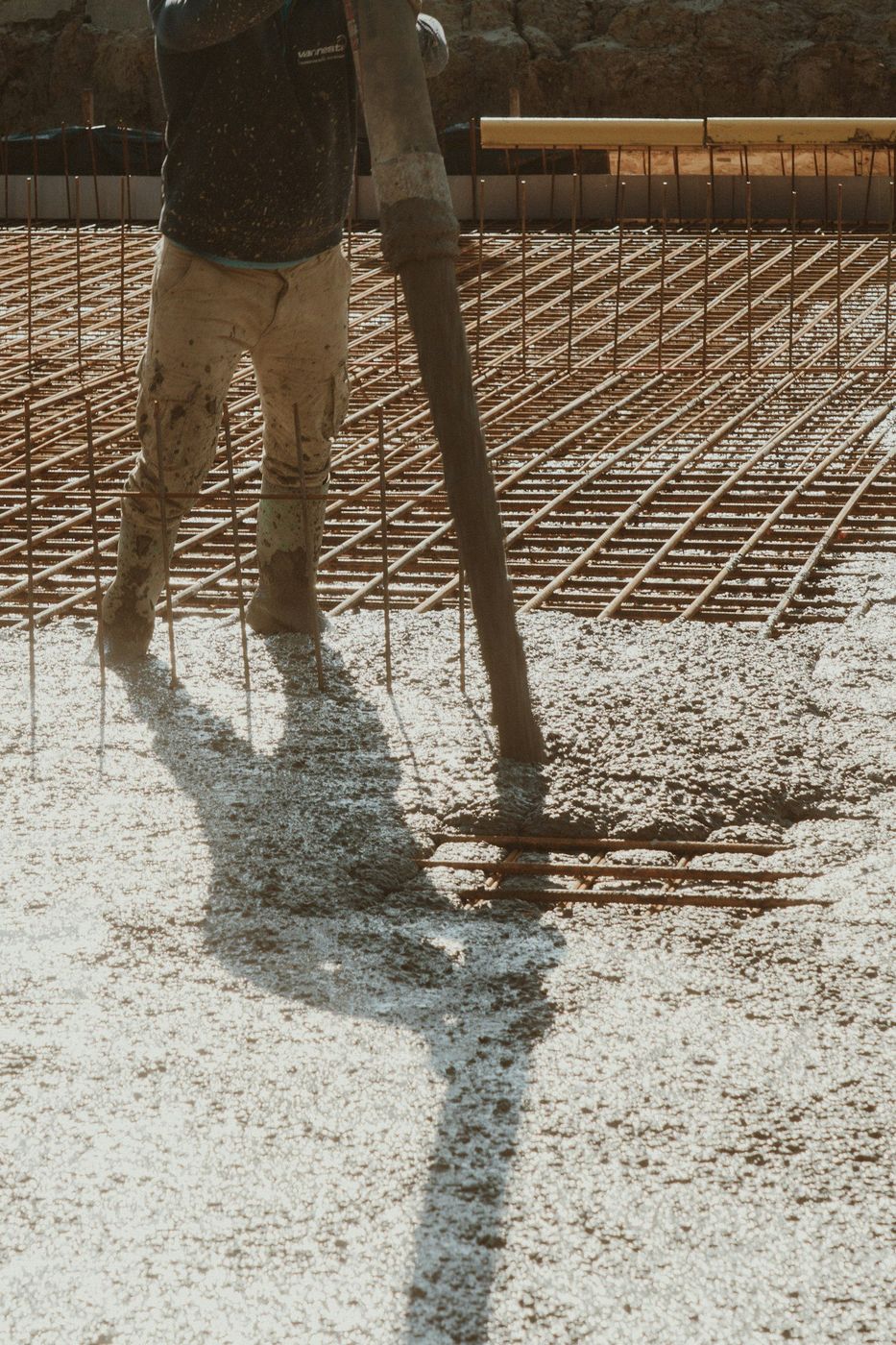
Equipment always ends up sitting on the worst dirt anybody left on the property.
Think about where equipment actually gets placed. Tight against the house in the side yard. Right over the trench a gas or electrical line came in through. Out on ground the grader shaped last season. Every one of those spots has the same thing in common: it's material somebody moved, and moved dirt keeps settling long after everyone forgets it was moved.
That's why a small pad tilts while the building beside it stays put. The concrete didn't fail. It was never the concrete. So when we price a pad in Arvada, we're mostly pricing what has to happen below it, and on newer west-side lots that conversation runs longer than the one about the slab.
A house sits on footings that reach past all the disturbed material. An equipment pad sits on whatever is right there, a few inches down. And what's right there, alongside a building, is almost always trench spoil: dirt that came out when the foundation was dug or a utility was run, then pushed back with a bucket and called done. That material has air in it. Over a couple of years the air leaves and anything on top drops with it.
Out at Candelas, Leyden Rock, and Whisper Creek this shows up early, because everything alongside those houses is backfill. Nearer Olde Town it's slower: ground stable for decades, but pads poured thin, poured on nothing, and set flush with grade so every rain runs across them. Same tilted condenser at the end. Different route to it.
| Where the pad ends up | Why that ground moves | How we build for it |
|---|---|---|
| Inside the backfill trench beside the foundation | That soil keeps compressing for a year or more after the house is finished | Move the pad clear of the trench, or bear through it to something solid |
| Right over a utility line trench | The ditch got backfilled loose because only a small pad was going on it | Recompact the line in lifts and run steel across it in the pad |
| On a graded fill pad from a new build | Fill placed in a hurry keeps consolidating, and never does it evenly | Confirm fill depth first, then thicken the pad or deepen the bearing |
| On top of an old pad or a paver base | Whatever failed under the old one is still sitting under the new one | Take it out and look. Stacking concrete just repeats the failure |
| On undisturbed ground away from the building | The most stable option available, if the equipment can live out there | Compacted base, honest thickness, and grade that sheds away from it |
A generator or a transformer isn't a distributed load. It's four small feet putting real weight into four small spots, and doing it while vibrating, which is a load that never stops working. So pads carrying machinery get thickness matched to the weight, steel tied on chairs rather than tossed in, and separation from anything they shouldn't transmit into. A pad tight against the house sends vibration into the framing, and you hear it in the room above.
Then the conduit. Anything passing up through a pad creates a weak line, and cracks are lazy: they run from one penetration to the next. We keep sleeves back from edges, add steel around them, and put control joints where we want the concrete to crack rather than through the stub-ups.
We coordinate with your electrician and installer, and we look at the dirt before we quote the concrete. (303) 569-4046.
Water is what turns loose ground into a tilted pad. Roof runoff with no gutter above it, irrigation hitting the same corner every morning, snow piled beside the unit for a week in February. All of it soaks the exact soil holding your equipment level. Setting the pad above grade, sloping it to drain, and moving the water source beats any amount of extra concrete.
Spring through fall is easy, and fall is best. Winter pads happen constantly, because equipment fails when it's cold and nobody waits until May for heat. That means heated mix water, non-chloride accelerator, blankets, and thawed ground underneath. It also means slower strength gain, so tell us the install date early. Keep deicers off new concrete the first winter; sand does the same job without eating the surface.
Still unsure about something?
Call the crew at (303) 569-4046 and we will talk it through.

Get a free, no-obligation estimate from a crew that knows Colorado soil, Colorado weather, and how to finish concrete that lasts.
Accessibility
Adjust the site to fit how you read and browse. Your choices are saved on this device.