
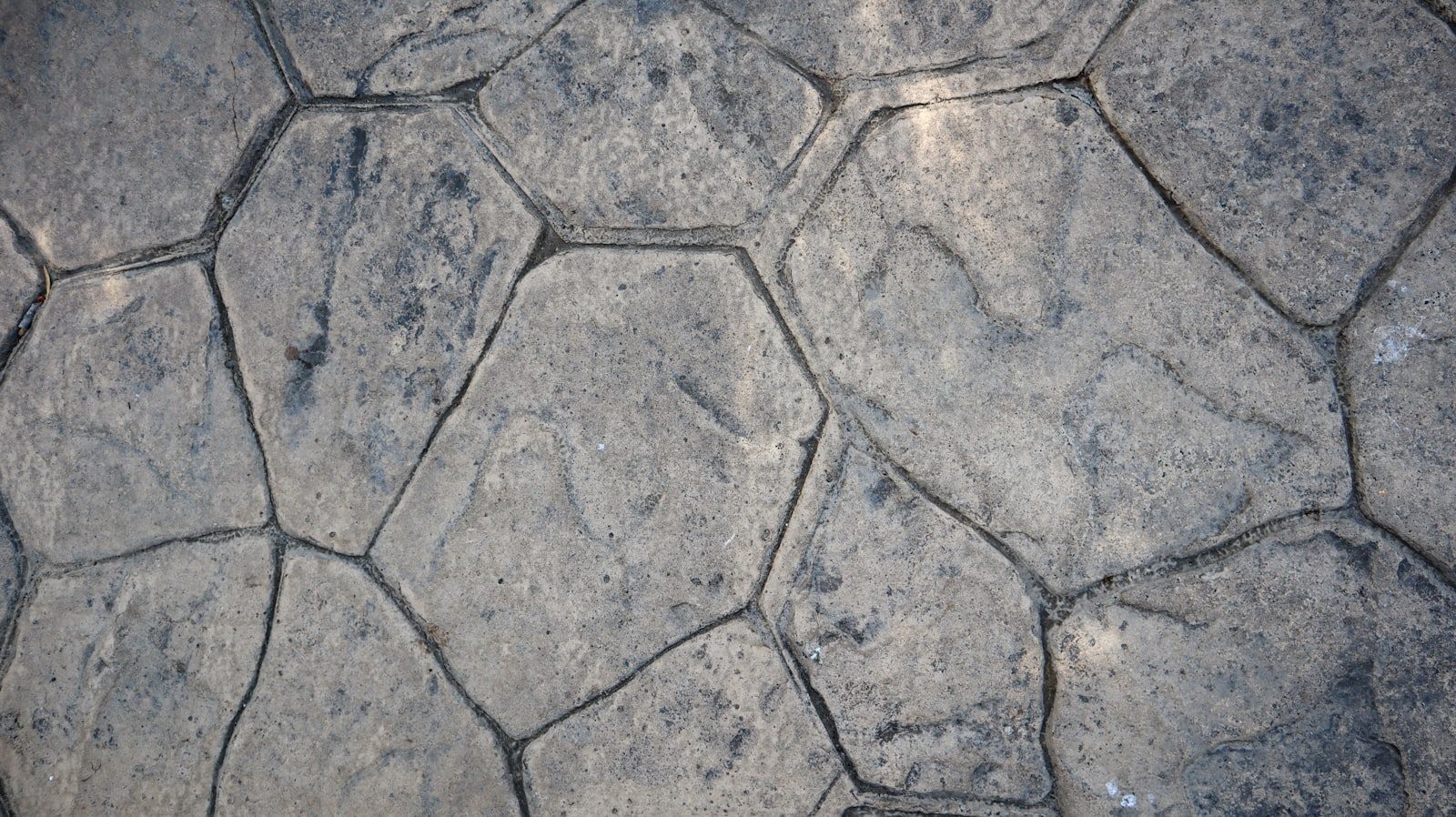
You can date a stamped patio from the sidewalk, and it's never the pattern that gives it away.
The pattern almost always survives. Slate, ashlar, wood plank, whatever got pressed into the slab years ago is still right there in the surface, sharp as the day the mats came off. What quits is everything sitting on top of it. Color goes flat in the high spots while the grout lines keep their darker tone, and from across the yard the whole thing reads bleached.
That's the call we take most often around here. Not cracks. Fade, haze, and peel. Most of those slabs are structurally sound and the repair lives in the top skin, which is the good news. The less good news is that whatever let the color go has usually been letting water into the joints for the same number of winters, and joints are where a stamped surface starts losing edges.
Stamped work fails in public. A driveway apron in Legacy Ridge, a front walk in Quail Creek, a courtyard slab in Bradburn: all of them sit where the street can see, and the symptoms are legible from twenty feet. Chalky pattern with dark joints means ultraviolet took the release color. A milky bloom under gloss means water got trapped when somebody sealed a damp slab. Coating lifting in the walking lane means the film went on too heavy.
None of that needs a tear-out. We've pulled stamped patios out around The Ranch, but only where the slab underneath had genuinely moved. If the panels are in plane and the pattern still holds relief, we're working on chemistry, not concrete. Strip, clean, recolor, reseal.
| What you see from the walk | What's happening in the surface | What it takes to put right |
|---|---|---|
| Pattern pale and dusty, grout lines still dark | Sun took the release color off every raised face. The recesses kept theirs. | Clean, put color back with a tinted sealer or an antiquing pass, then two thin coats |
| Cloudy white patches trapped under gloss | Moisture caught beneath a film, sealed too soon or pushed up from below | Strip the film, let the slab dry through, rebuild the coating in fall |
| Coating lifting in ribbons where people walk | Too heavy a pass, or a sealer rolled over one it doesn't like | Full strip. Patching a peel buys mismatched sheen and a second failure |
| Grout lines packed dark, green film on the shaded run | Water parking in the pattern instead of draining out of it | Deep clean, correct the flat spots, traction grit in the top coat |
| Chipped shoulders along one groove, crumbs collecting below | Freeze and thaw working an open joint, with ice melt helping | Rout it and fill with flexible sealant before the edge loss travels |
We'll tell you whether it's a color job or a concrete job before anybody schedules a visit. Call (303) 569-4046.
Stamped concrete carries its whole appearance in a layer thinner than a business card. Integral color runs through the mix, sure, but the depth and shading that make a slab read as stone come from release powder worked into the top fraction of an inch. Up here there's less atmosphere overhead to soften ultraviolet, and that thin layer takes the full dose every clear day of the year. Which is most of them.
Winter goes after the low points. Every grout line is a channel, and a channel holds snowmelt. Cross the freezing mark twice a day for weeks and that water expands right at the groove shoulders, which is where the crumbling always starts. Sealer isn't decoration on this product. It's the wear layer, and when it lapses you stop paying to reseal and start paying to recolor.
Late April through mid-October is when this work goes best, and if you let us pick, we're picking September. Warm slab, cool evening, dry air, a long runway before anything freezes hard. High summer means a first-light start, because a hot slab stiffens under the mats faster than a crew can press it and you end up with shallow pattern at the far end.
Winter stamping happens. Heated mix water, non-chloride accelerator, blankets over the finished slab, and a hard rule against pouring on frozen ground. The sealer is what waits. A January slab gets a curing product and sand for traction, nothing else, and we come back in spring when the concrete can actually accept a coating. Summer storms move a pour too, since rain during finishing works extra water into the paste and leaves a weak, dusty top layer.
Still unsure about something?
Call the crew at (303) 569-4046 and we will talk it through.

Get a free, no-obligation estimate from a crew that knows Colorado soil, Colorado weather, and how to finish concrete that lasts.
Accessibility
Adjust the site to fit how you read and browse. Your choices are saved on this device.