
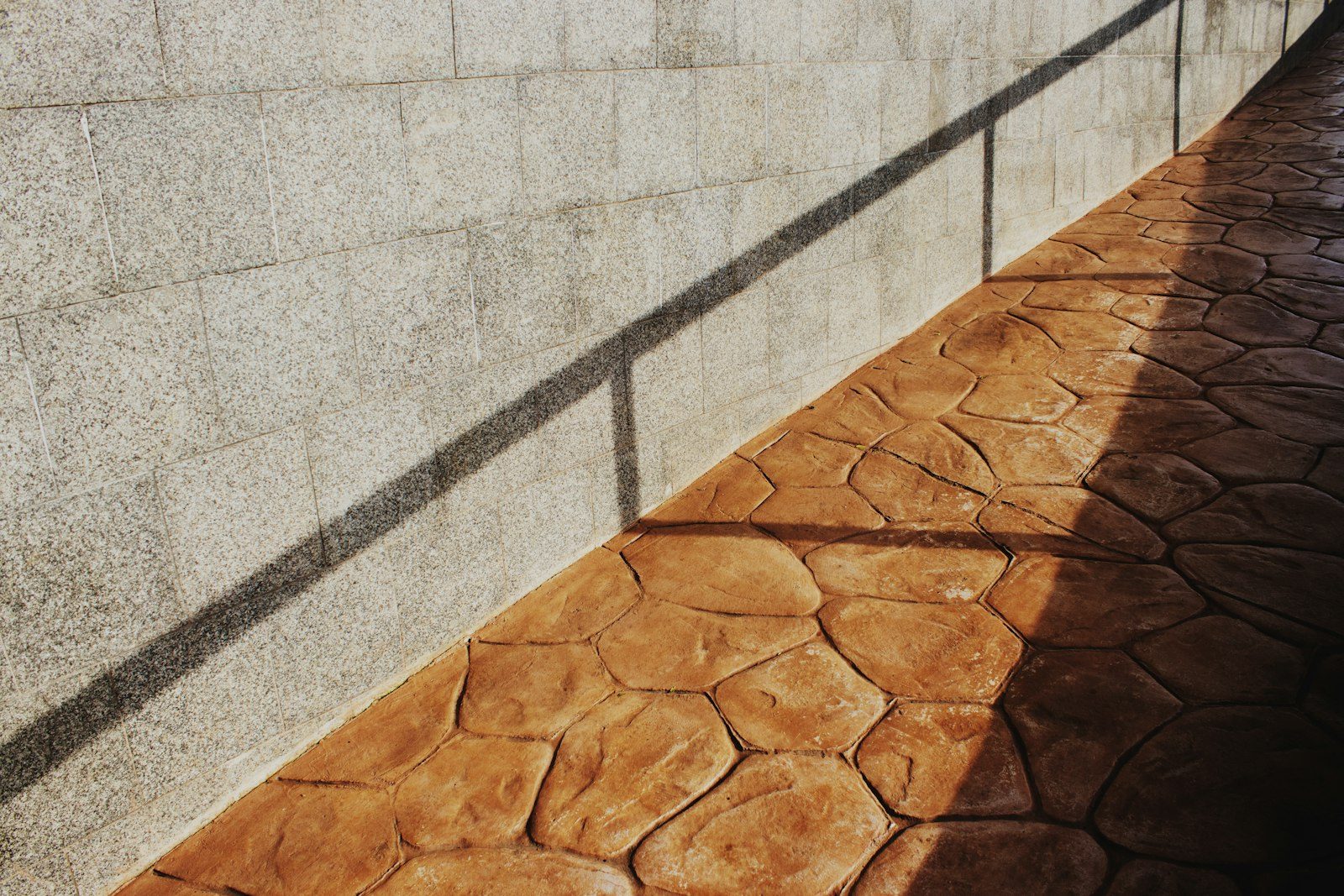
We lay the pattern out around the table, the grill, and the shovel route. Not around a drawing.
Most scoring gets designed on paper, which is why so much of it fights the people living with it. A grid looks great in a rendering. Then a chair leg drops into a groove every time somebody pushes back from dinner, grease from the smoker settles into a line nobody can scrub, and by February the shovel has chipped six corners on the path from the back door.
We do this the other way around. Before anybody snaps a chalk line, we want to know where you sit, where you cook, which door you use, and how you clear snow. The pattern gets built around those answers. It still looks like a design. It just happens to be one that survives a Tuesday.
A back patio in Quail Creek or off a walkout in The Ranch does about six jobs. It holds a table, it holds a grill, it's the route to the yard, it takes a summer storm every few weeks, and from November on somebody has to clear it. Every one of those has an opinion about where a groove belongs.
Grooves are small collectors. Not a flaw, just physics. A cut line gathers grit, needles, spilled charcoal, and meltwater, and holds all of it slightly longer than the flat surface next to it. In the right place that's invisible. In the wrong place you notice it weekly. So placement is a use question first and a looks question second, and the two usually agree once you're standing on the slab.
This gets confused constantly and the confusion does real damage. A working joint is structural. It reaches about a quarter of the way through, building a deliberate weak plane so the slab cracks there instead of picking its own route, and it gets sawed the same day the concrete goes down.
A decorative score is cosmetic and lives in the top fraction of an inch. Deep enough to throw a shadow, shallow enough to touch no steel and create no weak plane. Cut decoration at joint depth and you've invented cracks that were never coming. Cut a working joint at decorative depth and the slab ignores it and cracks somewhere else. We hold both numbers, and we never cut across a joint already doing its job. It gets folded into the pattern instead.
| How that part of the slab gets used | Why a groove there becomes a problem | What we do instead |
|---|---|---|
| Dining table and chairs | A chair leg catches the groove every time somebody scoots back | Keep the table zone one clean panel and put lines outside the chair sweep |
| Grill or smoker station | Grease finds the line and never fully comes back out of it | Leave the appliance footprint unscored, or set the pattern where a mat covers it |
| The path everybody genuinely walks | Grooves take the grit and the wear first, so the traffic lane looks dirty | Run lines along the path instead of across it |
| Hot tub or step approach | Wet feet and a groove is a stubbing hazard plus a place water stands | Nothing cut inside the approach. That one isn't negotiable |
| Gate or door swing arc | Debris packs the line and the sweep drags across it | Hold the pattern back and let the arc stay plain |
| The shovel route | A steel blade catches a cut corner and takes a bit more of it each winter | Shallow lines, softened edges, and a plastic blade from you |
Live with it for a day. Move the table onto it. Then tell us yes or move a line. Call (303) 569-4046.
On a new pour there are two windows. Green cutting with a soft blade happens within hours and leaves a slightly softened line with very little dust. Waiting a few days and dry cutting gives a crisper edge and far better control, which is what we want when line quality is the whole product.
Cutting an existing slab runs most of the year, since the limiting factor is water rather than cold. Wet cutting in freezing weather leaves slurry setting up inside the fresh groove, which is miserable to clean and looks it. Winter work goes dry with vacuum shrouds or waits for a warm stretch. Stain or sealer over the cuts waits for spring, when the slab is dry through and the nights hold.
Still unsure about something?
Call the crew at (303) 569-4046 and we will talk it through.

Get a free, no-obligation estimate from a crew that knows Colorado soil, Colorado weather, and how to finish concrete that lasts.
Accessibility
Adjust the site to fit how you read and browse. Your choices are saved on this device.