
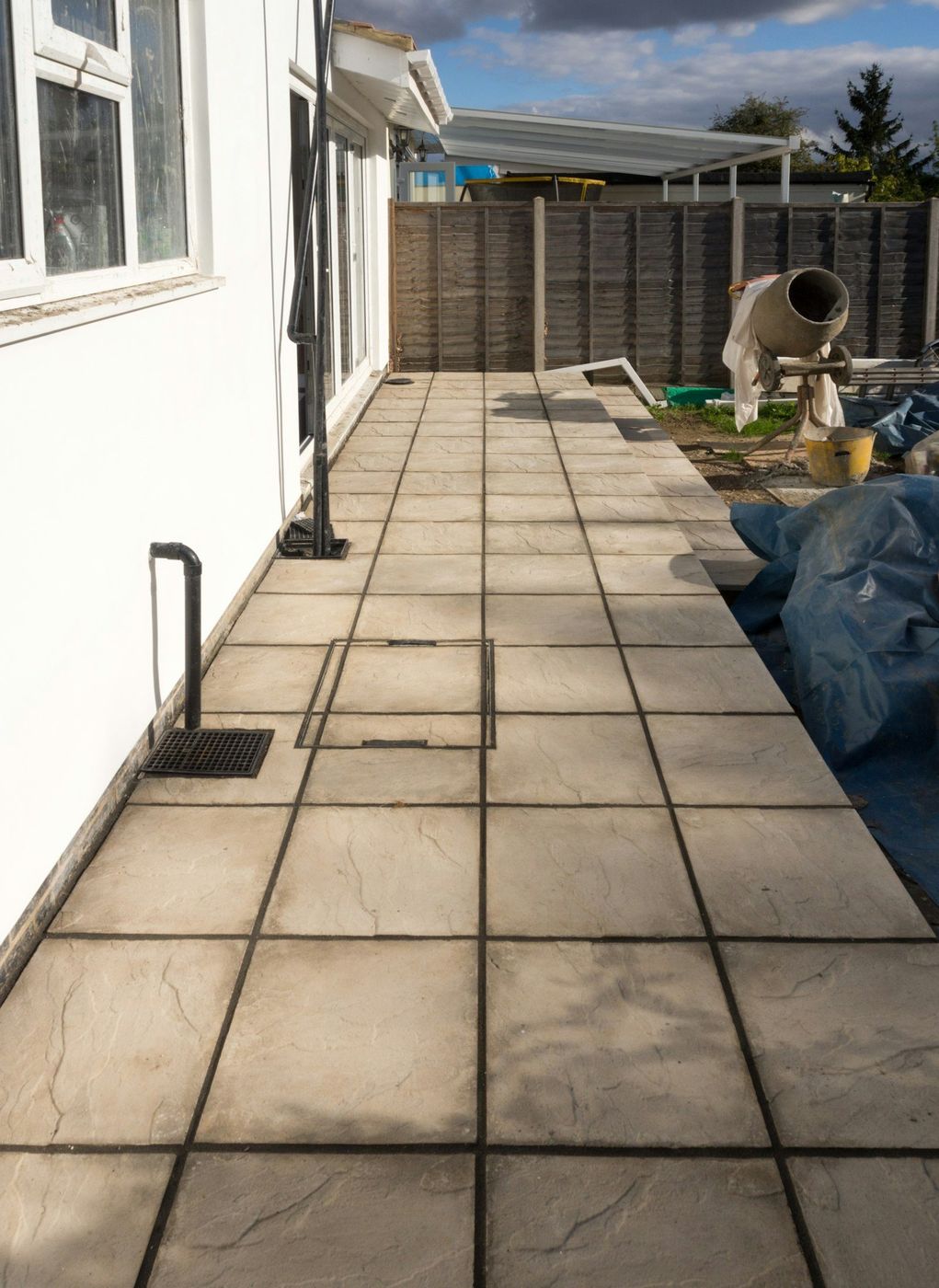
Four tests, about twenty minutes, and you know whether a topping is a good buy or a waste of money.
An overlay is a thin layer of engineered mortar bonded to concrete you already own. On the right slab it's the best value in decorative work, since you keep the base, the steel, and the thickness you already paid for and change only the part you look at. On the wrong slab it's paint over a rotten board.
So the whole conversation is which slab you have. We don't decide that from a photo, and we don't decide it from how ugly the surface looks, because surface damage and structural failure are unrelated problems that happen to look alike from a lawn chair. We test. Four checks, twenty minutes, and the answer is usually clear by the third one.
First we drag a chain or tap a hammer across the slab and listen. Solid concrete rings. A hollow, dead sound means the top layer has already let go of what's under it, and nothing bonds to a layer that has separated.
Second, water. We wet a few square feet and watch. Beading means a sealer or a curing compound is still up there and has to come off first. Quick dark absorption means an open surface, which is what we want.
Third, a chisel somewhere out of sight. If a light tap pops a flake the size of a coaster, the surface is scaling and sound concrete sits below it, which means more prep rather than a bigger problem. If the chisel bounces, we're in good material.
Fourth, we stand on the joint lines and shift our weight. Panels at different heights, a crack wide enough to catch a shoe, or a slab that rocks underfoot is movement, and movement kills toppings.
| The check | What we're after | What the answer changes |
|---|---|---|
| Sounding with a chain or a hammer | A clear ring versus a hollow thud | Hollow areas get removed and rebuilt, or the slab comes out entirely |
| Water on the surface | Absorption versus beading | Beading means a full mechanical strip before anything else happens |
| A chisel in a hidden corner | Whether a light tap pops a flake loose | Scaling adds prep hours. It does not disqualify the slab |
| Standing on the joints | Panels level with each other, nothing rocking | Movement is the disqualifier. A topping over a moving panel cracks the first winter |
| Watching where water goes | Puddles that sit for days after a storm | Drainage gets corrected first. A topping cannot create slope on its own |
| Measuring at doors and thresholds | How much height there is to work with | Sets the maximum thickness, and sometimes rules out the heavier systems |
That plus a hammer tap on your end usually answers it before anybody drives out. (303) 569-4046.
People ask for an overlay to fix a slope, level a settled corner, or bring a patio up to meet a threshold. Sometimes we can. Mostly we can't, because thin toppings have a hard ceiling and everything above that ceiling is a different product with different rules.
A skim coat at an eighth of an inch changes color and texture and nothing else. A stampable overlay at a quarter to a half inch carries a real pattern and takes a light feather at the edges. Past three quarters of an inch a topping has to be treated as concrete: it wants reinforcement, it wants its own joints, and it stops behaving like a bonded skin. Once you're at an inch and a half, ask honestly whether tearing out is the better answer.
Height is the other limit. Overlaying a garage floor raises it under the door, and overlaying a patio at a slider eats step height. We measure both before anybody talks finishes.
Overlay season is narrower than pour season. These thin polymer-modified products want surface temperatures above about fifty degrees and rising, with no freeze for a couple of nights after placement. That puts exterior work from mid-May through September, and June and September are the two months we'd pick.
Wind matters more than heat. A dry Front Range breeze pulls water out of a quarter-inch layer faster than a hot still day does, and a topping that flashes off before it bonds is a topping that comes up in sheets next spring. We shade, we mist, we work smaller sections, and on a genuinely windy day we move the date.
Interior work runs all year. Garage floors, basements, and shop slabs get done through the winter with heat in the space, which is why we book most indoor toppings between November and March and save the good weather for outside.
Still unsure about something?
Call the crew at (303) 569-4046 and we will talk it through.
Get a free, no-obligation estimate from a crew that knows Colorado soil, Colorado weather, and how to finish concrete that lasts.
Accessibility
Adjust the site to fit how you read and browse. Your choices are saved on this device.