
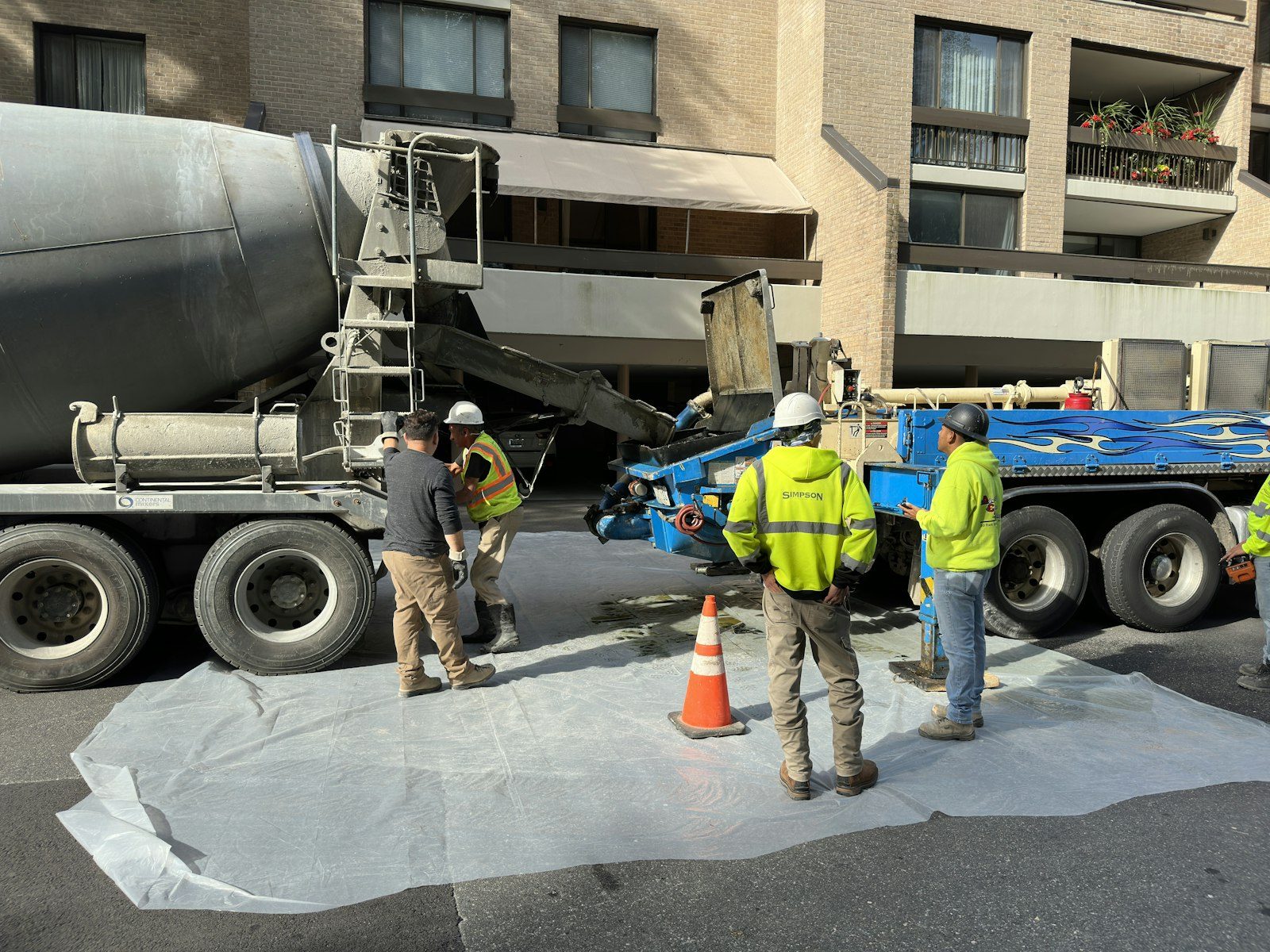
Trailer landing gear puts a building's worth of load on four square inches, and it does it in the same spot every day.
The decision usually arrives disguised as a repair. Something at the dock is broken, a bid gets requested, and only partway through the conversation does it turn out the real question is bigger: does this building need a proper depressed dock, or does it need a better ramp, or does it just need the approach rebuilt so trailers stop wrecking it every year?
We pour dock approaches, leveler pits, depressed docks, and grade-level ramps for warehouses, distribution and service buildings, and general contractors around Parker. Before we quote anything we want to know what shows up at your building, how often, and whether the truck backing in is a semi with a forty-eight-foot trailer or a straight truck with a lift gate. Those two answers point at completely different concrete.
| Arrangement | Right when | What it costs you |
|---|---|---|
| Depressed dock with a leveler pit | Semi trailers, daily volume, forklift loading in and out of the trailer | Most excavation, most coordination, best throughput |
| Grade-level door with an exterior ramp | Mixed vehicles, room to run a long ramp, moderate volume | Cheaper to build, slower to load, ramp needs winter attention |
| Dock lift at a grade-level door | Occasional trailers, tight site with no room for a ramp | Equipment cost and maintenance instead of concrete volume |
| Rebuild the approach only | Dock itself is sound, the pavement in front of it is failing | Fixes the actual failure for a fraction of a full dock |
| Add a second position to an existing dock | Trucks are queuing and the building side supports it | Structural work at the wall, plus a long shutdown of one bay |
Ask a property manager which part of the dock they've paid to fix and the answer is almost never the pit. It's the pavement in front of it. Here's why. A trailer backs in, drops its landing gear, and parks. That gear concentrates enormous load onto two small pads, in the same tire tracks and the same gear position, thousands of times over a slab's life. Add the tractor's drive axles braking on the same stretch and the constant twist of a rig turning to square up.
Standard parking-lot concrete cannot survive that, and neither can asphalt, which goes soft and dishes in July under a parked trailer. The approach in front of a dock needs its own design: thicker section, heavier bar on tighter centers, doweled joints so adjacent panels share load instead of stepping, and a length that covers the full parked position of the trailer rather than stopping ten feet out.
Slope matters as much as strength. The approach has to drain away from the pit, because a pit that collects water freezes in December and wrecks the leveler below it. We build fall away from the building and confirm the pit drain is real.
Send photos of the wheel tracks, the landing gear spots, and the pit. We'll tell you what's failing and what tier of fix it actually needs.
Nobody can pause receiving for three weeks. So dock work gets sequenced around your schedule, not ours. On a multi-position dock we take one bay at a time, wall it off, and hand it back before touching the next. On a single-position dock we look for a temporary answer: a grade door with a ramp, a cross-dock arrangement, or shifting deliveries to a satellite location for the duration.
Night and weekend work earns its cost here. Demolition is the loud, dusty part, and running it after hours means your shift never sees it. Pours are trickier after dark in Colorado because concrete placed into a cold night sets slowly and the finishing crew waits, so we prefer a Saturday morning pour over a midnight one when the calendar allows it.
Coordination is the other half. The equipment installer, the electrician running power to the leveler, the steel crew if a door opening changes, the striper at the end. Pour dates get set around embedded items, because chasing a leveler frame into cured concrete is a bad day. Winter jobs get heated water, blankets, and a longer barricade schedule.
Still unsure about something?
Call the crew at (303) 569-4046 and we will talk it through.
Get a free, no-obligation estimate from a crew that knows Colorado soil, Colorado weather, and how to finish concrete that lasts.
Accessibility
Adjust the site to fit how you read and browse. Your choices are saved on this device.