
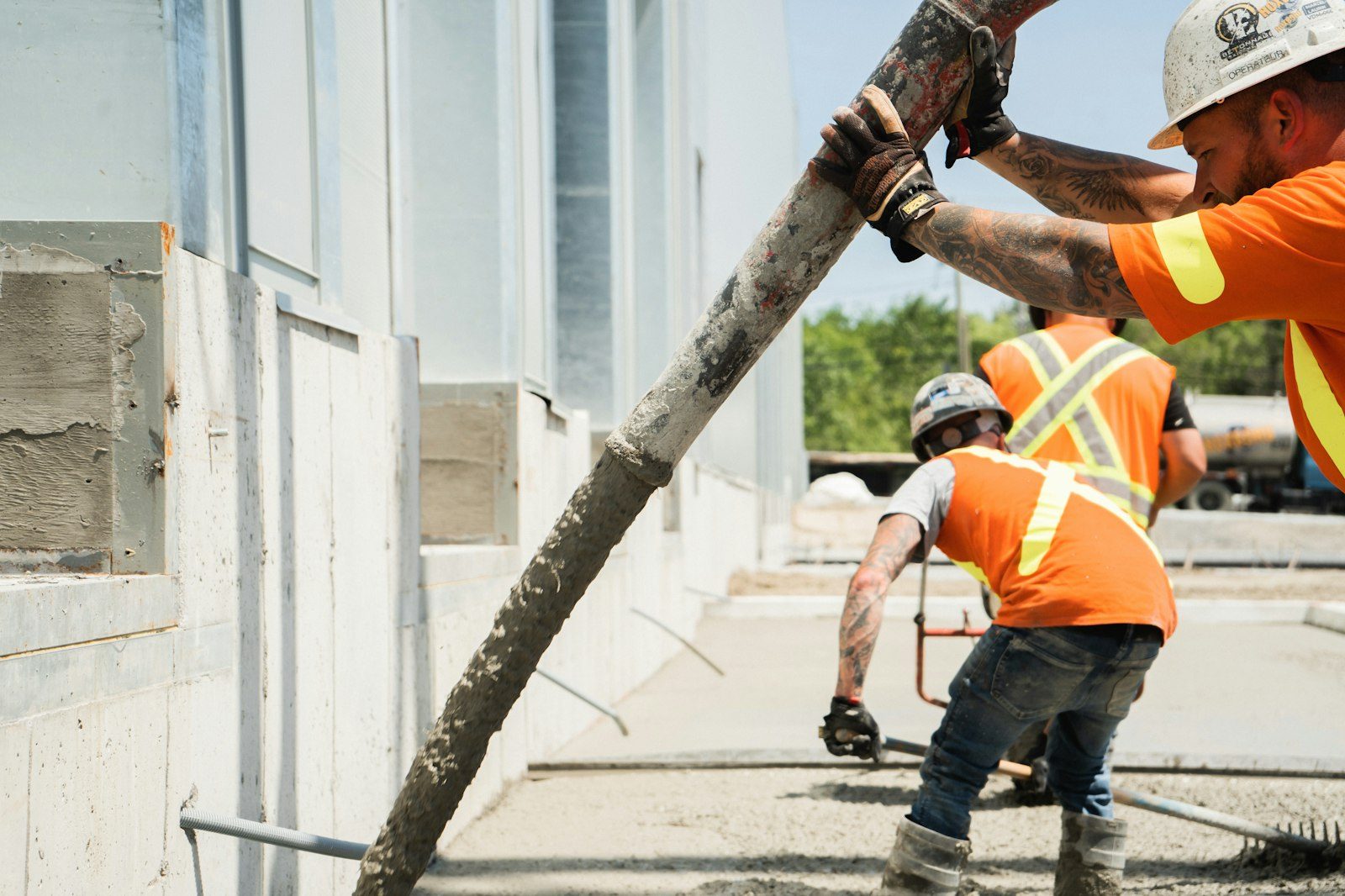
A gutter that holds a puddle was built wrong on one morning, and it stays wrong for thirty years.
Curb work moves fast, which fools people into thinking it's simple. A crew shows up, a run of broken curb disappears by ten, fresh concrete is down by two, and the barricades come off the next morning. Underneath that speed is a grade that either got shot correctly at seven in the morning or didn't, and no amount of good finishing rescues a flowline that runs uphill.
We replace and install curb, gutter, and pan for property managers, general contractors, and municipal-adjacent work around Parker. Retail frontage, apartment loop roads, church and school drives, island curb inside a lot, drive-over sections at entrances. This page walks through what actually happens on a pour day, because that's the part owners rarely get to watch and the part that decides whether the run drains.
We start at the grade, not the concrete. Before anything gets broken out, the crew shoots existing flowline elevations along the run and at both tie-in points, because the new curb has to marry into whatever stays. If the old line had a flat spot, that's the moment to design it out instead of rebuilding the same puddle.
Demo comes next. Saw cut clean at both ends so the tie-ins are square, break the old section, load it out. Then the subgrade gets trimmed and compacted to a consistent depth below the finished flowline. That trimming step is where curb quality is really made. A machine riding on an uneven base produces uneven curb, every time.
Placement depends on the run. Long lengths get slipformed with a machine walking a string line. Short pieces, radius returns, and tie-ins get hand-formed to the shot grade. Both take the same mix: 4,000 PSI, air-entrained, stiff enough to hold its shape.
Then finishing, jointing, curing, and the part nobody skips: a water check. We run water down the gutter before we leave. If it moves, we're done. If it stops, we know before you do.
| Profile | Where it belongs | Watch out for |
|---|---|---|
| Vertical curb and gutter | Perimeter drives, loop roads, anywhere you want vehicles kept off landscape | Plow blades chip the face. Set the reveal to plan and keep the corners tooled |
| Drive-over or rollover curb | Entrances, fire lanes, spots where trucks track wide | Easy to abuse. It needs the same base as everything else, not less |
| Valley pan or cross pan | Carrying flow across a drive aisle to an inlet | Grade tolerance is unforgiving. A flat pan is a permanent ice patch |
| Ribbon or flat curb | Edge restraint at islands and light-duty separations | Offers little containment. Wrong choice where snow gets pushed |
| Extruded landscape curb | Interior islands and planter edges | Not a structural element. Do not use it to hold back traffic |
Send photos of both ends and the low spot. We'll tell you whether it's a section repair or a full run before we drive out.
Curb is thin and exposed on every face, so it loses heat faster than a slab does. That changes how we treat it once nights drop. From late fall on, we use heated mix water, keep the load times tight so nothing sits in the truck, and blanket fresh runs the same afternoon. On a cold morning the concrete gains strength slowly, and pulling forms early on a green curb chips the corners you just built.
Snow removal is the other half of the problem. Curb is what a plow finds first. New curb that gets scraped in its first winter loses its edge, and once the top is opened, water gets in and freeze-thaw does the rest. We ask owners to flag fresh runs for their snow contractor and to hold chemical deicers off new concrete for the first season. Sand is fine.
Best window? Late April through October, and early fall is our favorite for curb specifically. Cool nights slow the set enough that finishers get a clean face, and there's a long runway before anything freezes on it.
The tie-in is where you can spot a rushed curb crew. Anybody can pour a hundred feet of straight gutter. It's the eight feet where new meets old, matching the reveal and picking up the existing flowline without a bump, that separates the ones who shot grades from the ones who eyeballed it.Straight from the crew
Still unsure about something?
Call the crew at (303) 569-4046 and we will talk it through.

Get a free, no-obligation estimate from a crew that knows Colorado soil, Colorado weather, and how to finish concrete that lasts.
Accessibility
Adjust the site to fit how you read and browse. Your choices are saved on this device.