
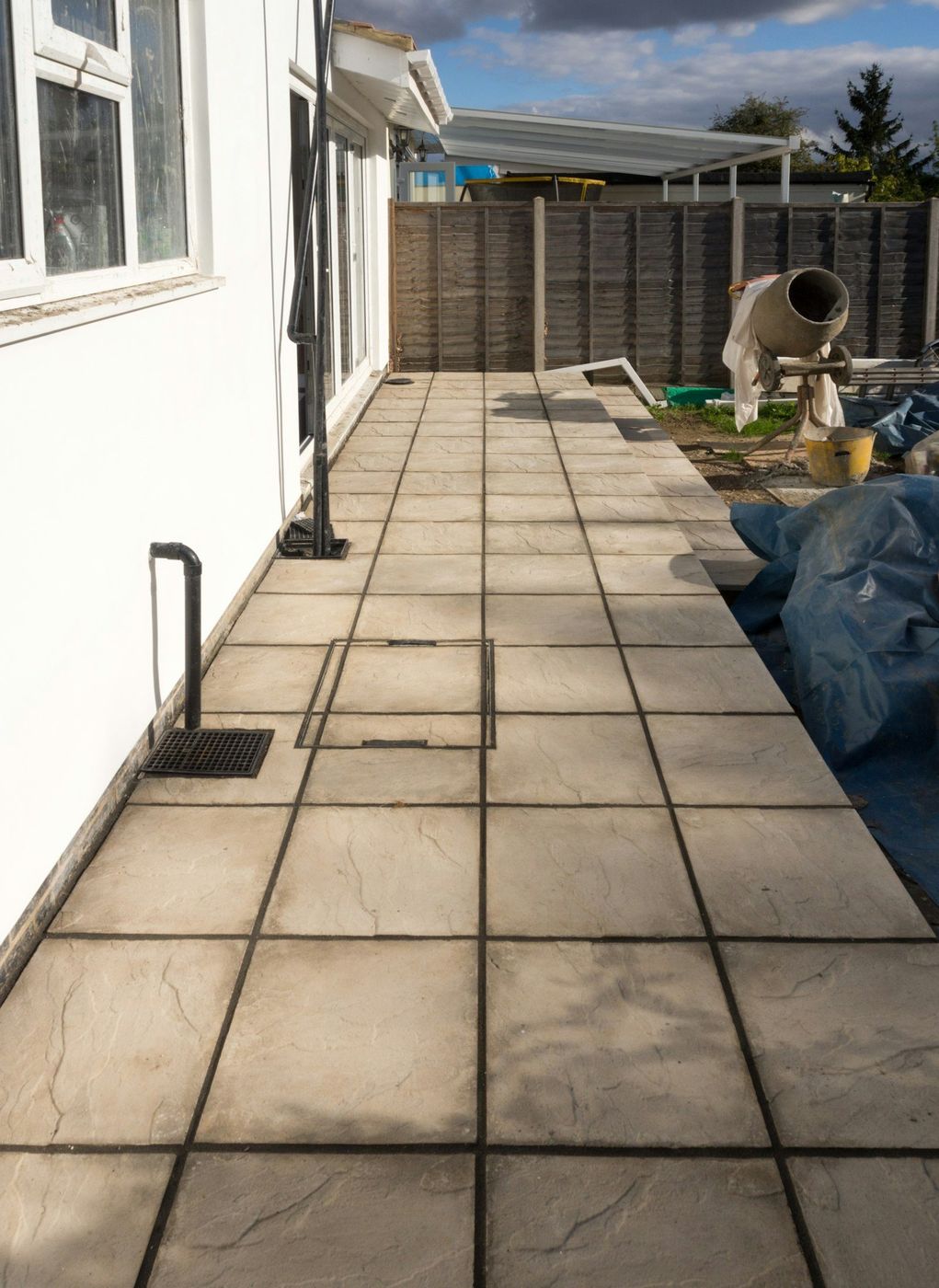
A flat, reinforced slab on a base that was built for the load, not just poured on whatever was there.
A spa pad is one of the few slabs where the concrete is the easy part. Four to six inches of good mix with steel in it will carry a filled hot tub without complaint. What fails is almost always the ground: soft fill nobody compacted, topsoil left in place because it was faster, a corner sitting over a trench that was backfilled loose. The tub finds that spot within a season and tilts toward it.
So we spend our time below the forms. Strip the organics, proof-roll the subgrade, dig out anything spongy, and build a base in lifts rather than dumping gravel and calling it good. Then we pour a slab thick enough and reinforced enough that it spans the small inconsistencies no one can see. That's the whole job. Everything you'll enjoy about the tub depends on dirt you'll never look at again.
A hot tub is a concentrated load in a small footprint, and unlike a car it never moves. Water, shell, cabinet, and a few people add up to thousands of pounds pressing on the same rectangle every hour of every day. Concrete handles that easily. Soil under that rectangle has to hold the same load without settling, and soil is where the story turns local.
Backyards in Parker are rarely native ground all the way across. Grading during construction moves dirt from the high side of a lot to the low side, and that low side is engineered fill which keeps compacting for years. Utility trenches run through the yard. Foundation excavations were over-dug and backfilled. In Idyllwilde and Reata, a spa going into a two-year-old backyard often lands on fill that hasn't finished settling.
We deal with that by not trusting the surface. A probe rod and a proof roll tell us where the soft pockets are. Those get dug out and rebuilt with base rock. Then steel on chairs, so the slab acts as one plate and bridges a weak spot instead of hinging over it.
Send us the model and the footprint. We'll size the slab, check the drainage, and get you poured before delivery day.
Every spa pad problem we get called back on traces to water. Not the water in the tub. The water around it. Roof runoff that lands beside the pad, irrigation overspray that soaks one corner every morning, a grade that lets snowmelt pond against the slab edge all February. Wet soil under one side and drier soil under the other is exactly the recipe for a slow tilt, and a spa is unforgiving about level.
So the pad gets a slight fall on it, away from the house, and the surrounding grade gets checked while we're there. Sprinkler heads within a few feet get pointed somewhere else. A nearby downspout gets extended past the pad. Out on the wooded acreage near The Pinery we also look at where water sheets off higher ground in a hard storm.
Season matters for the pour itself. April through October is the comfortable window, and early fall is our favorite, since a spa pad poured in September has a full month of mild weather to gain strength before the freeze cycle starts. We pour in winter when a delivery date demands it, using heated mix water, non-chloride accelerator, and insulated blankets, and we hold off entirely if the subgrade is frozen. Placing good concrete on frost is the same as placing it on nothing.
| Support | What's actually under it | Our take |
|---|---|---|
| Dedicated poured pad | Compacted road base over proofed subgrade, steel in the slab | What we recommend. Sized to the shell, sloped, thick enough for the load. |
| Existing patio slab | Whatever the original builder placed, often four inches and frequently no steel | Sometimes fine. We probe and check thickness first, because guessing cracks patios. |
| Thickened section inside a new patio | Same base, deeper concrete and extra steel in the spa footprint | Excellent when a patio is going in anyway. Reads as one continuous surface. |
| Pavers or a compacted gravel bed | Loose material that shifts with moisture and frost | No. A spa needs a rigid plane that stays flat for years. |
| Wood deck framing | Posts and footings, sized by somebody else | Only with engineered framing numbers in hand. On grade is simpler and cheaper. |
Still unsure about something?
Call the crew at (303) 569-4046 and we will talk it through.
Get a free, no-obligation estimate from a crew that knows Colorado soil, Colorado weather, and how to finish concrete that lasts.
Accessibility
Adjust the site to fit how you read and browse. Your choices are saved on this device.