
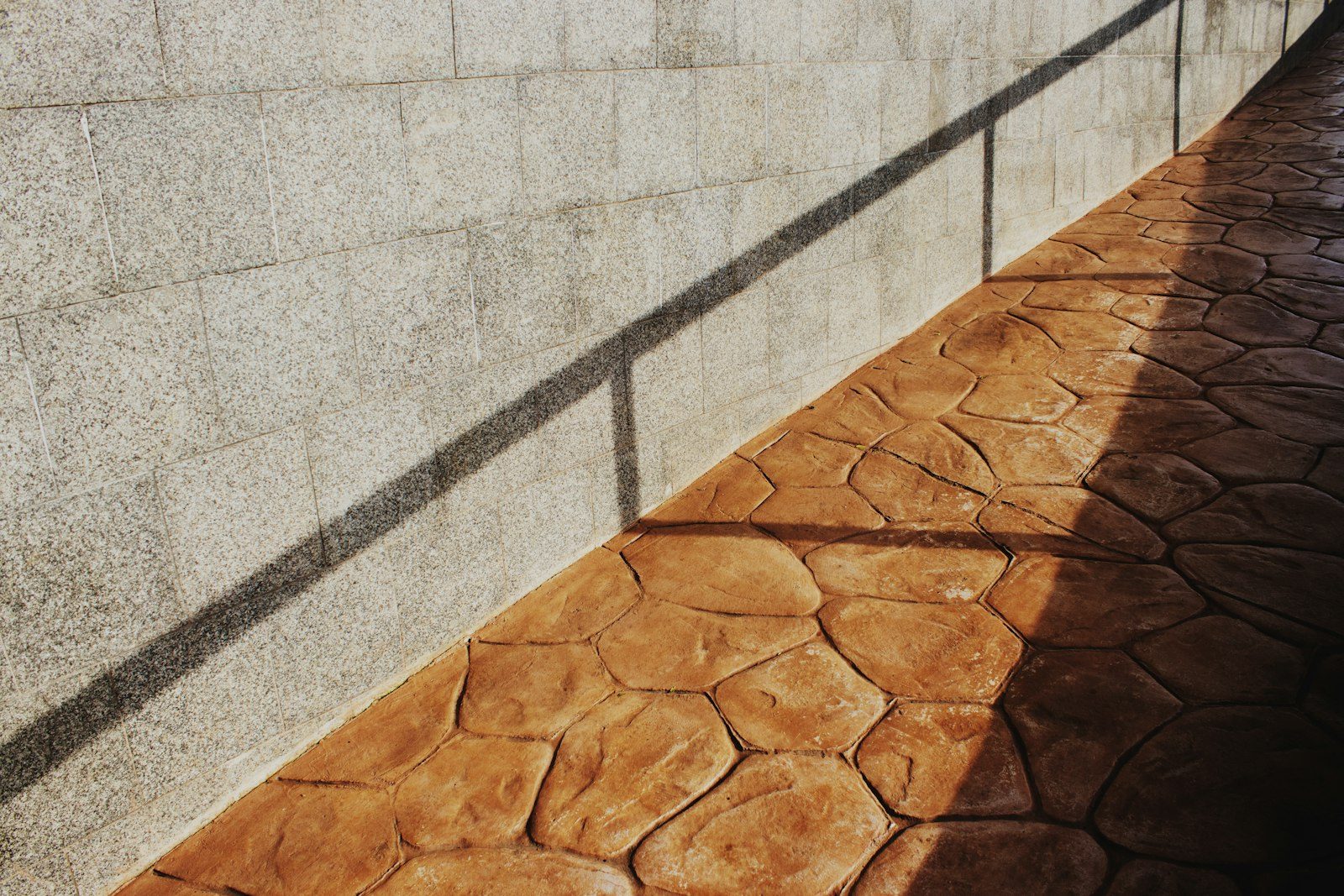
Front walks and side runs sized so two people fit, poured with pitch so water leaves on its own.
Parker went up in waves, and you can date a house here by its front walk. The Pinery came first, with paths that wander because the trees were there before the lots were. Stroh Ranch and Clarke Farms brought the builder ribbon: thirty six inches wide, poured the same week as the drive, straight from the curb to the stoop. Idyllwilde and Reata arrived later with wider entries and some actual thought about where a walk meets a porch.
We pour and replace all three generations. The wandering paths fail at the bends, where somebody guessed at joint placement or skipped it. The builder ribbons fail at the ends, where the walk ties into a stoop that settled on its own schedule. And the newest ones usually don't fail at all. They just need to be wider, because a path you walk single file is a path nobody likes using.
Thirty six inches is the number most builders use because it's the number that costs least. It works fine for one person carrying nothing. Add a grocery bag in each arm, or a stroller, or a second human being, and the walk quietly pushes somebody onto the grass. Forty two to forty eight inches changes how an entry feels, and on a front walk that extra foot of width is the cheapest upgrade in the whole project.
Pitch matters more, and almost nobody asks. We give the width a quarter inch of fall per foot, running away from the house, so melt sheets off instead of parking in the middle. Flat walks hold puddles. At 5,869 feet a puddle freezes hard overnight in February and lets go by noon, and that daily cycle turns a sound surface into a scaled one.
| Where the path runs | Width we build | What it changes |
|---|---|---|
| Front entry from drive or curb | 42 to 48 inches | Wide enough for two abreast. This is the one worth spending on. |
| Side yard service run to the gate | 36 inches | Straight, tight joints, pitched hard away from the wall it parallels. |
| Path to a garden bed or shed | 30 to 36 inches | Light foot traffic only. Fiber in the mix, no steel needed. |
| Anything a mower or wheelbarrow crosses | 36 inches minimum | Thicker section and mesh, because a loaded narrow wheel is a point load. |
| Walk running alongside a driveway | 36 to 42 inches | Isolation joint down the shared edge so the two slabs move separately. |
| Winding path on a treed lot | 36 to 42 inches | Extra control cuts at every curve entry and exit. |
A path that bends is where most walks crack, and it's a jointing mistake nine times out of ten. Concrete shrinks as it cures, and on a bend the inside radius is shorter than the outside, so stress stacks unevenly and the slab picks its own line. We cut square to the direction you're walking, space the cuts tight, and add one where a curve begins and another where it ends. On the older winding paths through The Pinery that's a lot of cuts. Fine. Cuts are cheap and cracks aren't.
Frost is the other half. A ribbon this narrow has unsupported soil on both sides, so it freezes from the edges inward, and water trapped underneath lifts the slab a hair with every hard freeze. Thirty times a winter and you've got a lip at a joint. Drainage is the real fix, and if a downspout is dumping on the line we deal with that before we form anything.
We'll measure the run, look at where your water goes, and hand you a written number. Free, and no follow-up pressure.
Everybody studies the concrete. Nobody looks at the dirt six feet off to the side. If the yard falls toward the walk, that walk is going to move, and it won't matter how clean the finish was. We fix the grade first or we tell you honestly why the low spot is going to come back.Straight from the crew
Still unsure about something?
Call the crew at (303) 569-4046 and we will talk it through.

Get a free, no-obligation estimate from a crew that knows Colorado soil, Colorado weather, and how to finish concrete that lasts.
Accessibility
Adjust the site to fit how you read and browse. Your choices are saved on this device.