
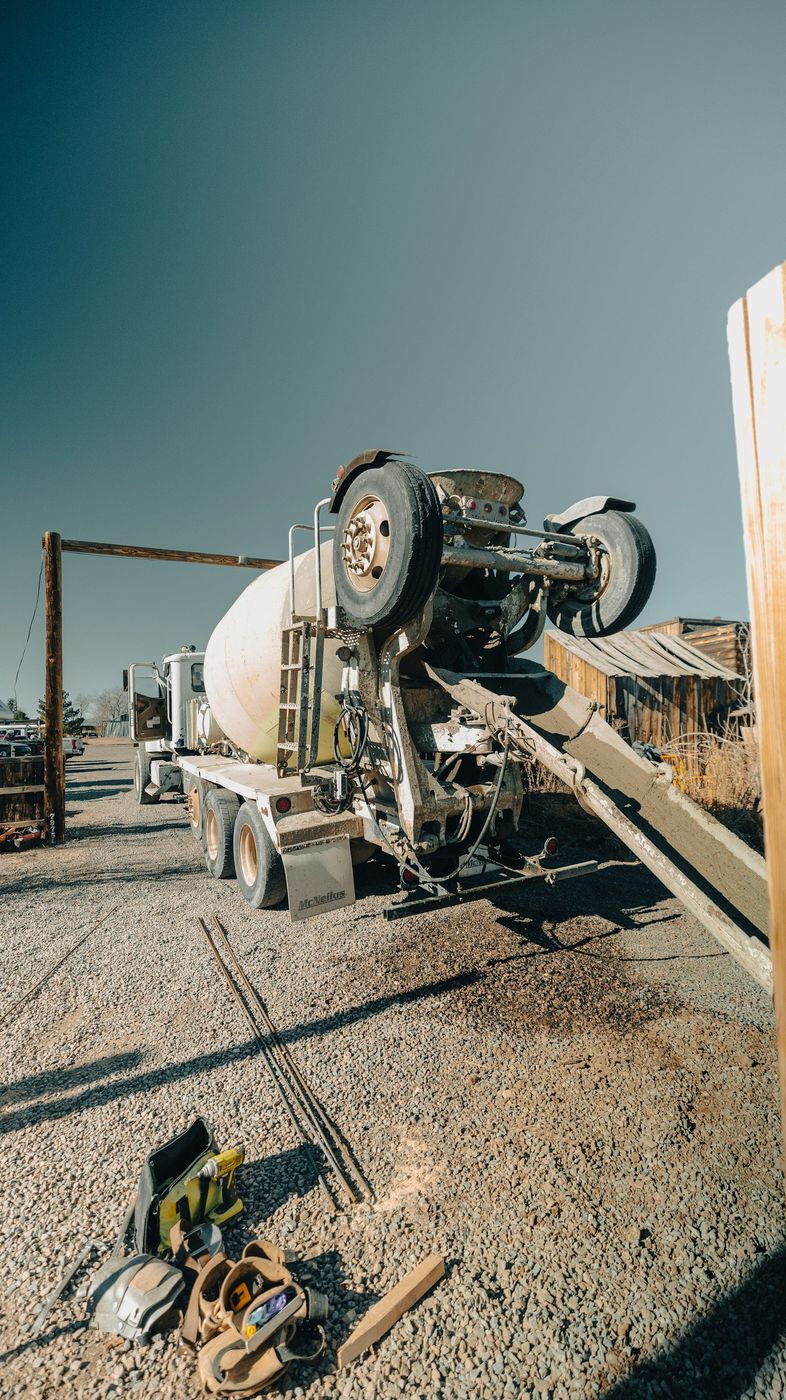
One small pour, one short morning, and about six things that have to happen in the right order.
An equipment pad is the smallest concrete job we do and the one with the least room for error. A patio a quarter inch off, nobody notices. A pad a quarter inch off can leave a generator on three of four feet, put a bend in a refrigerant line, or hand you a vibration problem that never leaves. Small pour, tight tolerance, delivery date already committed.
So we run pad day like a checklist rather than a pour. Here's exactly how a morning goes, who has to be there, what we're measuring, and where the job goes sideways when a step gets skipped or a trade shows up in the wrong order.
We start with string lines and a laser, setting the pad corners and the finish elevation off whatever the equipment has to connect to. Then we strip the topsoil out and keep going until we're in material that compacts. This is where a pad job earns its money. Four inches of concrete over loose fill is a pad that tips within two seasons, so we bring in road base, compact it in lifts, and check it rather than eyeballing it.
Conduit is the coordination point, and it's where these jobs go wrong. Your electrician needs stub-ups placed and secured before we set forms, at a height that clears the finished surface and inside the footprint the equipment expects. If conduit shows up after the forms, we're cutting and patching. After the pour, someone's coring around live wire.
| Step | Who owns it | What it costs if it's skipped |
|---|---|---|
| Submittal and anchor pattern | You or the equipment supplier | A pad the wrong size, or anchors in the wrong place. Nothing recovers that but a jackhammer. |
| Excavation and compacted base | Us | Settlement. The pad tips, the unit goes out of level, and connections take the strain. |
| Conduit and stub-ups | Your electrician, before we form | Cutting and patching new concrete, or coring around energized conduit later. |
| Forms, steel, and grade check | Us | Out-of-square pad, wrong elevation, and an installer standing there with a machine on a trailer. |
| Placement, screed, and finish | Us | A surface that ponds water or a finish too slick for a service tech to stand on. |
| Anchors or sleeves set to template | Us, from your supplier's drawing | Drilling anchors into green concrete on set day, which is how anchors pull out later. |
| Set day and connection | Your installer and electrician | Equipment set before the concrete has the strength for it, and a cracked new pad. |
A patio gets loaded when somebody walks across it. A compressor pad gets loaded a few thousand times a minute for years. That changes what the concrete has to be. Vibration finds every weakness: a thin section, an unconsolidated pocket, a crack that would have stayed cosmetic under static load. It also travels, which is why a generator pad tight against a foundation or a bedroom wall is a decision people regret.
Our answer is steel and separation. Rebar on a grid rather than mesh, because a pad that cracks under a running machine keeps working itself apart. An isolation joint wherever the pad meets a building, a slab, or a walk, so vibration and thermal movement aren't transmitted into something you care about. And enough thickness for the actual machine, not for the average machine.
Send us the submittal. We'll build backward from your delivery and put the schedule and the price in writing, free.
Pads are small enough that weather is manageable almost year round. In winter we heat the mix water, run non-chloride accelerators, and blanket the pad, and because the pour is small the protection is easy to keep on it. The constraint is the ground, not the air. Frozen bearing soil is a stop, so if we're pouring in January we thaw and protect the subgrade the day before rather than fighting it in the morning.
Summer is the opposite challenge. A small pad in direct sun at this altitude loses surface moisture fast, so we start early, cure wet, and never leave it uncovered on a hot, windy afternoon. Either way you get an honest set date. A machine placed on a pad that hasn't reached strength is how new concrete gets cracked.
Still unsure about something?
Call the crew at (303) 569-4046 and we will talk it through.

Get a free, no-obligation estimate from a crew that knows Colorado soil, Colorado weather, and how to finish concrete that lasts.
Accessibility
Adjust the site to fit how you read and browse. Your choices are saved on this device.