
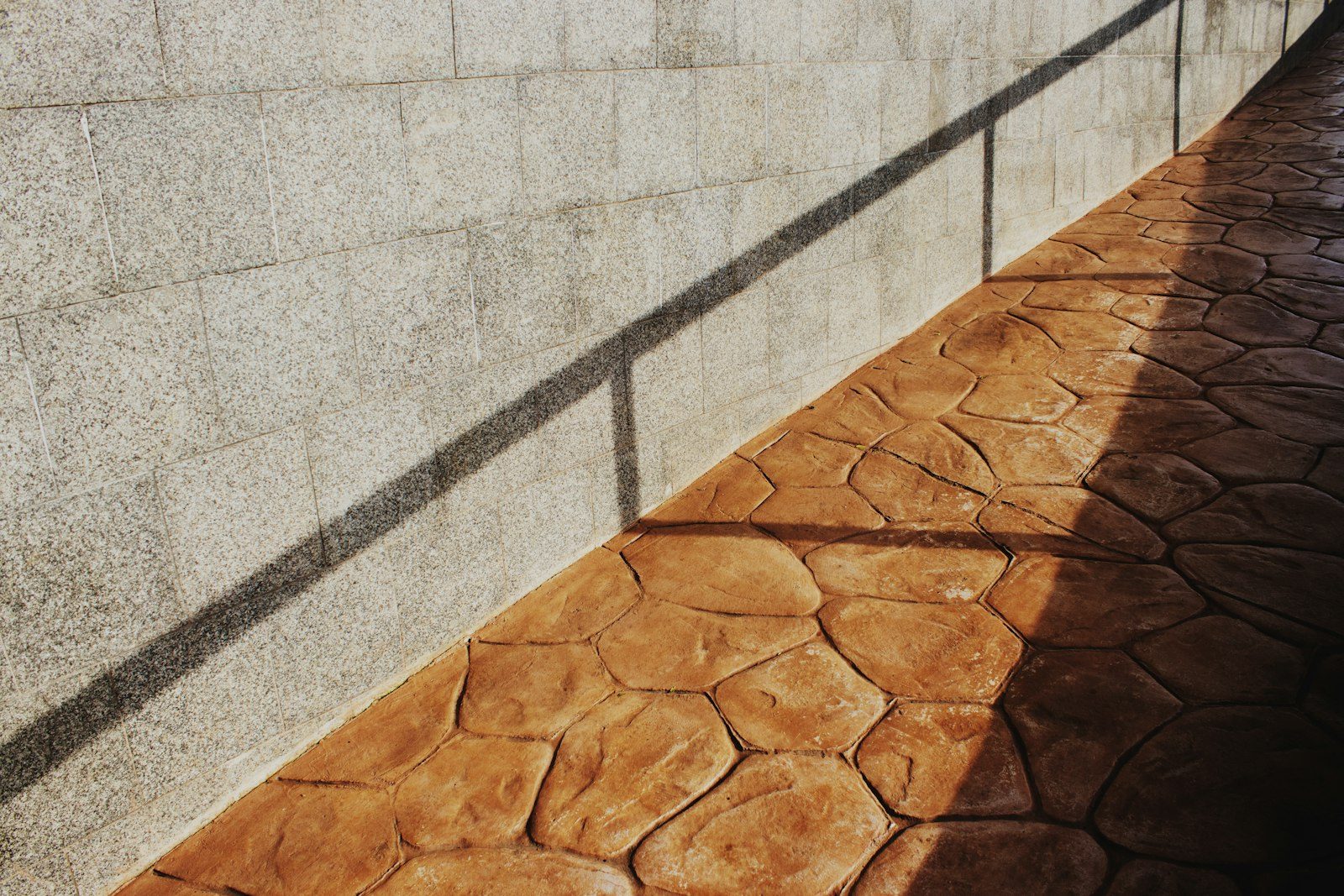
A path that holds ice into March was pitched wrong back in July.
Second week of February, sun out since ten, driveway bone dry. The front path isn't. There's a gray sheet of ice parked in the bend near the porch and it'll still be there Thursday. That is not a shoveling failure. It's a low spot, poured into the path the day somebody screeded flat instead of pitching to one side.
We build paths around Lone Tree that shed their own meltwater. Wide enough for two people, tilted a quarter inch per running foot toward the turf, cut where the concrete already wants to open up, sitting on base that got compacted rather than raked smooth. Most of these calls reach us from Fairways, Montecito, and Carriage Club, where the original runs are skinny, tired, and leaning the wrong direction. At 5,817 feet the physics doesn't care how old the house is.
Summer hides all of it. Water falls, goes somewhere, nobody watches where. Then the cold arrives and every mistake in the grade shows up in white. Snow softens in the afternoon, runs downhill, finds the dip, locks up after dark. Eleven repeats of that and you've got a layered ridge welded to the surface.
Shaded runs take the worst of it. A path along the north wall of a house in Montecito can carry ice six straight weeks while the rest of the lot is dry, because it never gets the couple hours of direct light it needs. We can't spin your house around. We can tilt the concrete so melt leaves, keep the texture coarse enough for a boot to bite, and aim runoff into grass instead of the next panel down.
The other cold-weather tell is a panel standing proud of its neighbor. Knock it with a shovel blade in January. Hollow ring means frost has been working under a slab that was never sitting on much of anything.
| The run | Width | What you get |
|---|---|---|
| Front door out to the drive | 48 inches | Two adults abreast, plus a stroller that never leaves the concrete |
| Side yard to the gate | 36 inches | Single file, trash carts, mower access |
| Out to a fire pit or around a patio | 42 to 48 inches | Room to slide a chair back without one leg landing in the mulch |
| Under 30 inches | We'll talk you out of it | Skinny ribbons lift more and split more |
Shoot it early, before the sun burns it off. That photo says more about your grade than a tape measure will.
A four-foot walk has mass and a long shared edge. A two-foot ribbon has neither one. Frost sneaks under it from both sides at once, pries it up like a lever, then sets it back down a half inch off from where it started. That's the whole story behind the stubbed-toe joints on older paths tucked behind Carriage Club homes.
Width helps some. Base helps more. We cut to grade, bring in road base, pack it in lifts, and test it before one form board goes down.
Curves get their own treatment. Concrete opens up where you tell it to or where it feels like it, and on an arc the stress collects along the inside of the bend. So we lay joints out on the radius instead of some grid we brought along, tighten spacing through the curve, and run every cut square to the edge. All of it sawed the day of the pour. A joint cut four days late is just decoration.
About half the paths we tear out are two feet wide and sitting on nothing at all. No aggregate, no steel, dumped onto native dirt in under an hour. They hold up fine until one soggy October, and then frost gets under a single panel and the run turns into a staircase.Our crew lead, after the walkthrough
Still unsure about something?
Call the crew at (303) 569-4046 and we will talk it through.

Get a free, no-obligation estimate from a crew that knows Colorado soil, Colorado weather, and how to finish concrete that lasts.
Accessibility
Adjust the site to fit how you read and browse. Your choices are saved on this device.