
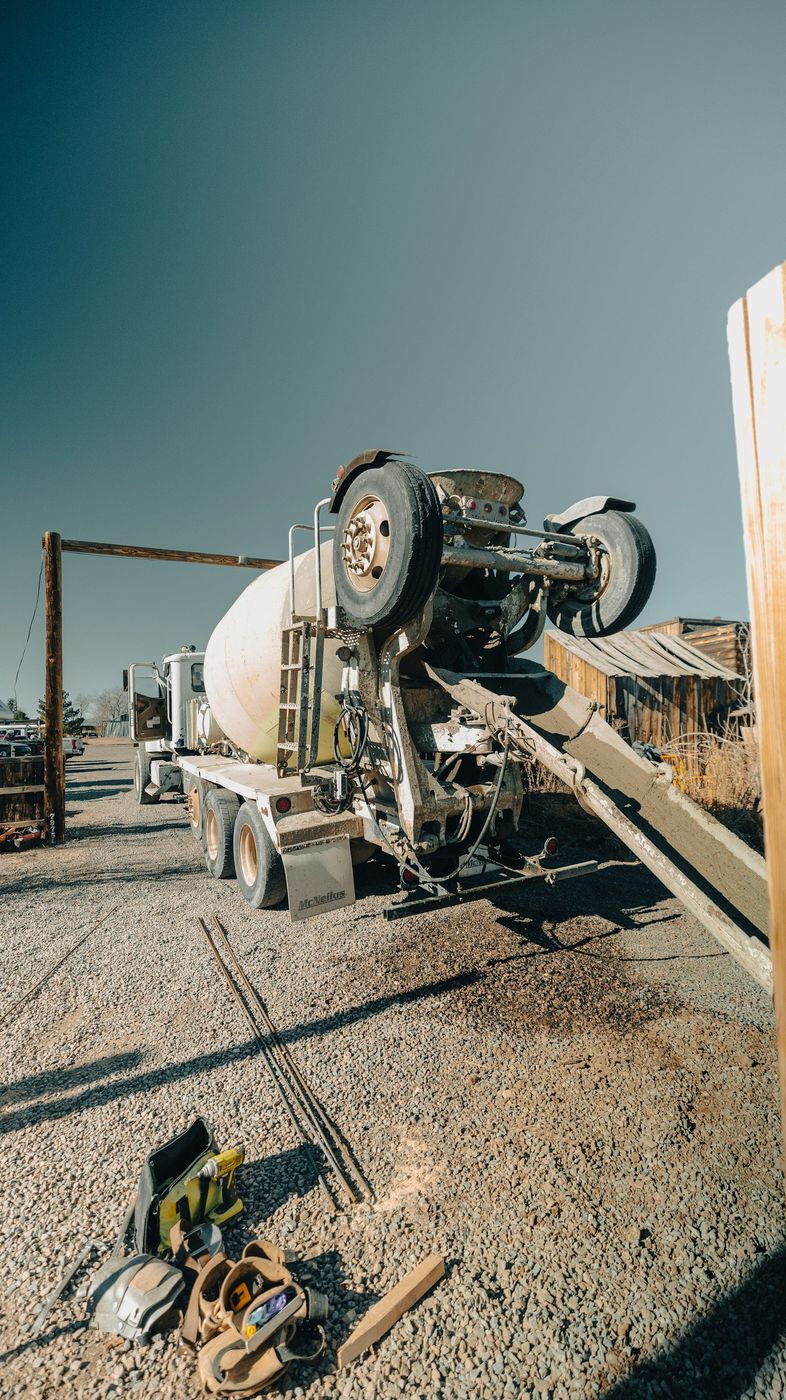
Gravel works fine right up to the morning you try to pull fourteen thousand pounds off it in April.
Everybody opens with the same question, and it isn't about concrete. It's whether a pad is worth pouring at all when the rig sits parked eight months a year. Fair question. The answer turns on weight, on how the ground behaves where you want to park, and on whether that trailer stays in the family for a decade or gets flipped next season.
So this is a decision, not a sales pitch. Gravel has a real place. Asphalt almost never does under a static load like this. Concrete wins when the numbers get big and the ground is unforgiving, which covers most lots we work on around Fairways, Montecito, and Carriage Club, where side yards are generous enough to park a rig but the soil was never built for one.
| Surface | Where it holds up | Where it lets you down |
|---|---|---|
| Compacted gravel | Light trailers, dry ground, short stints, tight budgets | Jack feet punch through, ruts form under the tires, spring runoff turns it into a bog |
| Asphalt | Almost nowhere for this use | It softens in July heat and a tongue jack sinks into it while you watch |
| Concrete | Tandem axles, long-term parking, level tolerance for slide-outs | Higher up front, and it needs proper base like anything else we pour |
| Concrete strips, gravel center | Split-the-difference budgets, single-axle trailers | You park in exactly the same track every time or the tires roll off |
Rolling weight isn't the problem here. Parking is. A fifth wheel puts most of its mass on two axles crowded into a few feet of slab, and the tongue jack or the front landing gear concentrates several thousand more pounds into two footprints the size of dinner plates. That load sits there. Through a wet May, through a freeze in December, through everything the ground does over a year.
Soil in this part of Douglas County won't hold still under that kind of pressure, and a slab bridging the motion needs steel and depth or it hinges in the middle. We pour RV work at 6 inches with #4 bar tied on an 18-inch grid, not the 24 a car drive gets. That tighter grid costs a few extra sticks. It's also the difference between a pad that flexes and one that cracks straight across at the axles.
Those two numbers plus a photo of the side yard get you a real answer on thickness and layout, no visit required.
Take the trailer length and add ten feet to it. Owners size a pad to the coach and forget they still have to get the coach onto it. You want room to straighten before the tires touch concrete, plus a few feet past the bumper for a bike rack, a generator, or the cooler you set down while unhooking. Width runs the same way. Twelve feet is the floor once an awning is out and somebody wants to walk past a slide.
The apron gets skipped constantly. Where new work meets your existing drive there's a seam, and two slabs poured years apart on different base will move independently. We dowel across it so pad and drive step together, and we keep the transition flat enough that a long wheelbase doesn't drag its tail coming over.
Timing runs late spring through October. Larger pours want settled weather because more surface sits open while the crew finishes. Fall is fine and often better. Winter we'll take on if a rig needs a home, using heated water, a chloride-free accelerator, and blankets, but the subgrade has to be thawed first.
The tell on a failed gravel pad never changes. Four dimples where the jacks sat, two trenches where the tires sat, and an owner telling me they added another load of rock last spring. The rock keeps vanishing because nothing under it got compacted.Our crew lead, after the walkthrough
Still unsure about something?
Call the crew at (303) 569-4046 and we will talk it through.
Get a free, no-obligation estimate from a crew that knows Colorado soil, Colorado weather, and how to finish concrete that lasts.
Accessibility
Adjust the site to fit how you read and browse. Your choices are saved on this device.