
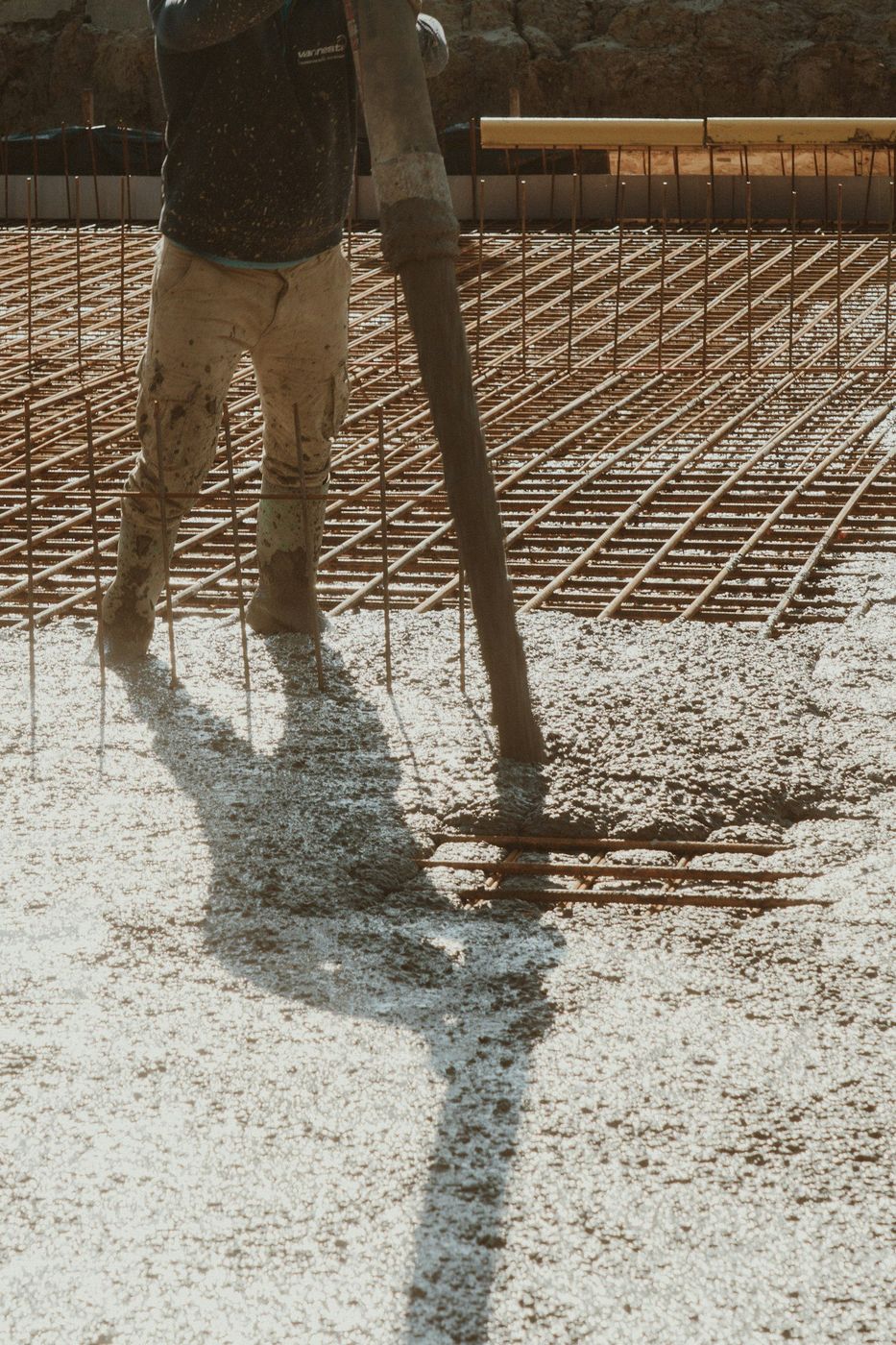
Most of what you pay for on a garage slab happens before any concrete shows up.
People price a garage floor like a patio with a roof over it. Same square footage, same mix, ought to be similar money. It isn't, and the reason has nothing to do with concrete. A patio has open sky above it and a truck backs right up to the forms. A garage slab lives inside four walls with one opening, so every piece of the old floor leaves through that opening and every yard of the new one arrives the same way.
That's the cost story in a sentence. We do this work across Lone Tree, from older attached garages in Fairways and Carriage Club to the deeper three-car bays around Montecito, and estimates swing on access and demolition long before finish enters the conversation.
Demolition first. Breaking up a floor inside a building is slow, loud, and physical. There's no room to swing big equipment, so a lot of it happens with a walk-behind breaker and a mini machine that barely clears the door. Every chunk gets carried or carted out. On a three-car bay that's a lot of trips.
Then there's what the floor touches. The slab usually sits against a stem wall or the bottom of the framing, and the old concrete has to come out without disturbing either. That means hand work along the perimeter, sometimes saw cutting a clean line and leaving a strip in place. Water heaters, furnaces, and sump pits complicate the same edges. If a bearing point sits on the slab, we plan around it before anything gets broken.
The concrete itself is the straightforward part. Mix, steel, and finish make up the smaller share of the total, which is exactly why two quotes for identical square footage can land far apart.
A garage takes on more water than people think. Snow rides in under a car, melts, and runs to whatever low point the floor offers. Moisture travels the other direction too, rising as vapor out of the ground and through the slab, which is what turns a coating cloudy or lifts it in sheets a year later.
So we put polyethylene under the concrete. Real sheeting, lapped and taped, over compacted clean aggregate instead of the soft fill a builder left behind. That layer stays invisible forever and it decides whether a coating is still bonded in ten years. We watch the door line too, where the slab meets outside air and frost gets nearest the underside.
| Driver | What it looks like on your job | Why it costs what it does |
|---|---|---|
| Access | Attached bay with a wide apron versus a detached garage behind a gate | Pump time, buggy runs, and crew hours track how far concrete travels |
| Demolition | Four inches of plain slab versus a thick reinforced floor | Steel in old concrete doubles breaking time and disposal weight |
| Base condition | Clean aggregate underneath versus soft fill and buried debris | Bad fill comes out, and hauling dirt costs what hauling concrete costs |
| Utilities in the floor | Sump pit, floor drain, radiant tubing, conduit crossings | Each one gets formed around and protected during the pour |
| Finish and coating prep | Broom texture versus a hard trowel left ready for a system | A coating-ready floor takes more finishing passes and tighter flatwork |
Text a photo from the back corner looking out. One frame answers most of the access questions.
Every bay gets pitched to the door. An eighth of an inch per foot is plenty, enough to move melt off the floor without a toolbox rolling on you. Interior drains are a different animal, needing discharge and a trap that won't freeze, so unless you wash vehicles indoors we send the water out the opening.
Coatings need patience. Give the slab twenty-eight days, then test it for moisture before anything goes down, because a system installed over a green floor peels and takes your money with it. Grinding first isn't optional either, whatever the box store kit claims.
The nice part about garage work is that the calendar barely applies. Roof, walls, so we tent and heat the space and pour through January when that suits you. Winter is honestly our easiest time to fit one in. The one hard rule holds either way: the ground underneath cannot be frozen when the concrete lands on it.
Still unsure about something?
Call the crew at (303) 569-4046 and we will talk it through.
Get a free, no-obligation estimate from a crew that knows Colorado soil, Colorado weather, and how to finish concrete that lasts.
Accessibility
Adjust the site to fit how you read and browse. Your choices are saved on this device.