
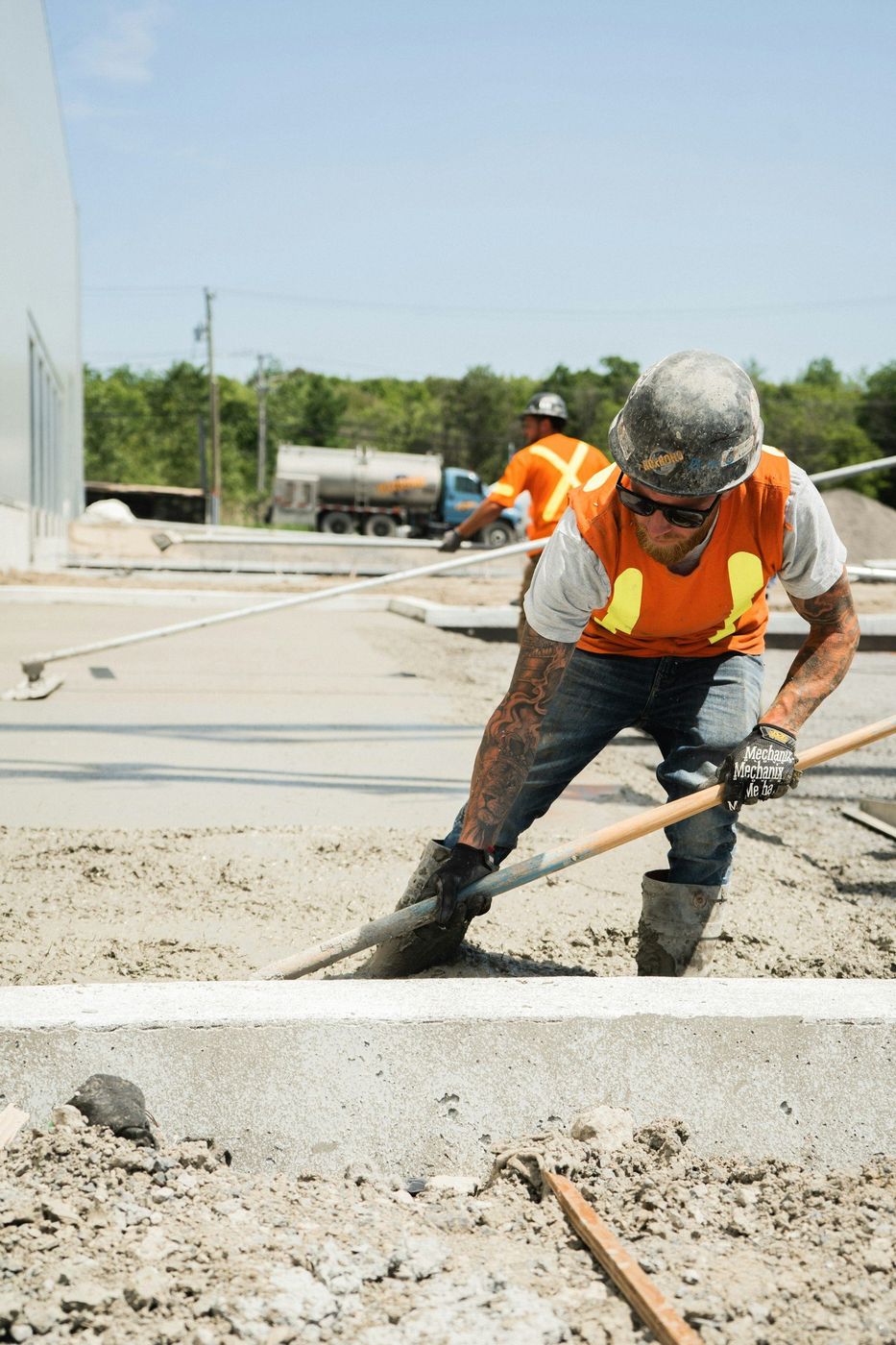
The concrete almost never fails. What's under it, and what water did to it, almost always does.
An equipment pad looks like the easiest concrete on any property. Small rectangle, flat top, done before lunch. Then the condenser sits an inch out of level after two winters, the line set is under strain, and a service tech is explaining that the unit is fine and the pad isn't.
Nearly every pad failure we get called out to is a base failure. The concrete is intact. What was underneath it wasn't, or water found its way there and stayed. So that's where we put the effort on generator, HVAC, transformer, compressor, and mechanical pads around Lone Tree, from the equipment yards at commercial buildings to whole house generators tucked beside houses in Heritage Hills and Carriage Club.
The building has depth on its side. Its footings reach past frost onto soil that was verified before anybody framed a wall. A pad poured on four inches of loose dirt has none of that, and it's light enough that the ground can push it around without much effort.
Then there's what a pad sits next to. Equipment pads live in the worst real estate on any property: right against the wall, directly under the roofline, in the strip where the original backfill went in and never fully settled. That soil is looser than anything else on the lot. Add roof runoff landing on it, condensate dripping year round, snow shedding off the eave in February, and a sprinkler zone somebody aimed generously, and you've got the wettest, softest ground on the property carrying a piece of equipment that hates being out of level.
Static weight is the easy part. Vibration is what separates a pad that lasts from one that cracks along a bolt line. Generators and compressors shake, and that shaking travels into the concrete and then into whatever the concrete touches. So we reinforce properly with steel on chairs rather than trusting fiber alone, we keep the pad isolated from adjacent slabs and building foundations with a joint, and on serious equipment we follow the manufacturer's isolation recommendation instead of improvising one.
Penetrations get planned before we pour, never after. Conduit stubs, gas line sleeves, condensate drains, and anchor bolt patterns all come off the equipment's own drawings, set in place while the forms are still empty. Coring a finished pad to add a conduit cuts steel and weakens the exact area you need strong.
| Water source | What it does to the pad | How we handle it |
|---|---|---|
| Downspout discharging nearby | Saturates loose backfill and undermines a corner | Extend the discharge well past the pad, every time |
| Roof runoff with no gutter above | Cuts a trench along one edge and erodes the base | Gutter the run or widen the pad's drainage apron |
| Snow sliding off the eave | Repeated freeze and thaw loading right at the edge | Set the pad clear of the drip line where the layout allows |
| Condensate from the unit | A permanently wet spot under one corner | Pitch the top and route the condensate line away |
| Sprinkler overspray | Keeps the subgrade soft all summer | Move heads or convert that zone to drip |
Send a photo and the equipment make and model. We'll size the pad, plan the penetrations, and quote it for free.
Most of this work happens between April and October, which lines up nicely with when equipment gets replaced anyway. Fall is our favorite window. The ground is dry, compaction is easy, and the concrete has weeks of moderate weather to gain strength before winter tests it. Summer is fine as long as we start early and get finishing done before an afternoon cell arrives, because rain landing on a pad during the finish window leaves a surface that dusts and scales later.
Emergencies don't check the calendar, and a failed furnace or a burned out generator in January is an emergency. We pour pads in cold weather with heated mix water, non-chloride accelerator, and insulated blankets, and we never place on frozen ground. One thing to hold off on all winter: deicing salt around a new pad. Magnesium chloride tracked off a driveway onto fresh concrete is the fastest way to pit a surface that was poured correctly.
Still unsure about something?
Call the crew at (303) 569-4046 and we will talk it through.

Get a free, no-obligation estimate from a crew that knows Colorado soil, Colorado weather, and how to finish concrete that lasts.
Accessibility
Adjust the site to fit how you read and browse. Your choices are saved on this device.