
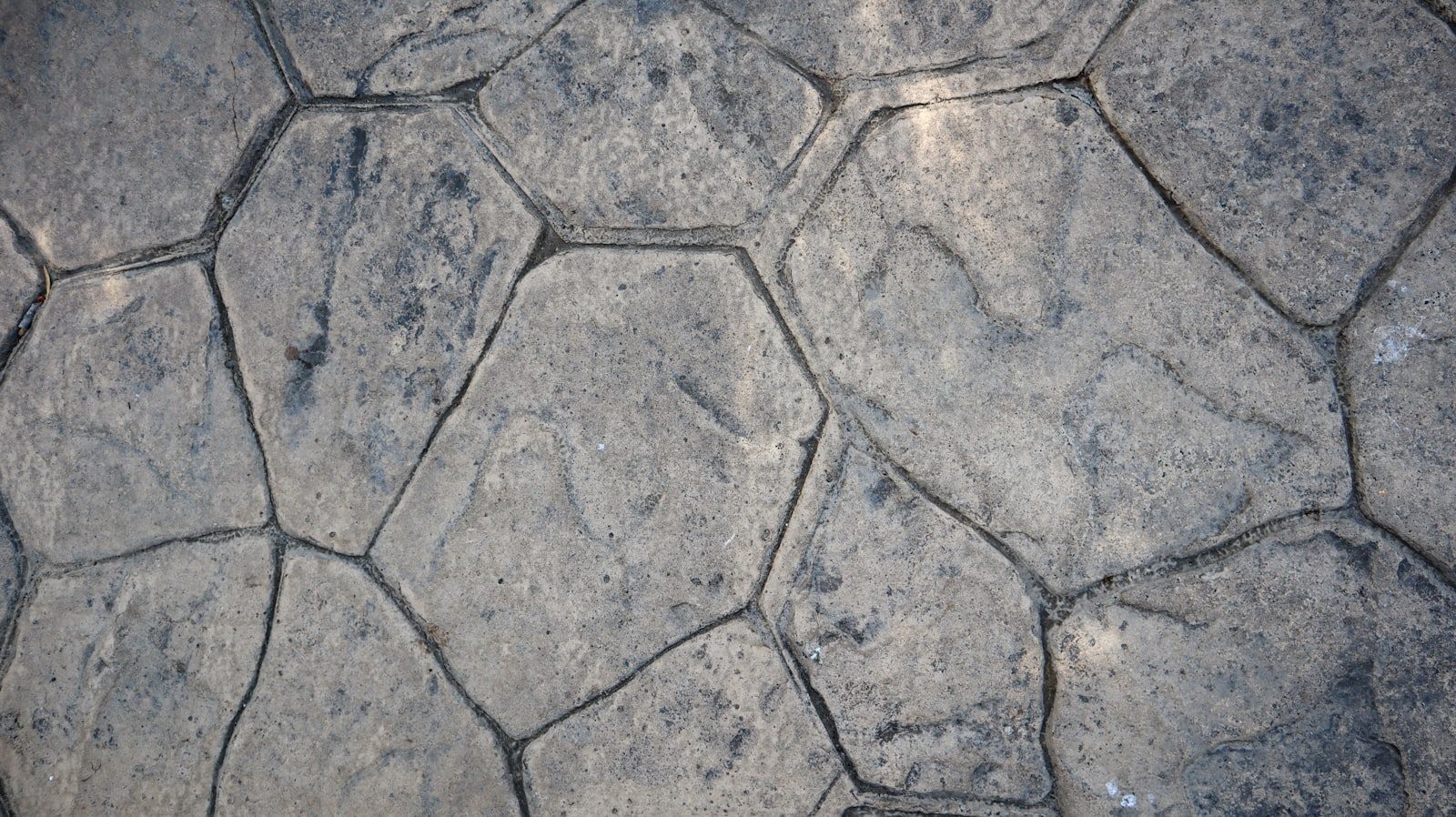
Pattern scaled to the house it sits in front of, which around here means very different lines on very different streets.
Lone Tree isn't one kind of house, which is the whole reason this page exists. Carriage Club and Fairways run to established homes on generous lots with existing hardscape a new pattern has to answer to. Heritage Hills has its own scale. Newer construction toward RidgeGate brings tight modern geometry and a lot of glass. A pattern right on one of those looks wrong on another, and the culprit is scale.
Scoring is a saw cut, a tooled line, or both, arranged deliberately across a slab. Cutting isn't the skill. Anybody can run a saw. The skill is deciding where the lines belong before the concrete arrives, so the pattern lands on sight lines the house already has and the working joints vanish inside it.
Here's the mistake we get called to look at. Somebody scores a big patio into two-foot squares because two feet felt like a normal tile size. Now a long terrace behind a house with twelve-foot ceilings reads like a bathroom floor. The pattern isn't wrong by itself. It's wrong next to that building.
The way out is to borrow a dimension from the house and repeat it. Column spacing, window mullions, the width of a door assembly, the coursing of stone on the facade. Pick one, build the grid off it, and the concrete starts looking like it belongs to the structure. On a modest back patio the same logic runs the other way: fewer lines, bigger fields. A small slab chopped into many pieces just looks smaller.
On established properties we're usually working next to something already built. Flagstone, brick borders, a stone wall, a patio added in stages over twenty years. Scoring earns its money there by tying those pieces together. We pick up a joint line from the existing flagstone and carry it into the new concrete so the eye reads one surface instead of a repair.
Newer homes are the opposite problem. Everything is square and deliberate, so the concrete has to stay quiet or it fights the architecture. Tight modules, clean orthogonal cuts, no diagonals. Both kinds of property get a practical benefit too: a slab full of scored lines gives shrinkage somewhere to go, along a line you chose.
We lay these patterns out off the building. Seeing the elevation tells us the grid before we ever get on site.
| Layout | Where it fits | What to watch for |
|---|---|---|
| Large ashlar grid | Wide terraces where a big blank field needs breaking up | Panels get large fast. Working joints must hide inside the grid or a crack shows up where the pattern didn't plan for one. |
| Diagonal diamond | Entries and courtyards that want to feel wider than they measure | Every intersection is a miter. Layout takes far longer and the edges allow no error. |
| Running bands with a border | Long walks and narrow side yards | The border has to hold one width around every curve or the eye catches the wobble. |
| Tight tile module | Modern elevations with big glass, where concrete should stay quiet | More lines means more places for grit. Sealing and cleaning matter more here. |
| Open field, one feature cut | Small back patios that shouldn't look busy | Works only if the feature line references something real. A random curve reads as a mistake. |
Timing separates the three ways to put a line in concrete. Tooled lines get pressed in with a jointer while the slab is still plastic, leaving a soft radiused edge that suits traditional work. Green cutting happens within hours of the pour with an early-entry saw, which gives crisp edges and relieves shrinkage before the concrete picks its own crack. Dry cutting later gives the sharpest line, and it's the only option on a slab already years old.
Weather runs the schedule. Green cutting is the one with a real window, and altitude and dry air move that window by hours depending on wind and sun. High summer, we're often sawing before dinner. Cool weather, we might be back at midnight. May through early October covers most of it. We don't score in freezing weather, because a cold slab chips at the cut edge instead of shearing clean, and a chipped line is permanent.
Still unsure about something?
Call the crew at (303) 569-4046 and we will talk it through.

Get a free, no-obligation estimate from a crew that knows Colorado soil, Colorado weather, and how to finish concrete that lasts.
Accessibility
Adjust the site to fit how you read and browse. Your choices are saved on this device.