
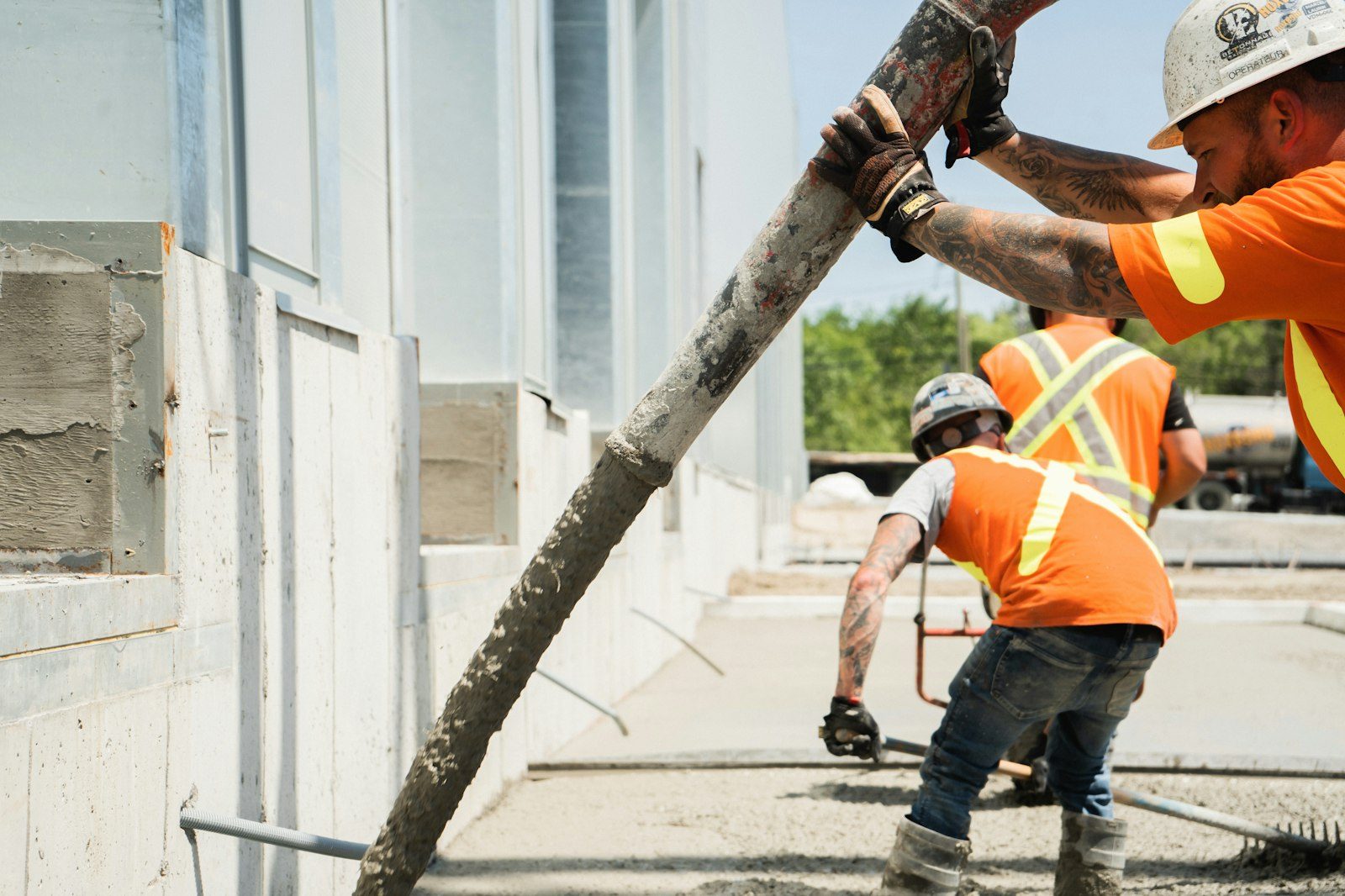
Reinforced basins built to hold water year after year, on properties with the room to do it properly.
Lone Tree properties fall into two camps when it comes to water, and the camp decides the build. The larger lots in Heritage Hills, Carriage Club, and the Fairways have the room and the mature landscaping for a real pond: a basin with depth, a bottom drain, circulation, and fish that need to survive a February. Those are structures, and we build them like structures.
Then there's the newer side. RidgeGate and Montecito yards tend to be tighter and more architectural, and the water we build there is usually a formal basin, a spill wall, or a compact feature that reads as part of the hardscape. Smaller doesn't mean simpler. A shallow rectangular basin sitting against a patio has to be dead flat at the rim, watertight at every corner, and detailed so it doesn't crack the first winter it freezes. Different job, same rule: concrete that holds water has almost no margin for sloppy work.
Every other piece of concrete on your property is allowed to let a little water through. A pond isn't. That changes the recipe and the details. We run a lower water-to-cement ratio than we would on a driveway, we often add a crystalline waterproofing admixture that keeps reacting and sealing hairlines over the life of the structure, and we place walls and floor in a way that either eliminates cold joints or treats them with a waterstop where they can't be avoided.
Reinforcement is continuous. A tied cage through the floor and up the walls, lapped at the corners, held off the subgrade on chairs so the concrete wraps every bar. Cracks in a pond aren't cosmetic, so we control them with steel and with joint placement rather than accepting them and patching later. And the floor slopes to a low point with a drain, because a pond you can't empty is a pond you can't clean.
Water expands when it freezes, and a pond wall that isn't detailed for that will find out in the first hard January. Depth is the main defense. Get enough water volume below the freeze zone and the bottom stays liquid while a cap forms on top, which is what koi need and what keeps ice from wedging against the walls. Sloping the upper walls slightly outward helps too, so a forming sheet of ice lifts instead of pushing sideways.
The other half is what happens outside the shell. Saturated soil around a pond freezes and expands against the concrete, so we backfill with drainable material rather than clay and give trapped water somewhere to go. And if you plan to run the feature all winter, we say so at design time, because a waterfall running in January builds ice in places you didn't expect.
| Approach | Where it shines | What to watch |
|---|---|---|
| Integral waterproofing in the mix | Permanent, nothing to replace, self-seals hairlines | Requires disciplined placement. No shortcuts on the pour. |
| Cementitious coating over the shell | Repairable, good on retrofits of an older basin | Needs recoating eventually. Bond prep decides everything. |
| EPDM liner inside a concrete shell | Fastest path to watertight, forgiving of small cracks | Liner has a service life. Rock and roots can puncture it. |
| Liner only, no concrete | Cheapest build for an informal water garden | Walls sag, edges slip, and it looks casual because it is. |
| Sprayed shell, sealed | Freeform shapes and boulder-set edges | Nozzle work has to be right. Thin spots leak. |
| Formed walls, sealed | Crisp geometry for architectural basins | Formwork cost climbs with every curve you draw. |
Leaks are findable. We'll run a drawdown test and tell you whether it's the shell, the plumbing, or the edge.
April through October is the working window, with late spring the busiest stretch because everyone wants the water running by June. Give the schedule room. Between excavation, steel, the pour, the cure, the waterproofing, the plumbing, and the rinse cycles that make the water safe for fish, a pond takes longer than a patio of the same square footage. It is not a two-week project.
Cold weather stops us for real reasons here. Waterproofing coatings have minimum application temperatures, curing a watertight shell in freezing conditions is asking for trouble at exactly the wrong place, and you can't fill and test a pond when the hose bibs are shut off. We'll do design, excavation planning, and equipment selection over the winter so the dig starts the week the ground opens.
Nearly every leaking pond we get called to is losing water at the edge, not through the floor. A liner that stops short, a rock set proud of the waterline, a stream bed that wicks. Owners assume the shell failed. Usually the shell is fine.Our crew lead, after the walkthrough
Still unsure about something?
Call the crew at (303) 569-4046 and we will talk it through.

Get a free, no-obligation estimate from a crew that knows Colorado soil, Colorado weather, and how to finish concrete that lasts.
Accessibility
Adjust the site to fit how you read and browse. Your choices are saved on this device.