
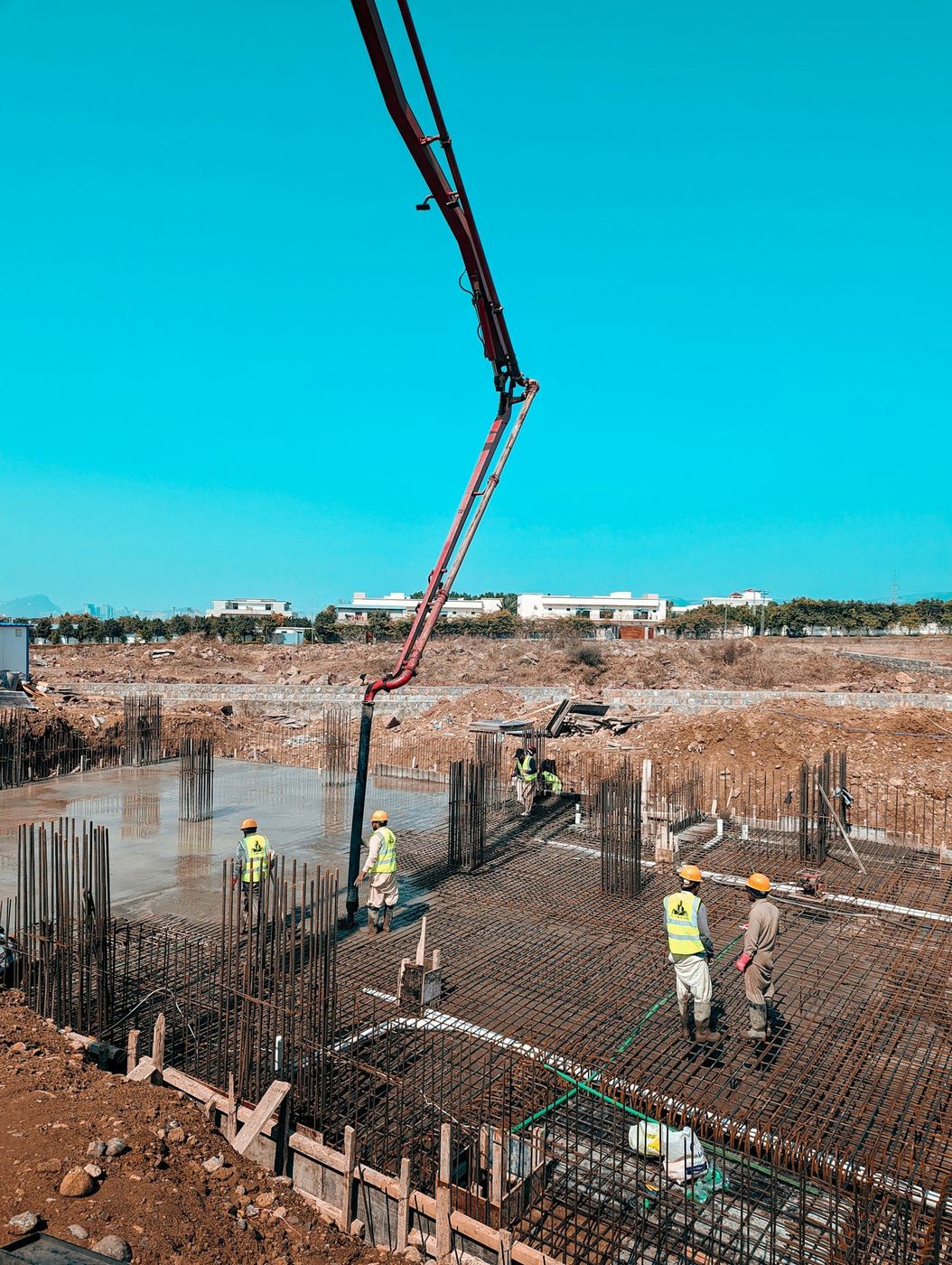
Spring breakup is one week long and it decides what your road costs you all year.
Late March, seven in the morning. The road into your site is frozen solid and a loaded truck crosses it without leaving a print. By one that afternoon the top eight inches have gone soft, the meltwater has nowhere to drain because there is still frost sitting under it, and the same truck drops to the axle. That is spring breakup, and for a private road on the Front Range it is the most expensive week on the calendar.
We build concrete access roads for commercial sites, equipment and utility yards, campuses, and community properties around Lone Tree. Concrete costs more the day it goes down. It also does not care what the ground beneath it is doing in March, which is the entire argument, and it is the reason owners who have already regraded a gravel lane four springs in a row stop asking about the price difference.
March is the first one. Frost leaves the ground from the top down, so a thawed layer sits on a frozen layer and water gets trapped in between. Any surface that depends on the strength of the soil under it loses that strength for a couple of weeks. Concrete does not, because a properly built slab spans the soft spot instead of leaning on it.
August is the second. Afternoon cells build over the foothills and drop a lot of water in twenty minutes. A road without a crown collects that water down the middle of the driving lane, and the middle of the driving lane is exactly where the loads are.
January is the third, and it is mechanical rather than natural. Plow blades, chains, and whatever your snow contractor spreads. Deicing chemistry pooling along a road edge does more damage over ten winters than the trucks do.
October is the last one and it sneaks up. The first hard freeze arrives here well before anybody feels ready for it, and a road poured too late in the fall can lose surface strength overnight if it is not protected. Sites still under construction near the RidgeGate corridor run into this every year, trying to get an access road in before winter shuts the dirt work down. Doable, but only when it is planned instead of improvised.
Everything about a road that survives breakup happens below the driving surface. We over-excavate soft ground rather than bridge it, place structural fill in lifts, compact each lift and test it, and then build a deep aggregate base that drains sideways instead of holding water like a sponge.
Then thickness and steel, matched to what actually drives on it. We ask what the heaviest vehicle is, how often it comes, and where it turns, then build the turns heavier than the straightaways because a steered axle grinds.
Drainage is the last piece and the cheapest insurance you will buy. A crown down the center, positive fall into a ditch, swale, or inlet at both shoulders, and culverts sized for the runoff coming at you. Roads serving community and amenity properties around Carriage Club and Heritage Hills usually fail at the shoulder first, where water was allowed to stand against the edge until the base under it washed out.
Tell us the length, the width, and the heaviest thing that drives it. We will price a concrete road against what you are already spending on maintenance.
| Surface | What March and January do to it | What the decade looks like |
|---|---|---|
| Reinforced concrete | Spans a thawing subgrade without rutting; shrugs off a plow blade | One build, joints maintained, very little else |
| Asphalt | Softens as the base weakens, ruts at the turns, cracks fill with meltwater | Sealcoat cycles, patching, and at least one full overlay |
| Chip seal | Loses aggregate under a blade and ravels along both edges | Repeated re-treatment with no structural gain at all |
| Road base or gravel | Turns to soup for two weeks, then washboards and dusts all summer | Regrading every spring plus fresh material hauled in |
| Asphalt millings | Firm while frozen, soft and rutting the moment it thaws under load | Cheap to place, graded again annually, replaced eventually |
Everybody wants to talk about the concrete and nobody wants to talk about the ditch. We have rebuilt roads where the slab was fine and the shoulder had washed out four feet under it. Move the water off the road and half the failures we get called about never happen.The crew lead's read on it
Still unsure about something?
Call the crew at (303) 569-4046 and we will talk it through.

Get a free, no-obligation estimate from a crew that knows Colorado soil, Colorado weather, and how to finish concrete that lasts.
Accessibility
Adjust the site to fit how you read and browse. Your choices are saved on this device.