
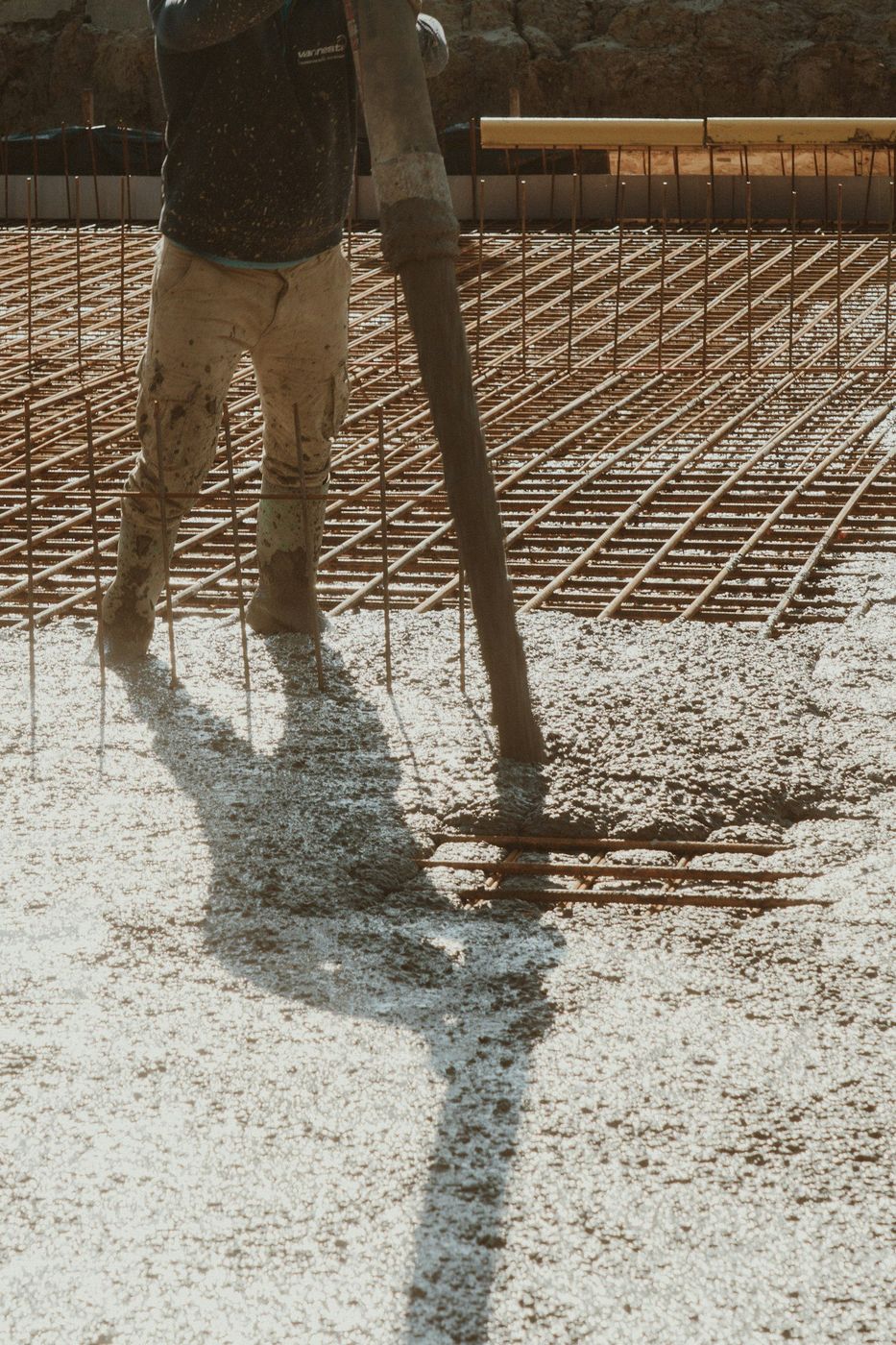
A dry April wind will ruin a slab faster than a July afternoon ever could.
Mid-April, mid-afternoon, and the sky is a perfect empty blue. Humidity down around twelve percent. Steady wind across open ground, warm enough that nobody has a jacket on. Homeowners see a gorgeous day to pour concrete. We see a day that needs a windbreak.
Dry air moving fast over a wet surface at fifty-three hundred feet pulls water out of a slab faster than the slab can bleed to replace it. The top skins over while everything under it is still soft. Then come short random cracks before the crew has even packed up, and a finish that never quite hardens. It's the most underrated weather risk on a Front Range flatwork job.
Four things drive how fast a slab loses water: air temperature, concrete temperature, humidity, and wind speed. Wind is the one people ignore and often the biggest term in the equation. A fifteen mile an hour breeze on a dry spring day beats ninety-five degrees and still air for sheer damage.
So we manage it. Windbreaks on the upwind side. An evaporation retarder sprayed between finishing passes, which slows moisture loss without adding water to the mix. Fog misting when it gets severe. Curing compound or wet cover the moment the finish will take it. What we never do is hose the surface and trowel it in, because that thins the paste exactly where the slab needs to be hardest.
Everybody worries about the hot days. It's the windy ones in March and April that get you. You'll have a beautiful surface at eleven and a map of little cracks by one, and there's no fixing it afterward.What the crew sees on site
| Location in the slab | What we do there | What it's holding up |
|---|---|---|
| Perimeter edge of a garage or shop | Turn the edge down and widen it into a thickened footing | The wall above, plus frost protection at the exposed edge |
| Under an interior bearing wall | A thickened strip running the length of the wall line | Roof and floor loads coming down through one narrow path |
| Across an overhead door opening | Extra depth and steel at the threshold where the slab is unsupported | Vehicle wheels hitting the same line thousands of times |
| Under a future post or column | An isolated pad poured deeper, tied to the slab or kept separate | A concentrated point load that a flat slab would punch through |
| Where a lift or heavy shelving goes | Local thickening and heavier reinforcing sized off the equipment | Anchors in tension and a lot of weight in a small footprint |
A vapor retarder goes directly under the concrete. Not under the gravel, and not with a sand blotter on top of it. That sand trick was standard practice for years, and it's why plenty of older floors around Columbine and Southbridge stay damp: the sand holds water between the plastic and the slab, and the only way out is up through the concrete.
Every interior floor gets one. Finished basement, addition, heated shop with a coating coming later. Garages are where people argue, and our answer is put it in. We use a real retarder instead of hardware store painter's plastic, lap the seams wide, tape them, and keep boots off it once it's down.
Tell us what's going on top and what the space becomes. We'll spec it around that. Free estimates, (303) 569-4046.
Late May through September gives the most forgiving conditions, with two caveats. Summer afternoons build storms fast over the mountains, so slabs start early and finish before the sky organizes itself. Early spring is when we're most careful about wind.
Winter work is real work, not a favor. No placing on frozen ground, so a January slab means thawing and protecting the subgrade first, heated water in the mix, a non-chloride accelerator, and blankets on the minute finishing wraps. New concrete also needs its whole first winter without deicing salt, magnesium chloride especially. Tell whoever plows your drive. Sand for traction, shovel early, and the surface holds up for years.
Still unsure about something?
Call the crew at (303) 569-4046 and we will talk it through.
Get a free, no-obligation estimate from a crew that knows Colorado soil, Colorado weather, and how to finish concrete that lasts.
Accessibility
Adjust the site to fit how you read and browse. Your choices are saved on this device.