
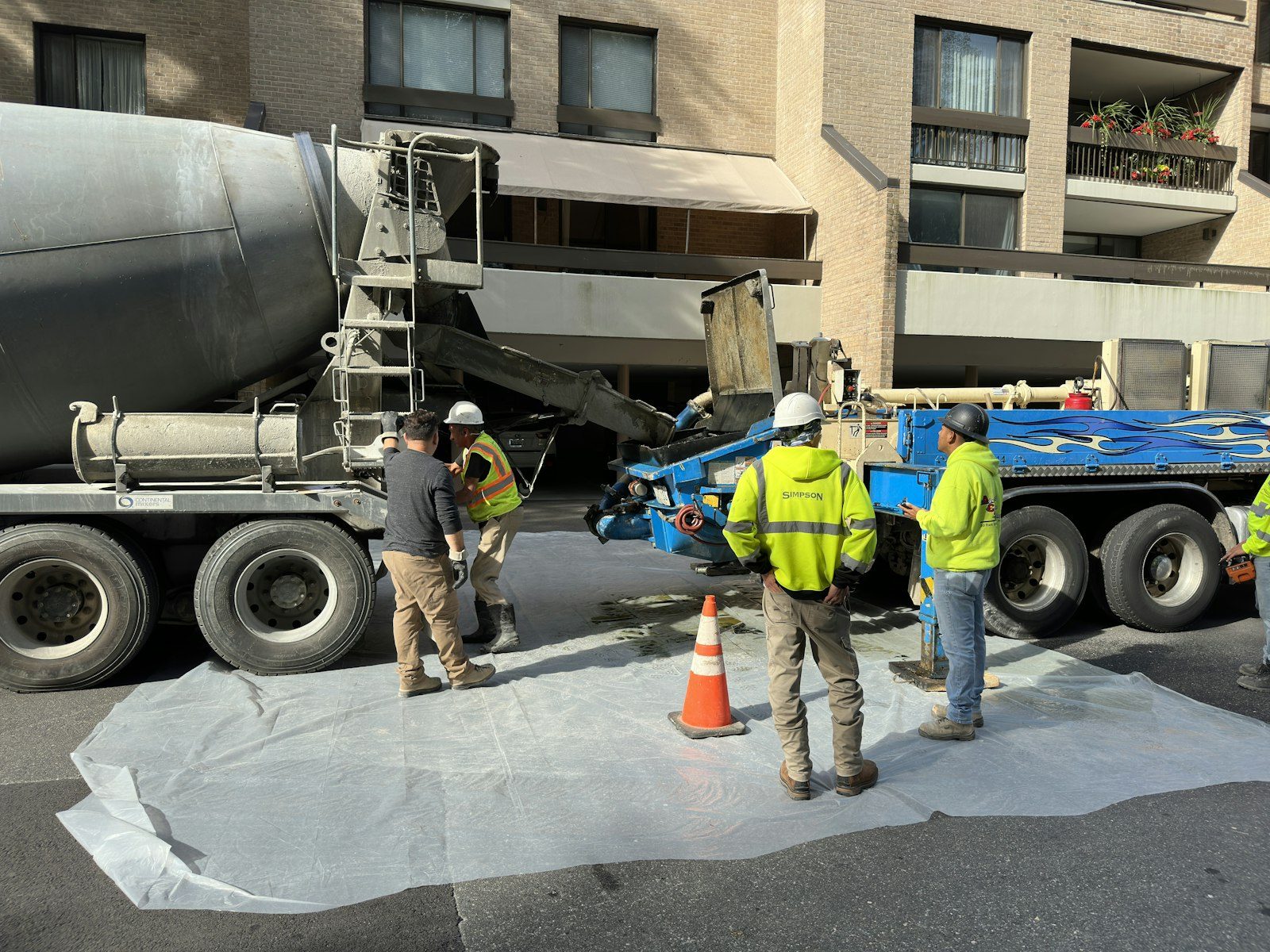
The loud part takes two hours. The twenty quiet minutes afterward decide the next fifty years.
Everybody watches the trucks. Concrete coming down a chute is genuinely good theater, and on a stem wall it's over faster than people expect. Two hours, maybe three, and the forms are full. Then the crowd wanders off and the crew does the work that matters: setting anchor bolts to a layout, striking the top of the wall flat, and checking that nothing moved while several tons of wet concrete pushed outward from the inside.
That's the part we'd want you watching. A stem wall is the transition between dirt and framing, and the framer inheriting it can't fix a top that isn't level or bolts that landed under a stud. So this page walks the day, from what's finished before the first truck backs in to why we won't let a wall fill faster than it can be consolidated.
Concrete goes in lifts, not in one continuous flood. Roughly a foot and a half to two feet at a time around the whole perimeter, then a pass with the vibrator, then the next round. Two reasons for that discipline. Consolidation is the first: a stick vibrator works air out of each lift and knits it into the one below, without running so long that the aggregate sinks. Pressure is the second.
Wet concrete behaves like a liquid until it stiffens, so the forms are holding back a serious sideways push down at the base. Fill too fast and that pressure spikes. Braces bend, ties strain, and a wall bellies where it should be straight. We set a rate of rise the forms can take and hold to it, even with a driver watching the clock.
Anchor bolts get pushed into wet concrete, which sounds casual and isn't. Each one needs the right embedment, the right projection above the finished surface, correct distance from every corner and every splice in the plate, and a position that doesn't collide with a stud, a hold-down, or a door opening. We work off a marked layout, not off memory, and we check the bolts again after the top has been struck. Concrete moves a little as it settles. Bolts move with it.
The top of the wall matters just as much. It gets screeded flat and true, because a sill plate lays across whatever we leave and every bump gets carried up into the framing. Cold days change the sequence here. In winter we let the sun get on the site first, pour late morning rather than at dawn, run heated mix water, and blanket the wall the same afternoon so the top surface keeps gaining strength overnight instead of freezing.
Send us the plan and the grades. We'll lay out the steps and tell you where the wall heights land. Free estimates, (303) 569-4046.
| What the ground does | How the wall answers | What we watch on pour day |
|---|---|---|
| Flat lot through Columbine or Southbridge | One continuous footing, uniform wall height all the way around | Rate of rise and keeping the top dead level across long runs |
| Gentle fall across the building pad | A shallow step or two in the footing rather than burying one corner | Clean vertical steps, extra steel lapped through each one |
| Bench cut into the slope near Ken Caryl | Taller wall on the uphill side, designed for the soil pushing on it | Bracing on the high side and backfill held back until strength is there |
| Walkout with a full story of drop | Full height wall on three sides, short wall and framed opening on the fourth | Corner reinforcing and the bolt pattern around the door opening |
| Rock under part of the footprint | Bearing changes across the building, so the engineer splits the detail | The transition point, where different support meets one continuous wall |
I've never met a framer who complained about a wall being too flat. I've met plenty who spent a morning shimming a plate because somebody screeded the top by eyeball at four in the afternoon.What our crew lead tells homeowners
Still unsure about something?
Call the crew at (303) 569-4046 and we will talk it through.
Get a free, no-obligation estimate from a crew that knows Colorado soil, Colorado weather, and how to finish concrete that lasts.
Accessibility
Adjust the site to fit how you read and browse. Your choices are saved on this device.