
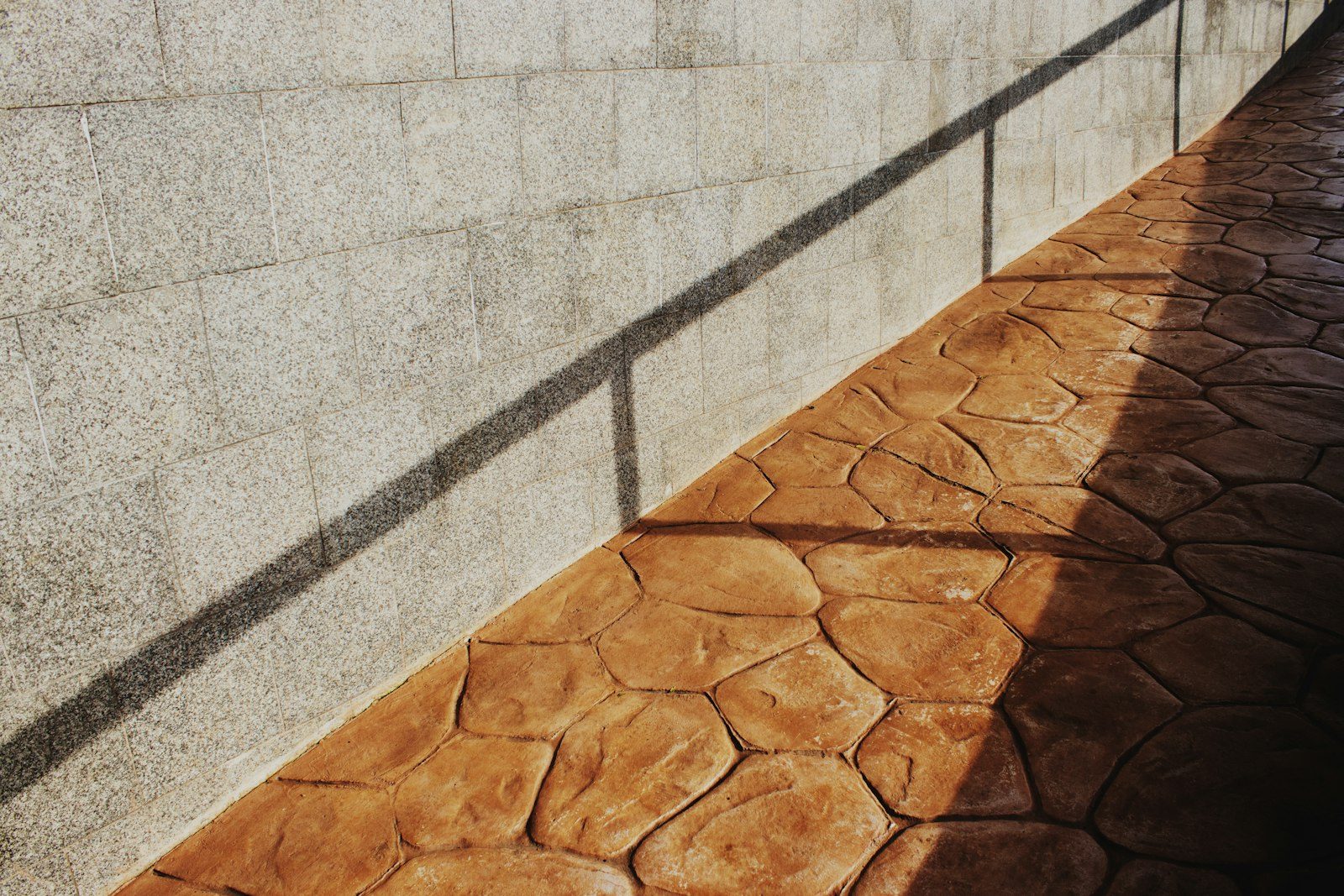
Poured paths, set stone, or fines. We'll tell you which one your run actually wants.
Most folks call about a walkway with half the decision already made. They know roughly where the path belongs. What they can't settle is whether to pour it, set flagstone, lay pavers, or keep spreading fines every couple of springs. So that's where we start. A forty-foot approach through the trees in Perry Park asks different questions than a twelve-foot hop from a side door out to the parking area.
Our bias, stated up front: on a lot with grade, pine shade, and a real winter, poured concrete wins most of the time. Not always. But the narrow, ice-holding, frost-prone runs that give people the most grief are exactly where one continuous slab with steel in it beats a hundred loose pieces that each get to move on their own schedule.
Three feet is the narrowest we'll build anything you use daily, and honestly it's tight. Four lets two people walk together without one of them in the mulch. Five is what we push for a main entry, since that's the width where a wheelbarrow, a stroller, or somebody hauling firewood doesn't have to think about their feet. Widening later costs more than pouring it right, and it never looks like one piece afterward.
Pitch gets ignored twice as often and matters just as much. About a quarter inch of fall per foot across the walk, always away from the house, so meltwater leaves instead of pooling and freezing overnight. On the rolling ground in Bear Dance and Sage Port the harder call is running slope. Past roughly five percent a walk stops being a walk and turns into a ramp people slide down in January. At that point we'd rather build a short flight with a level landing than pour a long slick incline you'll come to hate.
| Surface | Where it earns its keep | What it asks of you later |
|---|---|---|
| Poured concrete | Main entries, long runs, anything shoveled all winter | Very little, when the base is right. Cracks turn up where joints got skipped. |
| Flagstone set in sand | Short garden paths and informal routes through the trees | Resetting stones most springs. Frost pushes pieces out of plane and the gaps grow weeds. |
| Concrete pavers | Runs off a patio where the look outranks the shovel | Edge restraint gives, joint sand washes out, and a shovel catches every lip. |
| Crusher fines | Back paths and dog runs where a soft surface is fine | Fresh material each year, grit tracked indoors, and a wheelbarrow that wants to sink. |
Here's the thing homeowners rarely expect. The skinniest concrete on the property moves first, and it moves while the big slab twenty feet away sits perfectly still. A driveway is a wide, heavy, connected field that spreads load and shrugs off ground swelling a quarter inch. A three-foot walk has almost no mass, gets frozen soil pressing on it from both sides at once, and picks up like a plank when the ground under one panel lifts.
Shade compounds it. Half your path runs under ponderosas and stays frozen into April while the other half thaws by ten in the morning. Two ends of one slab living in two different seasons gives you a cracked panel and a lip you catch your toe on. We answer with depth and drainage: root mat out, four to six inches of road base compacted in lifts, and the run draining somewhere other than under itself. Steel goes in every walk, mesh on short light-duty paths and number four bar on chairs wherever the run crosses fill or takes a tire.
Send two photos and a rough length. We'll tell you what we'd build and what we'd skip. No charge for the opinion.
Curves are where cheap walk jobs give themselves away. Concrete cracks on the shortest line between two weak points, so on a radius we set joints along the true radial line, not wherever the saw operator felt like stopping. Panels stay near square through the bend. Where the walk lands on a porch or the parking area, an isolation joint goes between them, because those two pieces move on different schedules.
Season: mid-May into early October is the comfortable stretch, and September is our favorite month for path work. Warm days, cool nights, slab fully cured before anything hard freezes. Spring is fine once overnight lows quit dipping below freezing, which happens later in Larkspur than it does thirty minutes north. We'll work the cold shoulder using warmed mix water, a chloride-free accelerator, and blankets. Frozen subgrade is where we stop. Concrete placed on frost is concrete you buy twice.
Still unsure about something?
Call the crew at (303) 569-4046 and we will talk it through.

Get a free, no-obligation estimate from a crew that knows Colorado soil, Colorado weather, and how to finish concrete that lasts.
Accessibility
Adjust the site to fit how you read and browse. Your choices are saved on this device.