
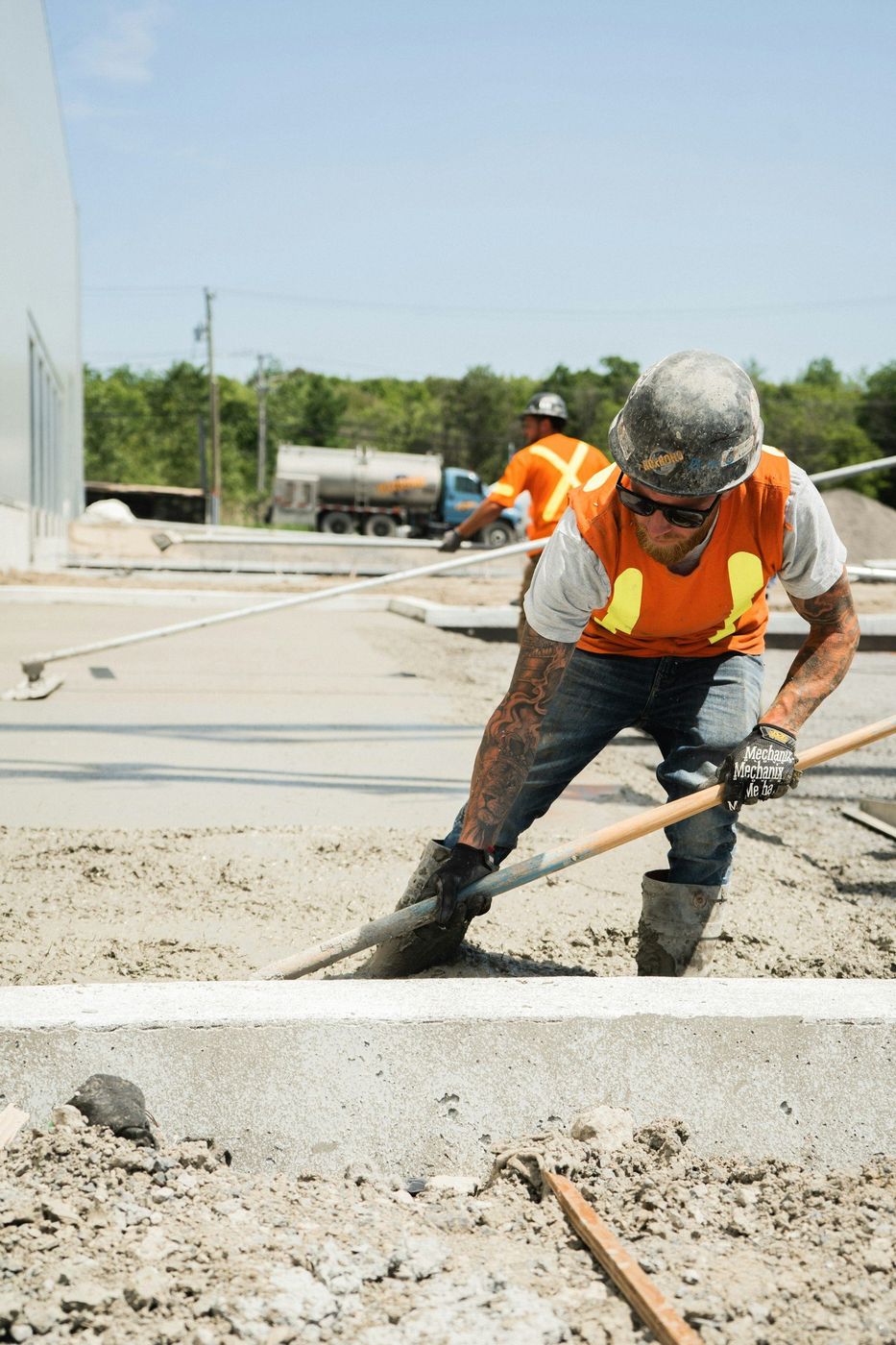
One pour, one crew, no cold joints. A court slab is a single continuous placement or it isn't a court.
A court pour has a rule that most concrete work doesn't: it goes down in one continuous placement, start to finish, no stopping. A cold joint across a playing surface is a permanent defect. The ball finds it, the surfacing telegraphs it, and nothing fixes it later. So the whole day is built around keeping concrete arriving at a steady rate with enough crew on the slab to stay ahead of it.
We build courts for associations, ranch and guest properties, and businesses adding an amenity around Larkspur. At nearly 6,700 feet on sloping, treed lots, the site work usually takes longer than the concrete does, and the two things that decide whether a court plays well are flatness and drainage. Both get settled before a truck ever shows up.
Siting comes first. Courts want a north-south orientation so players aren't looking into a low sun, and they want a spot where you can actually build a flat pad without carving a cliff into a hillside. Around Perry Park, Sage Port, and Bear Dance that's a real constraint, and it's why we walk the property with a level and a tape before anybody settles on a location. A court moved thirty feet uphill can save a retaining wall.
Then it's excavation, base, and grade. Free-draining compacted base goes in lifts, because a court slab is wide and flat with no place for trapped water to escape. We build the pad with a gentle single-direction fall, roughly one inch over ten feet, running end to end or side to side depending on how the site sheds water. Level sounds appealing and it puddles. A one percent slope drains and plays fine.
Forms go up the day before, steel gets tied on chairs, and net post sleeves get set and braced to exact spacing and elevation. Sleeves cast in during the pour hold far better than anything drilled in afterward, and their alignment has to be right before the concrete arrives because there's no adjusting them once trucks are running.
Send us the rough location and a photo of the slope. We'll tell you what the site work looks like before you budget anything.
| Configuration | What it suits | What to know |
|---|---|---|
| Single court, minimum surround | Tight sites and private properties with limited space | Playable, but chasing a ball takes you off the pad quickly |
| Single court, generous surround | Most association and guest-property installs | The version people are happiest with. Room behind the baseline matters. |
| Two courts side by side | Communities with real demand and league or clinic use | One shared pour, better cost per court, needs a genuinely flat site |
| Court with a shared-use overlay | Properties wanting basketball or general recreation too | Line conflicts and hoop footings have to be planned before the pour |
| Court plus perimeter walk and pads | Amenity areas with seating, shade, or storage | Same mobilization. Separate trips cost more. |
We start early. Concrete comes in on a steady rotation, gets placed across the full width, and the screed follows immediately behind it. Laser screeding earns its cost here, because flatness is the difference between a true bounce and a surface that annoys everybody who plays on it. Behind the screed comes bull floating, then a wait while bleed water rises and leaves.
That waiting stretch is the part clients find strange. The crew stops, the slab looks finished, and nothing appears to happen for an hour. Finishing too early traps bleed water at the surface and gives you a weak top layer that scales in a couple of winters. So we wait for the concrete, not the clock.
Finish is a smooth trowel or a light broom depending on what surfacing goes over it. Acrylic court coatings need a specific profile, so we coordinate the finish with your surfacing contractor rather than guessing. Then curing goes on immediately, and the slab has to stay wet-cured or covered while it gains strength.
Weather is the whole risk. A summer cloudburst landing mid-finish can ruin a court surface permanently, and unlike a driveway you can't just live with it. We watch the afternoon build and will call the pour off the morning of rather than gamble. Late spring through early fall is the window at this elevation, with September the standout: warm days, cool nights, and a long cure before frost. Court slabs are one of the few pours we won't schedule in deep winter, since the flatness and finish quality matter too much to fight the weather for it.
Every complaint I've heard about a court traces back to two things. Somebody built it dead level and it holds water after every storm, or somebody stopped the pour for lunch and there's a line across the kitchen that never goes away. Get the slope and the continuity right and the rest is just good finishing.Straight from the crew
Still unsure about something?
Call the crew at (303) 569-4046 and we will talk it through.

Get a free, no-obligation estimate from a crew that knows Colorado soil, Colorado weather, and how to finish concrete that lasts.
Accessibility
Adjust the site to fit how you read and browse. Your choices are saved on this device.