
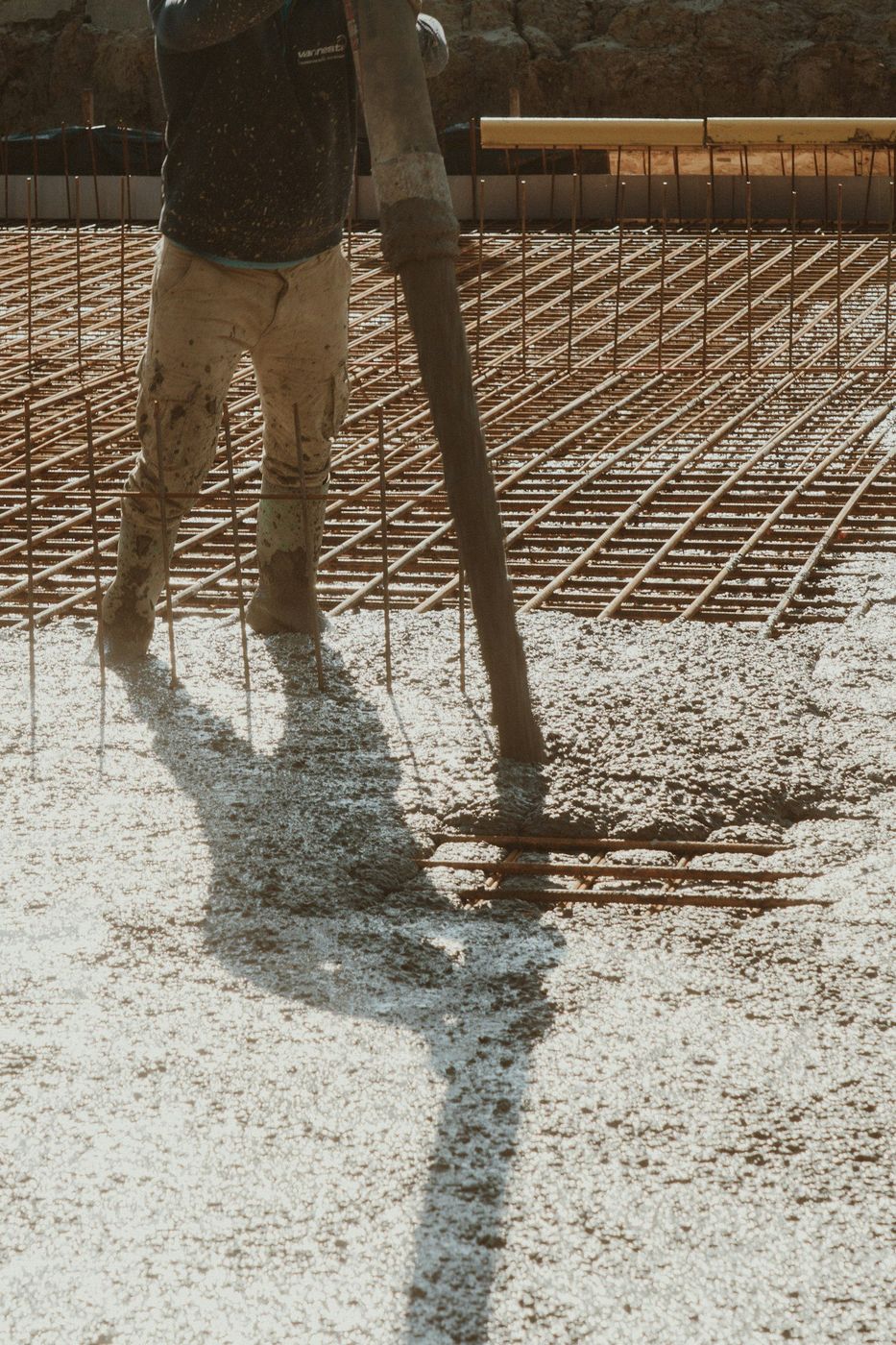
Six inches of reinforced concrete, conduit sleeved before the truck shows up, and a finished plane flat enough to trust a full spa on.
A filled spa with four people in it is a small car parked in one spot forever. That load never moves, never spreads, never gets a break. Which is why a hot tub pad is one of the few residential slabs where we go heavier than the usual rules and don't negotiate about it. Six inches. Steel on a tight grid. Base compacted in lifts, not dumped and raked.
Here's how the day itself runs, because almost nobody has watched a pad get poured, and the sequence explains the price better than any sales pitch could. Out here it's a logistics problem too. The mix has to reach a spot that's usually behind the house, down a slope, and a long way from anywhere a loaded ready-mix truck can safely stand.
Every hot tub needs power brought to a disconnect, and the cleanest way to do that is under the slab in a sleeve rather than around it later. We want your electrician's input before we tie a single bar, because the stub location has to clear the tub's equipment bay and land where the disconnect can legally sit. Once concrete is down, moving that conduit means cutting the pad you just paid for. The electrical work, the permit for it, and the inspection are their scope; getting the sleeve in the right place is ours.
The same logic covers anything else that wants to live under the concrete. A sleeve for a future gas line to a fire feature. A drain if the pad sits in a spot that collects roof runoff. On sloped Larkspur lots we'll sometimes run a small drainage layer and an outlet under the pad, because a spa surround that traps hillside water becomes an ice rink by December. It costs almost nothing on pour day and it's a project later.
Send us the model and a photo of the spot. We'll tell you what the pad needs and how we'd get concrete to it.
| Roughly when | What's happening | Why it matters to you |
|---|---|---|
| First thing | Crew arrives, protection laid on the drive and the route to the work, forms rechecked for level | Twenty minutes here prevents ruts and a cracked apron later |
| Mid-morning | Truck backs in or the pump sets up, mix verified at 4,000 PSI with air entrainment | Air entrainment is what lets the surface survive freeze-thaw at this elevation |
| Placement | Concrete placed in one continuous go, rebar kept up on chairs, corners consolidated | A pad poured in two sessions has a cold joint through the middle of it |
| Screed and bull float | Surface pulled to plane and floated, level checked as it goes | This is where the quarter-inch tolerance is won or lost |
| Wait | Crew stands around watching it stiffen, which looks like nothing and is the whole trade | Finishing too early traps bleed water and weakens the top |
| Finishing | Edges cut, broom or light float texture applied, surround transitions detailed | Texture matters here. Wet feet on a smooth pad is how people fall |
| Same day | Control joints sawed, curing protection applied, site cleaned and the route swept | Joints cut on time decide where the slab cracks instead of leaving it to chance |
May into October is the comfortable window, and September might be the best of it: warm afternoons, cool nights, dry air, and runway for a full cure ahead of hard frost. Summer pours start early, because the afternoon buildup over the foothills is dependable enough to schedule around. Storm water hitting a slab mid-finish gets worked into the top layer, and you pay for that later in dusting and scaling.
Winter pads do happen. Heated mix water, a non-chloride accelerator, blankets over the fresh work, and a close read of the fronts. Frozen subgrade is the hard no: concrete set over frost drops when that frost releases. On a shaded north-side yard at 6,720 feet the ground stays hard long after the air feels fine, so we probe instead of guessing.
One altitude wrinkle worth planning for. Wind and thin-air sun pull moisture out of fresh concrete quickly, so we keep the pad covered and wet-cured on breezy days. Surfaces that dry too fast craze, and nobody wants to look at that under a brand new spa.
Still unsure about something?
Call the crew at (303) 569-4046 and we will talk it through.
Get a free, no-obligation estimate from a crew that knows Colorado soil, Colorado weather, and how to finish concrete that lasts.
Accessibility
Adjust the site to fit how you read and browse. Your choices are saved on this device.